
Beyond the Graph: Identifying Social Bridge-Builders via Machine Learning
17608_Identifying Structural Hole Spanners in Online Social Networks Using Machine Learning.
This paper introduces a machine learning framework to identify Structural Hole (SH) spanners in online social networks using user profiles and Generated Content (UGC) instead of global topology. Leveraging ego networks and cross-site linking (Foursquare to Twitter), the CatBoost-based model achieves a superior F1-score of 0.857.
TL;DR
Researchers from Fudan University have developed a novel approach to identify Structural Hole (SH) Spanners—the critical "bridge" users who connect disparate social groups. Unlike traditional methods that require the entire, often-private social graph, this method uses Machine Learning to identify these influencers based on their profiles, content, and cross-platform activity, achieving an impressive 0.857 F1-score.
The Problem: The "Closed-Garden" of Social Data
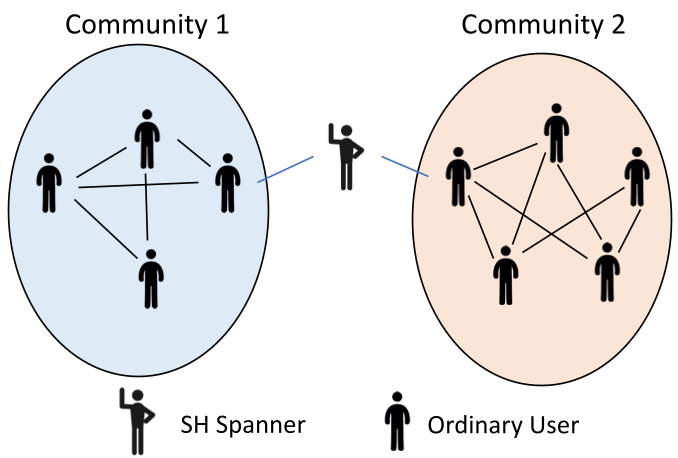
In social network theory, a "Structural Hole" is a gap between two groups of people who have complementary resources but no direct connection. The individual who fills this gap is an SH Spanner. These users are the ultimate information brokers, controlling the flow of ideas and exerting significant influence.
Traditionally, finding these people required the entire social graph (every connection between every user). However, in the modern era, this is nearly impossible because:
- Privacy Settings: Users hide their friend lists (e.g., on Facebook).
- Cold Start: New users don't have enough connections yet to be "seen" by graph algorithms.
- Scalability: Processing billions of nodes and edges is computationally exhausting for algorithms like HAM or HIS.
The Insight: Influencers Leave a Digital Paper Trail
The authors' core intuition is that a user's role in the network hierarchy is reflected in how they present themselves and what they post, not just who they follow. If you are a bridge between diverse communities, your profile and content likely exhibit different patterns compared to a user buried deep within a single, homogenous clique.
Methodology: A Multi-Dimensional Feature Approach
The proposed model moves away from the global adjacency matrix and focuses on three feature sets:
- Descriptive Features: Demographic info and statistics of User-Generated Content (UGC).
- Ego Network Features: Instead of the whole graph, the model only looks at a user's immediate "ego network" (their direct friends and the connections between those friends). They use metrics like Efficiency and Constraint to quantify the "hole" around the user.
- Cross-Site Features: This is the secret sauce. By linking a user's Foursquare profile to their Twitter account, the model gains a holistic view of the user’s social behavior across different digital ecosystems.
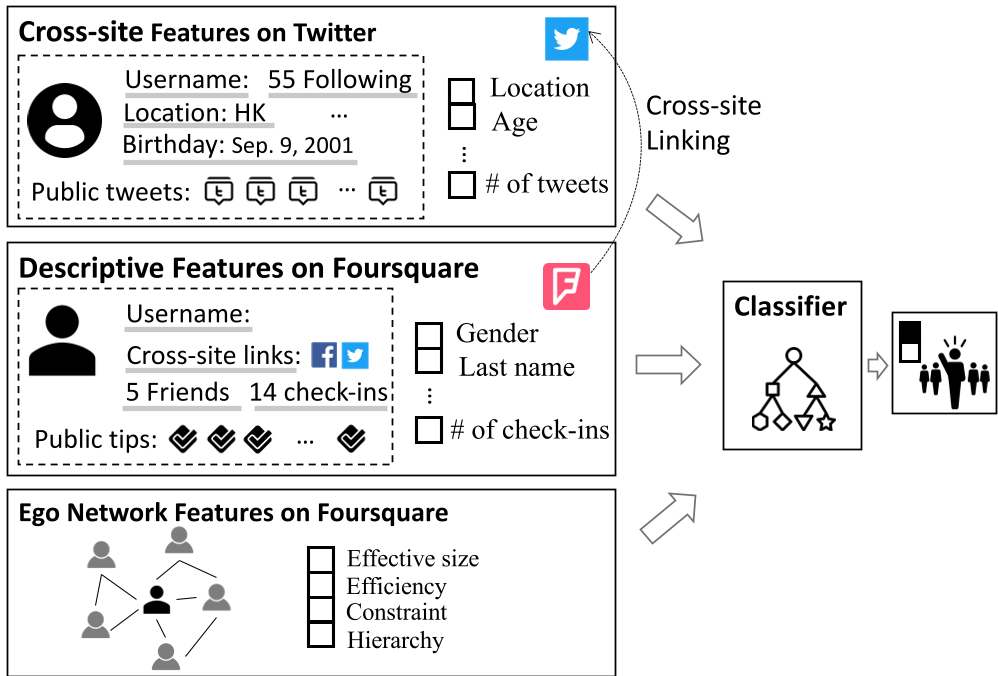
The classification is handled by CatBoost, a high-performance gradient boosting library that excels at handling categorical data ubiquitous in social profiles.
Experimental Results & The Cold Start Victory
The researchers tested their model on a massive crawl of over 9 million Foursquare users, with over 35% linked to Twitter.
- SOTA Comparison: Using the HIS algorithm as ground truth, the machine learning model matched the identification of SH spanners with high precision (F1: 0.857).
- The Cold Start Test: This was the most impressive result. Even when the model was denied access to a user's profile and friends on the primary site (Foursquare) and only allowed to look at their external Twitter data, it still achieved an F1 of 0.775.
Deep Insight & Conclusion
This research proves that "Social Capital" is manifest in behavior, not just connectivity. By shifting from topology-dependent to feature-dependent identification, third-party developers can now identify influencers without needing "God-mode" access to a platform's entire database.
Takeaway: For businesses and researchers, this means identifying key opinion leaders (KOLs) is now possible even on platforms with strict privacy controls, provided there is a multi-platform footprint to analyze. The future of social analytics isn't just about the "dots and lines"—it's about the data living within the nodes.