
Identifying Subcommunities: Bridging Graph Theory and Social Psychology
Identifying subcommunities using cohesive subgroups in social hypertext
Identifying Subcommunities Using Cohesive Subgroups in Social Hypertext proposes a methodology for detecting virtual subcommunities by applying n-clique and k-plex analysis to social networks derived from hyperlinks and comments. The framework validates structural subcommunities against psychological metrics like the Sense of Community Index (SCI) using the TorCamp Google group as a case study.
TL;DR
This research presents a framework for identifying subcommunities within broader social networks by using k-plex analysis. The study moves beyond simple graph metrics by validating that people in these identified "cohesive subgroups" actually feel a stronger sense of influence and emotional connection to the group. Testing this on the TorCamp tech community, the authors found that structural network position directly maps to the psychological experience of community.
The Problem: When "Community" is Too Broad
Most social network analysis treats communities as monolithic blocks or clusters. However, in reality, large communities (like a city's tech scene or a massive Google Group) contain smaller, tighter "subcommunities."
- The Limitation: Centrality measures (like PageRank) tell us who is "important," but they don't necessarily reveal a cohesive group where everyone interacts closely.
- The Insight: By looking for k-plexes—structures where members are allowed to miss a few connections but remain largely interconnected—we can find the "inner circles" of a network.
Methodology: The Core of Cohesion
The authors model social hypertext (blogs, comments, and replies) as a directed graph. To find subcommunities, they iterate through:
- n-cliques: Where every member is within distance n of every other member.
- k-plexes: A more relaxed and realistic version of a clique where in a group of size n, every member has direct ties to at least n-k others.
Architecture of Subgroup Analysis
The authors found that as the "tightness" (k) of a subgroup is adjusted, a stable core of members usually emerges. This "fuzzy" boundary is more representative of real-world human interactions.
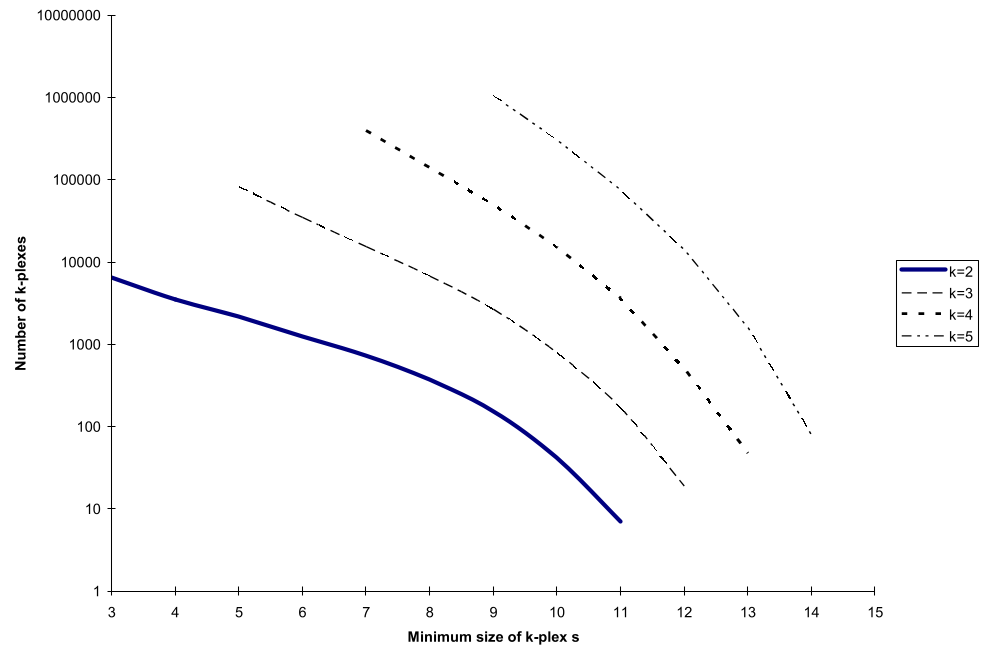 Figure 1: The distribution of k-plexes by size. Notice how the number of subgroups stabilizes, indicating a core subcommunity.
Experiments: The TorCamp Case Study
The researchers analyzed the TorCamp Google group, a hub for Toronto-based tech enthusiasts. They crawled two years of data, resulting in a network of 146 nodes.
Key Structural vs. Psychological Findings:
- Betweenness Centrality: Members of the 3-plex subcommunity had significantly higher betweenness centrality (frequently acting as "bridges" for information).
- Personality Links: Interestingly, those in the subcommunity scored higher on Openness but lower on Conscientiousness. This suggests that "inner circles" in tech communities might be driven by more inquisitive, less rigid individuals.
- Validation: Using the Sense of Community Index, they proved that members of the structural 3-plex scored higher on Influence and Emotional Connection.
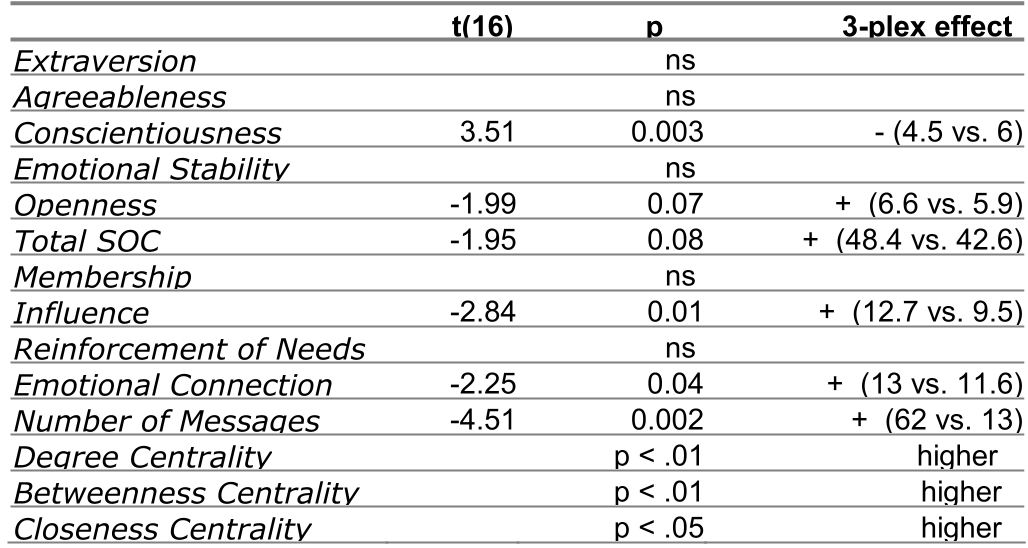 Table 1: Significant t-test results comparing 3-plex members vs. non-members across personality and community metrics.
Deep Insights & Takeaway
This paper is a classic example of Sociotechnical analysis. It provides two major takeaways for today's platform designers:
- Structural Validation: You can't just trust the math; you must validate that "clusters" in a graph correspond to "feelings" in the users' minds.
- Product Application: By identifying these k-plexes, platforms can identify connectors and leaders. If a new member connects with someone specifically from a high-cohesion k-plex, their probability of retention likely increases.
Limitations
The study was limited by a small survey sample (25 respondents). While the statistical significance was achieved for influence and connection, a larger scale study would be needed to see if these patterns hold in more "toxic" or less professional social hypertexts.
Conclusion
As the web evolves from a network of documents to a network of people (Social Hypertext), methods like k-plex analysis provide a surgical tool for understanding how subcommunities form and function. It proves that the "strength of weak ties" is important, but the "cohesion of dense subgroups" is what creates the emotional backbone of a community.