
Beyond Novelty: Decoupling Social and Task Engagement in Robotic Tutors
Identifying Task Engagement: Towards Personalised Interactions with Educational Robots
The paper proposes a novel computational model for automatically detecting task engagement in educational robotics. It introduces a multi-modal approach—incorporating facial expressions, gaze, touch gestures, and physiological signals—to enable robotic tutors to provide personalized pedagogical and empathic interventions.
TL;DR
Human teachers possess an innate ability to sense when a student is drifting away. This paper outlines a research roadmap to replicate this "intuition" in robotic tutors. By developing a model that separates social engagement (liking the robot) from task engagement (focusing on the lesson), the authors aim to create truly personalized educational AI that knows exactly when—and how—to intervene.
The "Distraction" Problem in Educational Robotics
One of the biggest hurdles in Educational Human-Robot Interaction (eHRI) is the "Novelty Effect." Children often interact enthusiastically with a robot because it is a cool gadget, not necessarily because they are learning.
Current state-of-the-art systems often struggle to answer a critical question: Is the child looking at the screen because they are solving the math problem, or are they just waiting for the robot to make a funny sound? If a robot intervenes based on a "false positive" of engagement, it may disrupt the child's actual cognitive flow.
Methodology: The Framework for Detection
The authors propose a computational architecture that treats the "Learner Model" as a feedback loop. This model isn't just a static profile; it’s a living representation of state, informed by:
- Visual Cues: Facial expressions (affect) and gaze/head direction.
- Physiological Signals: Real-time arousal measured via electro-dermal activity (EDA).
- Contextual Interaction: Touchscreen gestures and task progress on an interactive table.
Architecture Overview
The research plan is structured into three distinct experimental pilots to isolate variables:
- Task Only: Measuring pure engagement using high-engagement (Whack-a-mole) vs. low-engagement (repetitive buttons) tasks.
- Social Only: Measuring the bond with a "helpful" vs. "disinterested" robot.
- The Hybrid State: Understanding how task difficulty and robot persona interact.
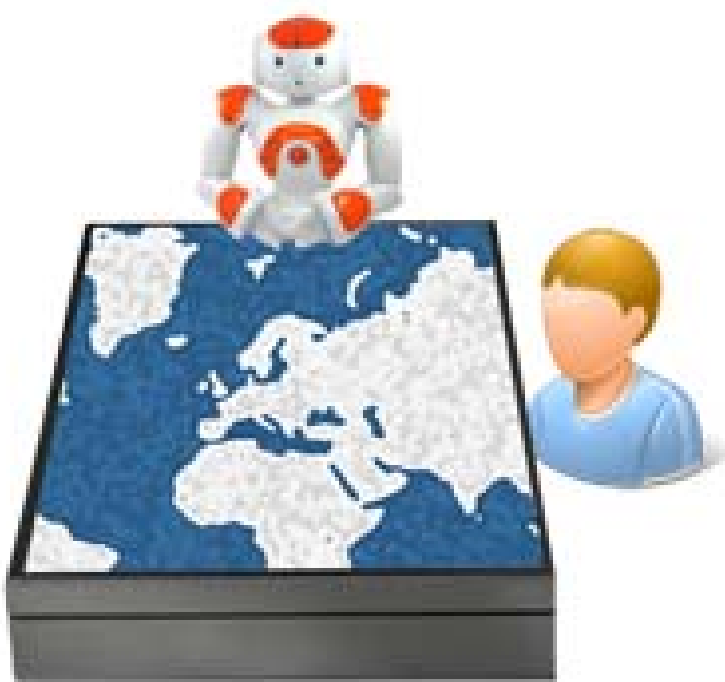 Fig 1. The proposed setup: A humanoid robotic tutor paired with an interactive touchscreen table to capture multi-modal engagement data.
Key Insight: Personalization thru Feed-Forward Logic
The most innovative aspect of this work is the Platform-Independent Learner Model. By monitoring behavioral and cognitive states, the system can dynamically adjust:
- Challenge Level: If engagement drops due to boredom (too easy) or frustration (too hard).
- Teacher Persona: Switching between "Guided Learning" and "Discovery Learning" based on the child’s individual learning history.
Experimental Design & Results
The paper utilizes a Wizard-of-Oz (WoZ) approach for its second milestone. In this phase, a human operator controls the robot's higher-level social responses behind the scenes. This allows the researchers to gather high-quality data on how children react to a socially perceived tutor before the AI becomes fully autonomous.
The expected outcome is a system where:
- Accuracy: High-precision detection of student "Flow" states.
- Effectiveness: Quantifiable increases in learning retention compared to non-adaptive robotic tutors.
Critical Analysis & Future Outlook
While the paper presents a robust theoretical and experimental framework, the computational cost of processing real-time video, EDA, and touch data simultaneously remains a challenge for in-classroom deployment.
Furthermore, the distinction between social and task engagement is a vital contribution. Future AI tutors must move past being "entertaining companions" and become "perceptive educators." This work lays the cornerstone for robots that don't just teach, but understand the learner's journey.
Conclusion
As we move toward classrooms where one-to-one human-robot ratios become possible, the ability to automatically identify and support task engagement will be the difference between a high-tech toy and a transformative educational tool.