
Beyond the Follow Button: A Stochastic and Knowledge-Based Approach to Social Trust
Identifying trusted similar users using stochastic model and next-closure based knowledge model in online social networks
The paper introduces a hybrid framework for identifying "Trusted Similar Users" in Online Social Networks (OSNs) by combining a Stochastic Differential Equation (SDE) model for trust evaluation with Formal Concept Analysis (FCA) for interest-based similarity grouping. The method successfully categorizes users into fine-grained groups such as Trusted Similar Users (TSU) and Untrusted Dissimilar Users (UDU).
TL;DR
In the era of massive Online Social Networks (OSNs), identifying who to trust is as critical as finding who shares your interests. This paper presents a dual-engine framework: a Stochastic Model to capture the dynamic "pulse" of user trust and a Formal Concept Analysis (FCA) model to map the complex landscape of user interests. By merging these, the authors move beyond simple keyword matching to a multi-dimensional "Trusted Similar User" identification system.
Problem & Motivation: The Dynamic Decay of Trust
Most social grouping tools (like Facebook Smart Lists) act as static filters. However, human relationships are anything but static. The authors identify two primary gaps:
- Interaction Dynamics: Traditional trust models ignore the temporal frequency and duration of interactions.
- Semantic Overlap: Interests are not binary; they are hierarchical. If you like "Movies" and I like "Sci-Fi," we are partially similar, but simple matching might miss this nuanced connection.
The research intuition here is that trust is a stochastic process—it evolves with randomness over time—while similarity is a lattice structure where concepts are nested within one another.
Methodology: The Dual-Engine Framework
1. The Trust Engine: Stochastic Differential Equations (SDE)
Instead of a simple "friend count," the authors use SDE to compute the "closeness" probability based on interaction types: Likes, Comments, and Chats.
- Why SDE? It accounts for the time gap between interactions and the "random walk" nature of social behavior.
- Ranking Importance: Not all interactions are equal. Using Rank Order Centroid (ROC), "Chatting" is weighted more heavily than a simple "Like" when calculating the final trust score.
2. The Similarity Engine: Formal Concept Analysis (FCA)
To handle the "Who has What interest" problem, the authors use FCA to generate a Concept Lattice.
- The Next-Closure Algorithm: This creates formal concepts (Extent/Intent pairs) where users in the same concept are 100% similar.
- Jaccard Index: Since the lattice is partially ordered, the Jaccard Index is used to calculate the % of similarity between different overlapping concepts (e.g., a "Music & Travel" group vs. a "Music & Books" group).
 Figure 1: The Proposed System Architecture integrating Data Collection, Trust Computation, and Knowledge Modeling.
Experiments & Results: Mapping the Social Lattice
The authors tested their model on Facebook data retrieved via Graph-API. The FCA tool (ConExp) generated a complex lattice of 53 concepts.
- Trust Classification: Using a Bayesian Classifier, users were labeled as Trusted (T) or Untrusted (U).
- Similarity Labeling: Users were categorized as Similar (S) or Dissimilar (D) based on their position in the lattice and their Jaccard similarity score.
The most significant finding is shown in the final result table, where the authors cross-reference these labels.
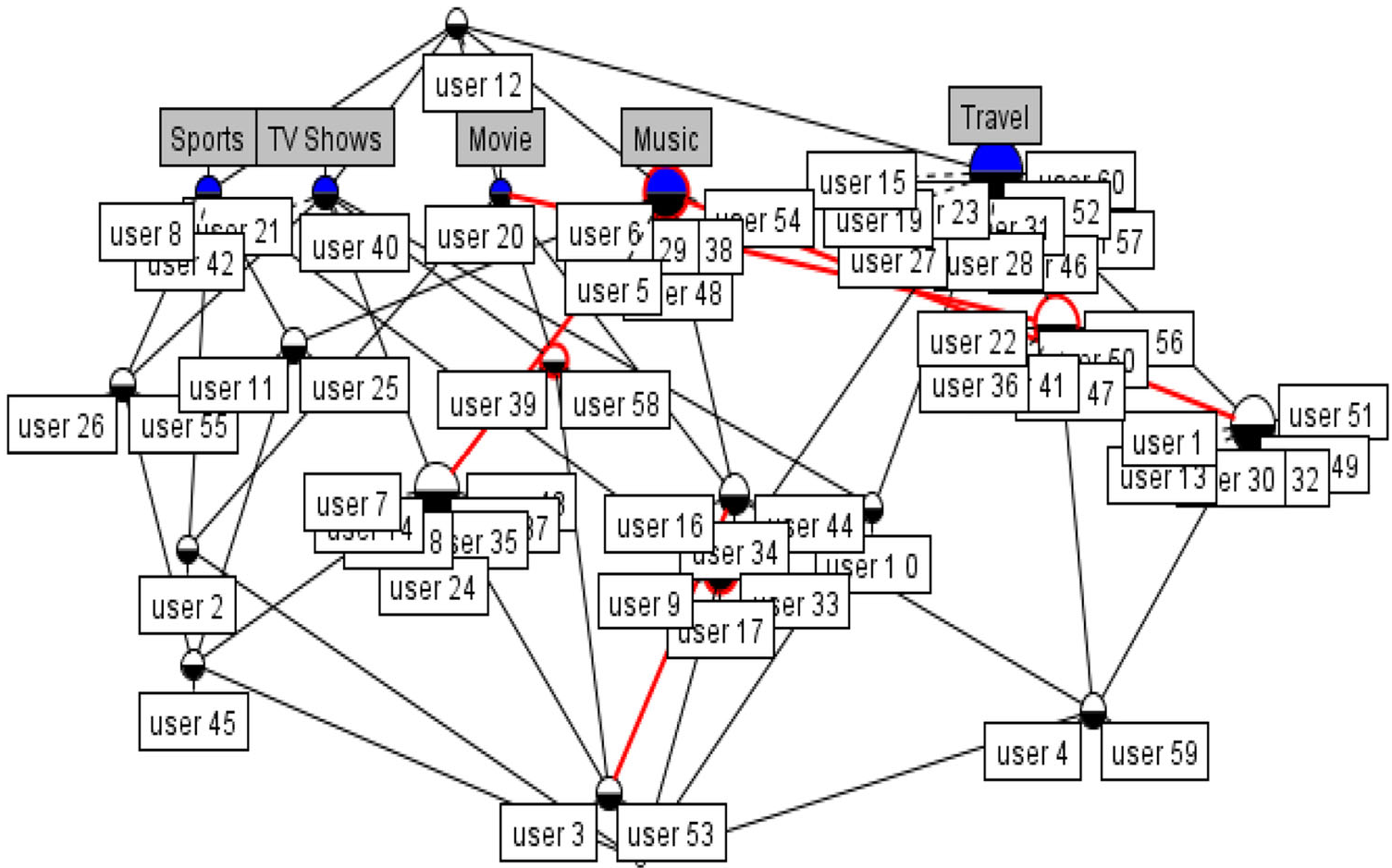 Figure 2: The interest-based Concept Lattice showing the hierarchical relationship between different user interests.
The study reveals that Trusted Users are not always Similar, and Similar Users are not always Trustworthy. For instance, User U57 was identified as having similar interests but was labeled "Untrusted" due to a lack of meaningful interaction history. This distinction is vital for preventing the formation of toxic communities.
Critical Insight & Conclusion
This work provides a rigorous mathematical foundation for what we intuitively feel in social networks: Trust is earned through interaction, while similarity is discovered through identity.
Key Takeaways:
- FCA is superior for sparse data: Unlike standard ML that requires full data matrices, FCA handles missing "interest" values naturally.
- Dynamic vs. Static: The main limitation identified is the reliance on static profile data for interests. The authors suggest that future work should integrate "Dynamic Interest Tracking" (e.g., changes in what a user posts about) into the FCA model.
By combining the "How and When" of interaction with the "Who and What" of profile identity, this hybrid approach sets a new standard for intelligent, safe, and relevant social grouping.