
Linking the Fragments: Identifying Users Across the Social Web Without Login Data
User data distributed on the social web: how to identify users on different social systems and collecting data about them
The paper presents a non-intrusive heuristic approach to uniquely identify users across multiple social systems (like Flickr and MySpace) by aggregating public profile data. The core method utilizes a weighted attribute-matching algorithm that estimates an Identification Probability (IdP) to enable "cross-system personalization" without requiring specialized authentication protocols like OpenID.
TL;DR
In a digital landscape where user preferences are scattered across Facebook, Twitter, Flickr, and specialized forums, building a coherent user model is a monumental task. This paper introduces an algorithmic approach to uniquely identify users across different social systems by analyzing public profile attributes (nicknames, age, city) rather than relying on private authentication like OpenID. By calculating an Identification Probability (IdP), the system can discover new user data with high precision (up to 95%).
Background: The Fragmented Digital Self
The "Social Web" of 2010 (and even more so today) created a problem: your interests in photography live on Flickr, but your professional life is on LinkedIn. For an adaptive recommender system to work effectively, it needs a holistic view of the user. Historically, this required "Cross-System Personalization" frameworks where systems explicitly talked to each other. The authors of this paper argue that we don't need a "common passport"—we can simply look at the digital footprints users leave behind.
The Motivation: Why Public Data?
The researchers identified a crucial bottleneck: most existing solutions (like OpenSocial or MySpaceID) require platforms to join a specific framework. This creates a "walled garden" effect. Their insight was to treat a user's identity not as a single token, but as a collection of attributes. Some attributes are "strong indicators" (same homepage = same person), while others are filters (different gender = different person).
Methodology: The Weighted Match Architecture
The core of the system is a multi-step parser/matcher pipeline:
- Attribute Classification: Attributes are categorized as positive indicators (e.g., personal URL) or negative indicators (e.g., persistent traits like gender used to exclude matches).
- Nickname Specificity: Not all nicknames are equal. The system calculates a rareness score based on character combinations and length; "billsmith1999" is more unique and thus weighted more heavily than "bill."
- Cross-System Connection: If profile A on Flickr and profile B on MySpace both match an input profile and also share a new discovered attribute (like a specific city), the link between them is strengthened.
 Figure 1: Conceptual overview of the distributed user data environment.
Calculation of Identification Probability (IdP)
The system doesn't just give a "Yes/No" match. It maps points to a scale of 0-100%. The IdP is calculated by matching the input profile against itself to establish a "Maximum Possible Score" for a 100% match, then scaling the retrieved results against that ceiling.
Experiments & SOTA Results
The authors used Profilactic (a legacy profile aggregator) to create a ground-truth dataset of 300 users who had already linked their MySpace and Flickr accounts.
Key Findings:
- Precision vs. Threshold: When the system claimed a 100% match probability, it was correct 94.9% of the time.
- Recall Density: More than 290 profiles (out of the 600 total across two platforms) were identified with an IdP over 86%.
- The "City" Effect: Providing the user's city significantly boosted Recall, as it acted as a powerful filter in the multi-step matching process.
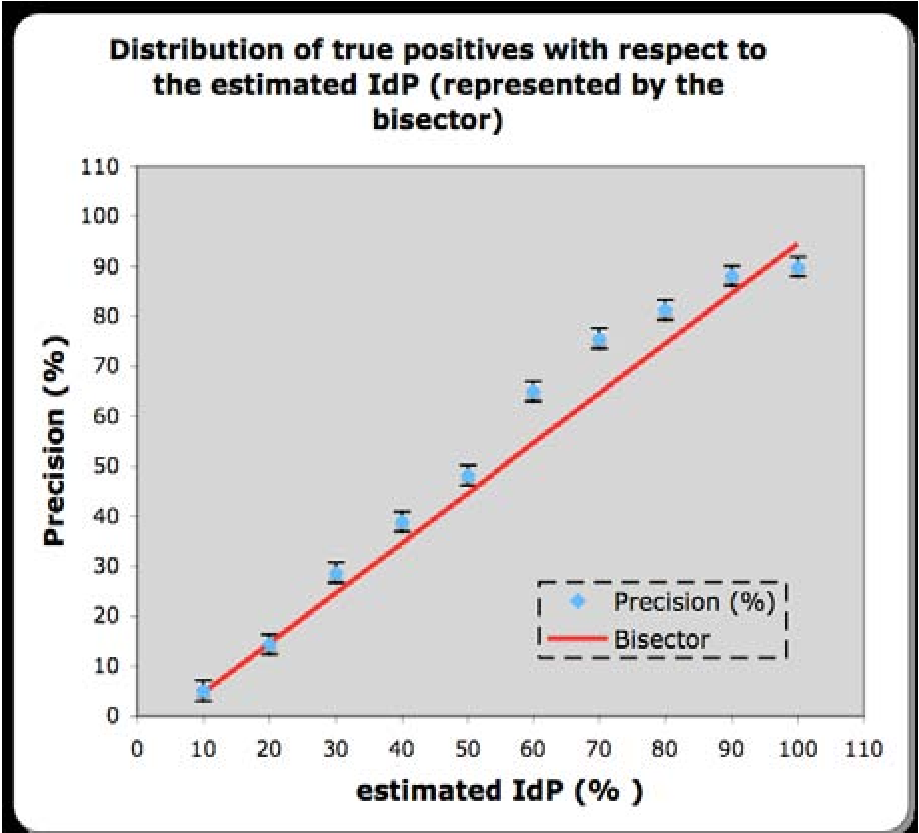 Table 4: Precision and Recall metrics across different IdP ranges. Note how Precision stays remarkably close to the estimated IdP.
Critical Analysis & Conclusion
The Takeaway
This work pioneered a "no-permission-needed" approach to user modelling. It proves that a relatively small set of public data points can be used to "handshake" between systems, effectively breaking down the data silos of the early Social Web.
Limitations & Future Work
- Static Heuristics: The weighting of attributes was manual. Modern adaptations would likely use machine learning to learn these weights dynamically.
- Data Volatility: Users change nicknames and relocate. The current algorithm assumes a high degree of persistence that may not hold over decades.
- Privacy Concerns: While the paper emphasizes "public data," modern privacy regulations (like GDPR) would require a much more careful approach to "inferring new data" about users without explicit consent.
In the lineage of user modeling, this paper remains a foundational text on User Model Interoperability, demonstrating that the "Social Web" is its own directory if you know how to read the patterns.