
ReLP: Leveraging Social Dynamics to Decode Political Polarization on Twitter
Identifying Users with Opposing Opinions in Twitter Debates
This paper introduces ReLP (Retweet-based Label Propagation), a semi-supervised framework designed to identify user stances in Twitter debates. By combining a novel label propagation algorithm based on retweet co-occurrence with a supervised Multinomial Naive Bayes classifier, the method achieves high accuracy in polarizing users on controversial topics like gun reform.
TL;DR
In the noisy arena of Twitter debates, identifying who stands where usually requires massive amounts of manually labeled data—a luxury researchers rarely have. ReLP (Retweet-based Label Propagation) solves this by using a handful of "seed" users (like Barack Obama or the NRA) and propagating their stances through the network based on who retweets whom. This semi-supervised approach hits a 95% F-measure, outperforming traditional text classifiers by significant margins.
Contextualizing the Problem: The Metadata Goldmine
Twitter is a goldmine for public opinion, but it is notoriously difficult to mine. The 140-character limit (at the time of the study) means word cues are scarce, and the rapid evolution of slang defeats static lexicons.
The authors identify a critical bottleneck: Supervised Learning's dependency on manual labels. Manually categorizing thousands of users for every new debate (gun control, abortion, climate change) is impossible. ReLP shifts the focus from what is said to how information flows, utilizing the "Retweet" as a signal of ideological alignment.
Methodology: The Logic of Co-occurrence
The core insight of ReLP is the Retweet Co-occurrence Matrix. The authors argue that if two different tweets are frequently retweeted by the same group of users, those tweets likely share the same stance.
1. The Column-Normalized Matrix
The framework constructs a matrix where each element represents the fraction of users who retweeted both tweet and tweet . This provides a mathematical proxy for ideological proximity.
2. The Propagation Loop
- Step 1: Seed Selection. Start with high-profile "vocal" users with known stances.
- Step 2: Label Propagation. Labels flow from known tweets to unknown tweets via the co-occurrence matrix.
- Step 3: Supervised Refinement. Once a robust set of tweets is labeled via propagation, they serve as training data for a Multinomial Naive Bayes classifier (using unigrams, bigrams, and trigrams) to capture users who don't retweet frequently.

Experiments: Bridging the "Silent Majority" and "Vocal Minority"
One of the paper's strongest points is its evaluation strategy. They didn't just test on famous politicians (the Visibly Opinionated); they manually labeled 500 "common" users (the Moderately Opinionated) who only post 2-4 times.
Key Results
The performance metrics demonstrate that ReLP is not just slightly better—it is transformative for this task:
- Moderately Opinionated Users: F-measure of 95.01% (ReLP) vs 80.94% (Naive Bayes Baseline).
- Visibly Opinionated Users: F-measure of 97.59% (ReLP) vs 88.23% (Naive Bayes Baseline).
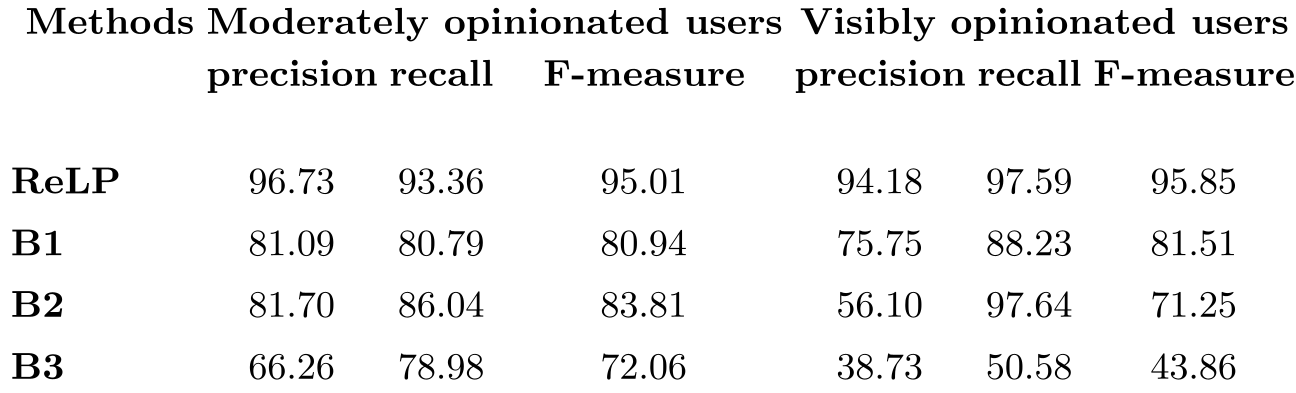
The results prove that using retweet patterns to "Bootstrap" training data creates a much cleaner signal than using hashtags (Baseline 2) or raw clustering (Baseline 3).
Critical Insight: Why Does It Work?
The success of ReLP lies in its ability to handle the heterogeneity of social media data. By using label propagation first, the model filters out the "noise" and captures the core ideological features of the debate. When the Naive Bayes classifier is finally trained, it isn't learning from noisy human-labeled data, but from a structurally consistent set of behaviors.
Limitations & Future Directions
While powerful, ReLP relies on a "bipolar" assumption (For vs. Against). In modern discourse, stances are often nuanced or multi-faceted. Furthermore, the reliance on retweets might struggle with "hate-tweeting" or "quote-tweeting" where a user shares content to mock it—a behavior that has increased since this paper was published.
Conclusion
ReLP provides a blueprint for low-resource stance detection. It proves that in social networks, structure is often more informative than content. For researchers and companies looking to gauge public sentiment without spending thousands on manual annotation, the retweet-propagation path remains one of the most efficient strategies in the academic toolkit.