
ID-ReNN: Decoding Ideological Bias in Indian Mass Media via Recursive Neural Networks
Ideology Detection in the Indian Mass Media
Deep learning-based end-to-end framework for ideology detection in Indian mass media. The study proposes a Recursive Neural Network (ReNN) model, termed ID-ReNN, to classify stances on economic and technology policies, achieving State-of-the-Art (SOTA) performance in domain-specific ideological classification.
TL;DR
Researchers from IIT Delhi have developed an end-to-end system to quantify ideological bias in Indian newspapers. By leveraging Recursive Neural Networks (ReNN) and a novel Entity Blinding technique, the system can distinguish between neutral factual reporting and biased policy stances. The study reveals a systematic skew in Indian media toward pro-government economic views and technology determinism.
Background & Positioning
In the era of "fake news" and algorithmic echo chambers, understanding the "gatekeeping" role of traditional mass media is vital. This work moves beyond simple sentiment analysis (positive vs. negative) to Ideology Detection (Pro vs. Anti-policy). It positions itself as a specialized tool for computational social science, outperforming even heavyweights like BERT in this specific, high-context niche.
The Core Problem: Why Sentiment ≠ Ideology
Standard sentiment tools like SentiStrength or VADER are built for product reviews. If a politician says, "It is a challenge to implement this great policy," a sentiment tool might flag "challenge" as negative. However, the ideological stance is clearly "Pro."
Furthermore, classifiers often "cheat" by memorizing that specific politicians (like PM Modi) are usually associated with "Pro" statements, failing to actually analyze the argument when that same politician offers a rare critique.
Methodology: The ID-ReNN Framework
The authors propose a two-step classification pipeline built on the linguistic structure of a sentence.
1. Architectural Choice: Why Recursive?
Unlike standard Recurrent Neural Networks (RNNs) that process text as a flat sequence, Recursive Neural Networks (ReNN) process sentences based on their Dependency Parse Tree.
- Intuition: It builds the meaning of a sentence from the ground up—combining words into phrases, and phrases into a final ideological vector. This is far more effective for picking up nuances like sarcasm or complex negations in political rhetoric.
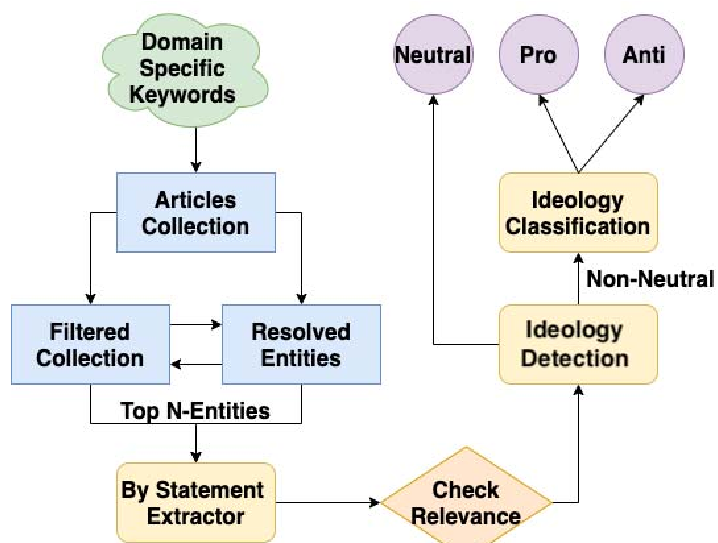 Fig 1: The end-to-end pipeline from news crawling to stance classification.
2. Entity Blinding: Removing the "Crutch"
To force the model to learn how something is said rather than who said it, the researchers replaced all names (Person/Org) with a generic token. This prevented the model from simply looking at a name to guess the stance, leading to a massive jump in generalizability across different policies.
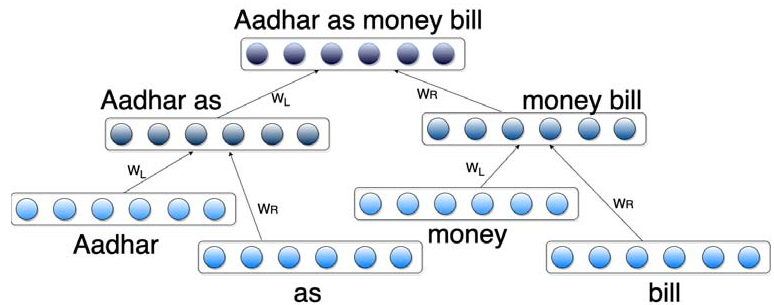 Fig 2: Example of word representations merging into phrase vectors.
Experimental Results
The researchers tested their model on high-stakes Indian topics: Aadhaar, Demonetisation, and GST.
- SOTA Performance: ID-ReNN achieved an F1-score of 0.81 (Economic) and 0.93 (Tech), significantly beating BERT-base.
- Domain Specificity: Fine-tuning word embeddings on Indian news was critical. Words like "Smart" or "Digital" carry specific ideological weight in the Indian context (referring to specific government missions) that generic Google News embeddings miss.
Media Bias Analysis
When applied to six major English dailies, the results were striking:
- Pro-Policy Skew: Media houses covered "Pro" statements roughly 70% of the time.
- Tech Determinism: For technology policies (e.g., e-Governance), the media showed an overwhelming "Deterministic" bias (viewing tech as a panacea), with very little room for skepticism.
Critical Analysis & Professional Insights
The success of ReNN in this study highlights a key trend in NLP: bigger is not always better. While Transformers (BERT/LLMs) dominate general tasks, structural models like ReNN that respect syntax are exceptionally powerful for low-data, high-precision social science tasks.
Limitations: The model currently assumes all phrases in a sentence share the same stance. In reality, a sentence could be balanced (containing both pro and anti-arguments). Future iterations using "Attention" mechanisms over sub-nodes of the parse tree could solve this.
Conclusion (Takeaway)
This research provides a scalable, objective "Media Monitor." It proves that by using Entity Blinding and Structural Parsing, we can build AI that understands the underlying rhetoric of power, providing a data-driven mirror to the biases of the Fourth Estate.