
IDNet-A: Synergizing Dense Connectivity with Multi-Scale Inception Modules
IDNet-A: Variant of DenseNet with Inception-Family
IDNet-A is a novel CNN architecture that hybridizes DenseNet's dense connectivity with the Inception family's multi-scale feature extraction. By replacing standard bottleneck layers with a sparse "unit_inception" module, it achieves state-of-the-art representational power with significantly higher parameter efficiency on CIFAR datasets.
TL;DR
IDNet-A is a architectural hybrid that merges the Dense Connectivity of DenseNet with the Multi-scale Feature Extraction of the Inception family. By embedding sparse Inception modules within dense blocks, the authors created a network that is both "deeper and wider" yet more parameter-efficient. On the CIFAR-100 benchmark, it achieves an impressive 17.13% error rate, showcasing superior representational power over standard DenseNet and ResNet variants.
Background: The Quest for Depth and Width
In the evolution of Convolutional Neural Networks (CNNs), two distinct paths to performance emerged:
- Going Deeper (The ResNet/DenseNet Path): Solving the gradient vanishing problem through skip connections or dense concatenations to ensure information flow across many layers.
- Going Wider (The Inception Path): Increasing "width" by using parallel filters of different sizes (1x1, 3x3, 5x5) to capture features at various scales simultaneously.
The authors of IDNet-A recognized that these two philosophies are complementary. While DenseNet excels at feature reuse, it traditionally relies on uniform kernel sizes in each layer.
Problem & Motivation: The Redundancy Trap
Standard deep networks often suffer from "feature dullness"—where information becomes diluted as it passes through many layers. DenseNet mitigated this by concatenating all preceding feature maps. However, the computational cost of making every layer "wide" using standard convolutions is prohibitive. The authors' insight was to use the Inception Module's sparse structure to increase network width at a "reasonable cost," essentially allowing the network to see both the "forest" (large kernels) and the "trees" (small kernels) at every step of the dense connection.
Methodology: The I-Dense Block
The core innovation is the I-Dense Block. Instead of a simple 3x3 convolution, each layer in the block is a "unit_inception" module.
1. The Sparse-Dense Hybrid
As shown in the architecture diagram below, the module splits the input into multiple paths. By using various filter scales, the model captures a richer set of features.
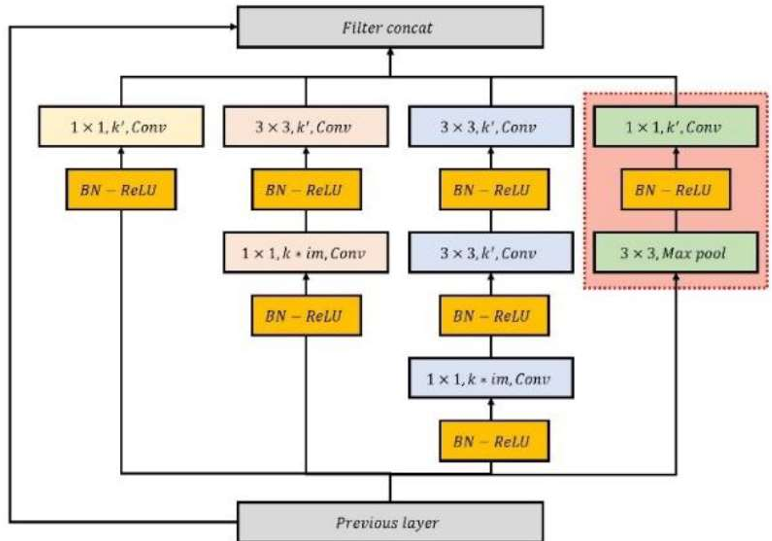 Figure 1: The Dense Layer of IDNet-A. The "unit_inception_no_max_pool" variant proved most effective.
2. Hyperparameter Control ( and )
To prevent the channel dimensions from exploding:
- Growth Rate (): Controls how many new feature maps are added at each layer.
- Inception Middle (): A new hyperparameter introduced to tune the width specifically within the multi-scale branches.
3. The "No Max Pool" Discovery
One of the paper's more interesting findings was that including max-pooling within the dense layers (a staple of original Inception modules) actually hurt performance on CIFAR datasets. Removing it created a more "pure" feature flow that optimized better for dense connectivity.
Experiments & Results
The authors conducted extensive testing on CIFAR-10 and CIFAR-100.
SOTA Comparison
IDNet-A consistently outperformed baseline DenseNets. For instance, an IDNet-A with 7M parameters reached 18.87% error on CIFAR-100+, whereas a standard DenseNet with the same parameter count sat at 20.2%.
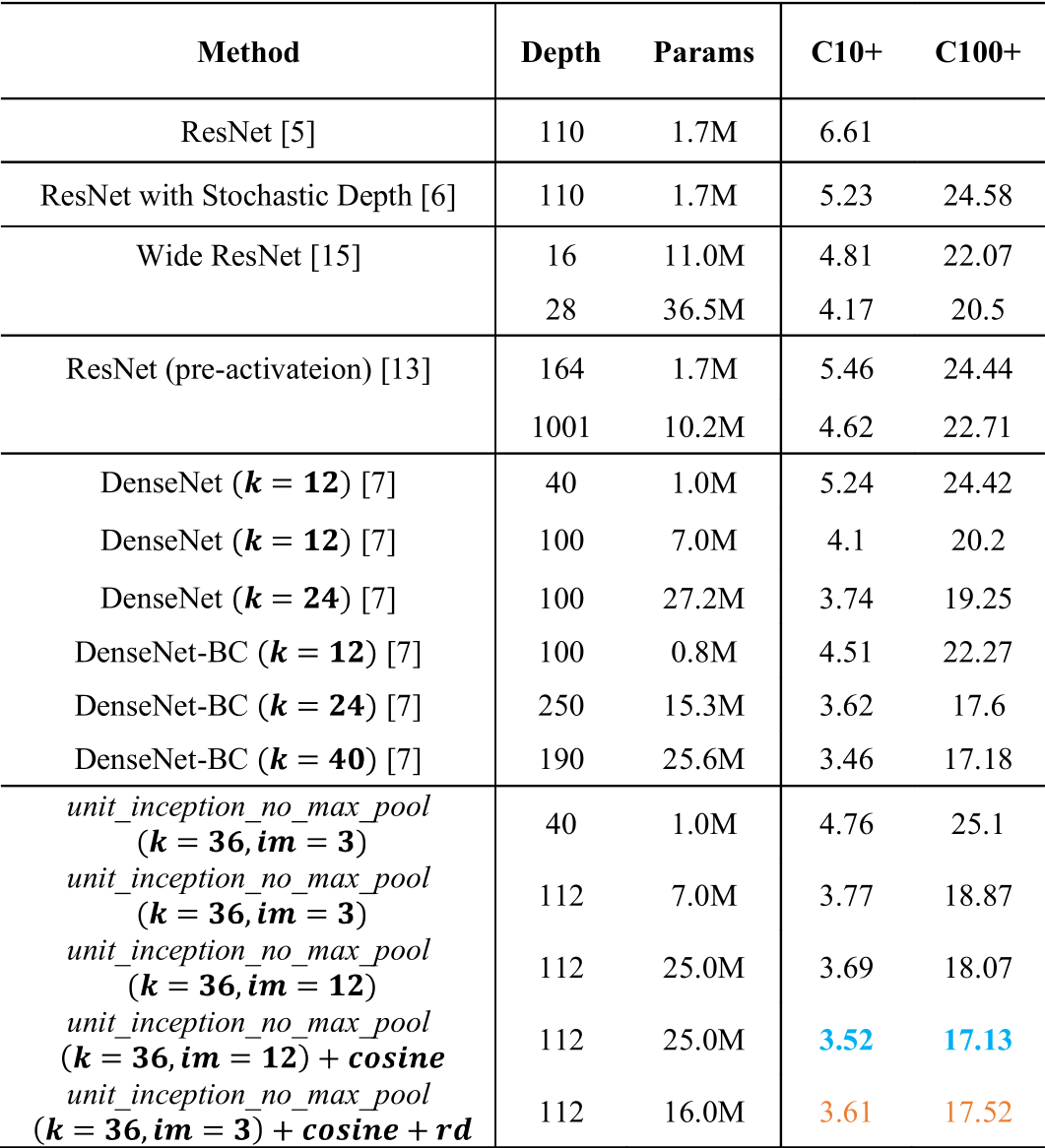 Table 1: IDNet-A variants vs. ResNet and DenseNet. Bold values indicate the benefits of Cosine Annealing.
Parameter Efficiency
Efficiency is where IDNet-A truly shines. By using sparse convolutions to achieve the effect of a wide network, it maintains a high "accuracy-per-parameter" ratio.
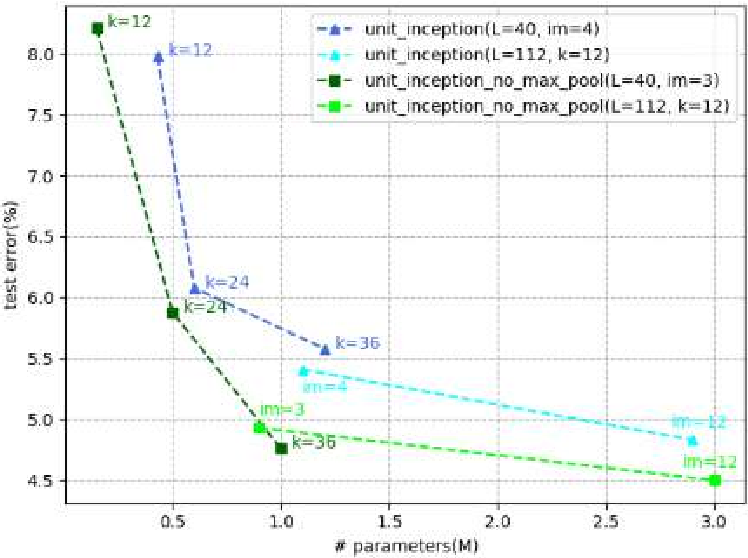 Figure 2: Performance vs. Parameters. IDNet-A (unit_inception_no_max_pool) stays consistently below its siblings in error rate.
Critical Analysis & Conclusion
Takeaway
The success of IDNet-A highlights that architectural diversity within a single layer is just as important as the total depth of the network. By forcing the model to process information through multi-scale filters, it gains a stronger inductive bias for visual tasks.
Limitations
- Complexity: The introduction of the hyperparameter adds another layer of complexity to neural architecture search (NAS).
- Dataset Scope: The study is primarily focused on CIFAR. It remains to be seen how these multi-scale dense blocks scale to much higher resolution images (e.g., 4K medical imaging) where Inception modules usually thrive.
Future Outlook
This work paves the way for "Automatically Discovered" hybrids. Future research could combine these insights with State Space Models (SSMs) or Transformers to see if multi-scale sparse attention can provide similar benefits to long-sequence modeling.