
RFID Sensing: The Silent Architect of the Precision Agriculture Revolution
IEEE instrumentation & measurement magazine
This paper provides a comprehensive survey of RFID sensing technologies—categorized into chip-based, chipless, add-on, and antenna-based sensors—and their transformative role in smart agriculture. It highlights the successful implementation of these sensors in monitoring micro-climates, soil health, plant growth, and post-harvest quality, establishing RFID as a SOTA backbone for precision farming.
TL;DR
Agriculture is undergoing a digital metamorphosis, moving from "guesswork" to "precision." This paper explores how Radio Frequency Identification (RFID) is transcending its origins in logistics to become a sophisticated sensing platform. By leveraging chip-based, chipless, and antenna-sensing mechanisms, RFID allows farmers to monitor everything from soil salinity to leaf temperature with zero battery maintenance and hyper-local accuracy.
Background: Beyond the Barcode
While the industry has long used RFID for livestock tracking and supply chain management, the "Smart Agriculture" (or Precision Farming) paradigm requires more. We need to know why a crop is failing, not just where it is. The core challenge is deploying sensors across vast, often harsh, terrains without the nightmare of changing thousands of batteries. RFID provides the perfect "passive" answer.
Problem & Motivation: The Granularity Gap
Conventional IoT sensors are often too bulky for leaf-level monitoring and too expensive for high-density deployment. Prior work in wireless sensor networks (WSN) faced significant hurdles in power harvesting and environmental interference (e.g., soil moisture blocking RF signals).
The authors' insight is that the RFID tag—specifically its antenna and backscattering behavior—can be used as the sensor itself. This eliminates the need for separate sensing hardware, drastically reducing cost and power requirements.
Methodology: The Four Pillars of RFID Sensing
The paper categorizes the technology into four distinct archetypes, each with a specific "Inductive Bias" for different agricultural tasks:
- Chip-based Sensors: The sensing logic is inside the IC. Simple but limited in scope.
- Chipless Sensors: No microchip. Data is encoded in the "EM signature." These are ultra-cheap and work well under interference.
- Add-on Sensors: High-precision external sensors connected to an RFID chip. This is the "heavy lifter" for complex chemical analysis like pH or Ammonia detection.
- Antenna Sensors: The "purest" form. Physical changes (like a crack or moisture) change the antenna's resonance properties.
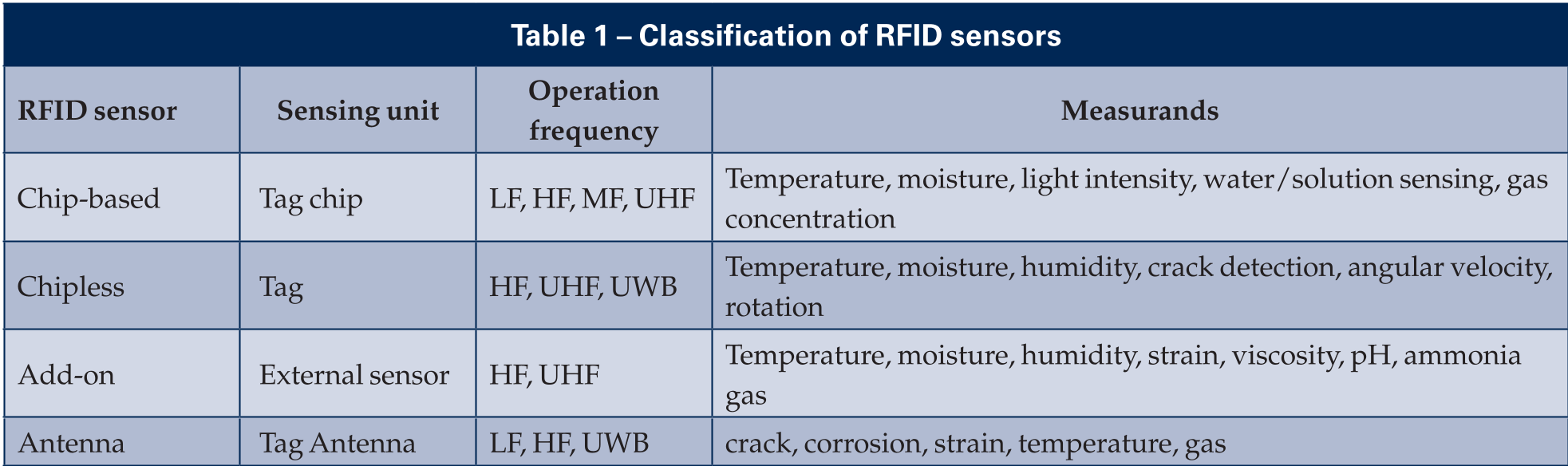 Table: Comparison of sensing units and measurands across RFID types.
Real-World Applications: From Roots to Harvest
1. Leaf-Level Micro-Climates
Standard weather stations measure field-average temperature. RFID tags attached to individual leaves allow for local climate control. By using FM backscattering, these tags can communicate leaf health data using only 290 μW of power—essentially "stealing" energy from ambient RF waves.
2. The Soil "Black Box"
Monitoring soil moisture and salinity is notoriously difficult because water absorbs RF energy. The research highlights the use of reference tags (one exposed to soil, one shielded) to cancel out noise, enabling accurate moisture readings at depths previously unreachable by passive tech.
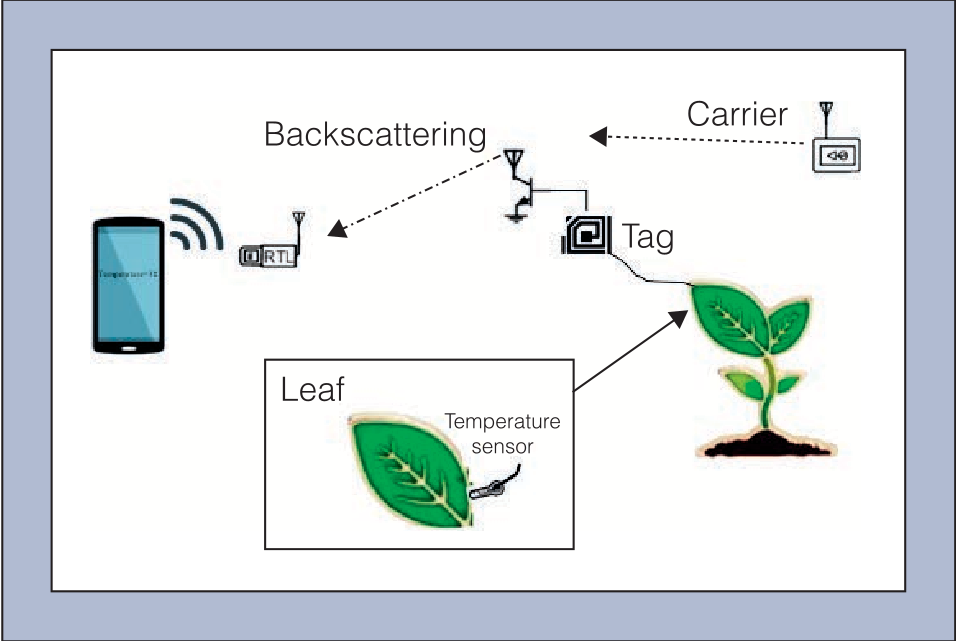 Figure: Deploying RFID tags for real-time environmental and plant physiological monitoring.
3. Smart Harvest & Quality Control
The journey doesn't end at the harvest. The paper details how RFID sensors in "Silo bags" or vegetable packaging monitor Ammonia accumulation (an indicator of rot) and CO2 levels.
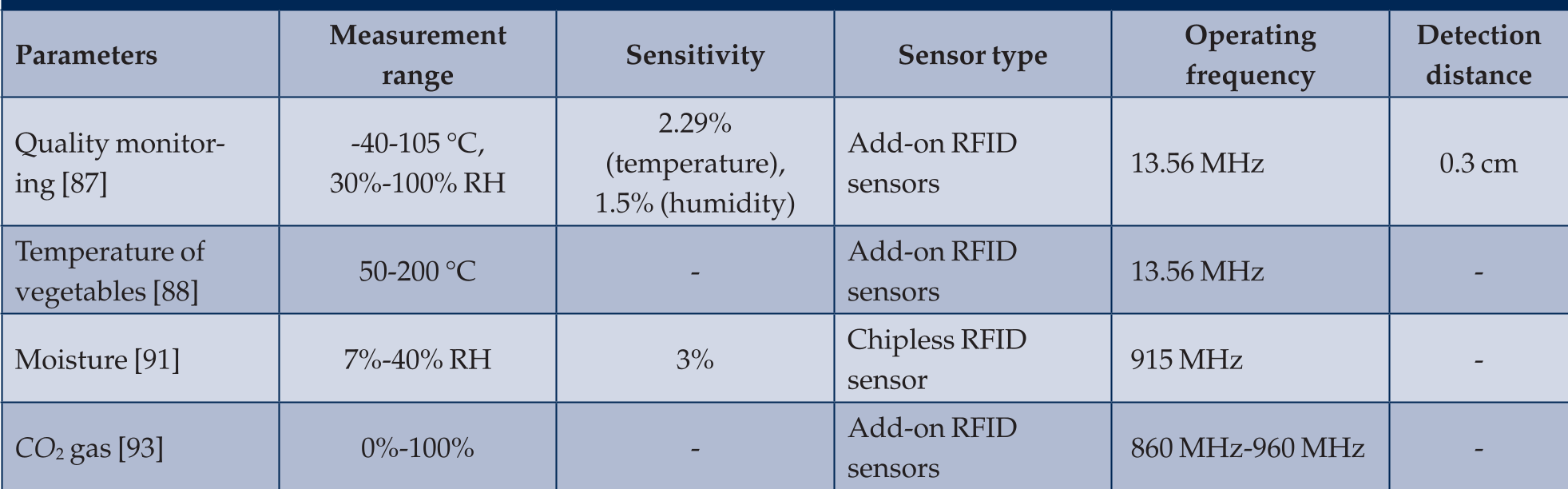 Table: SOTA Performance of RFID sensors in harvest quality monitoring.
Critical Analysis & Conclusion
Takeaway
RFID sensing is the only technology that realistically scales to the "per-plant" level required for the 9.7 billion people population goal of 2050. The ability to integrate ID and sensing into a single, batteryless footprint is its "unfair advantage."
Limitations
- Interrogation Complexity: While the tags are cheap, the readers (interrogators) and the algorithms needed to decode antenna-based data remain complex and expensive.
- Environmental Sensitivity: Soil conditions can significantly "detune" RFID antennas, leading to signal loss.
Future Outlook
The next frontier is Hybrid Integration. Combining RFID's passive sensing with LoRa’s long-range communication (up to 1.3km in soil tests) or Smartphone-based NFC reading will democratize this tech for small-scale farmers, not just industrial giants.