
IGATA: Bridging Freemium Games and Crowdsourcing through Psychological Attraction
IGATA: An Attraction-Based Online Task Recommendation Framework in Freemium-Crowdsourcing Platform
This paper introduces IGATA, an online task allocation framework for Freemium-Crowdsourcing platforms that replaces in-game purchases with crowdsourcing tasks. By quantifying psychological "reward attraction" and player quality through in-game attributes, IGATA achieves superior task matching and profit maximization.
TL;DR
IGATA (In-Game Attribute Task Allocation) is a pioneering framework that turns gamers into high-quality crowdsourcing workers by offering in-game rewards instead of cash. By mathematically modeling reward attraction and dynamic player quality, it maximizes both player satisfaction and platform profit.
Background: The Freemium-Crowdsourcing Synergy
The "Freemium" model—where games are free to play but charge for "Premium" boosts—is a multi-billion dollar industry. IGATA leverages a clever insight: instead of making players watch ads or pay cash for a "Fire Sword," why not let them perform a micro-task (like image labeling or data verification) to earn it? This creates a win-win where the platform gets data and players get items they actually value.
The Core Problem: Motivation and Quality
Prior attempts at gamified crowdsourcing lacked two critical components:
- Quantification of Attraction: Not all rewards are equal. A "Mana Potion" is worthless to a Warrior but priceless to a Mage.
- Implicit Quality Control: Without performance history (common in ephemeral gaming sessions), how do we know if a player's work is reliable?
Methodology: The IGATA Framework
The authors define the Online Gamified Task Allocation Problem (On-GTAP) and solve it through a sophisticated three-phase pipeline.
1. Modeling Attraction & Quality
- Attraction Index: Calculated by the match between player categorical factors (e.g., Race, Class) and task reward attributes.
- Quality Vector: Uses numerical attributes (e.g., Level, Win Rate) weighted by a dynamic coefficient .
2. The 3-Phase Allocation Strategy
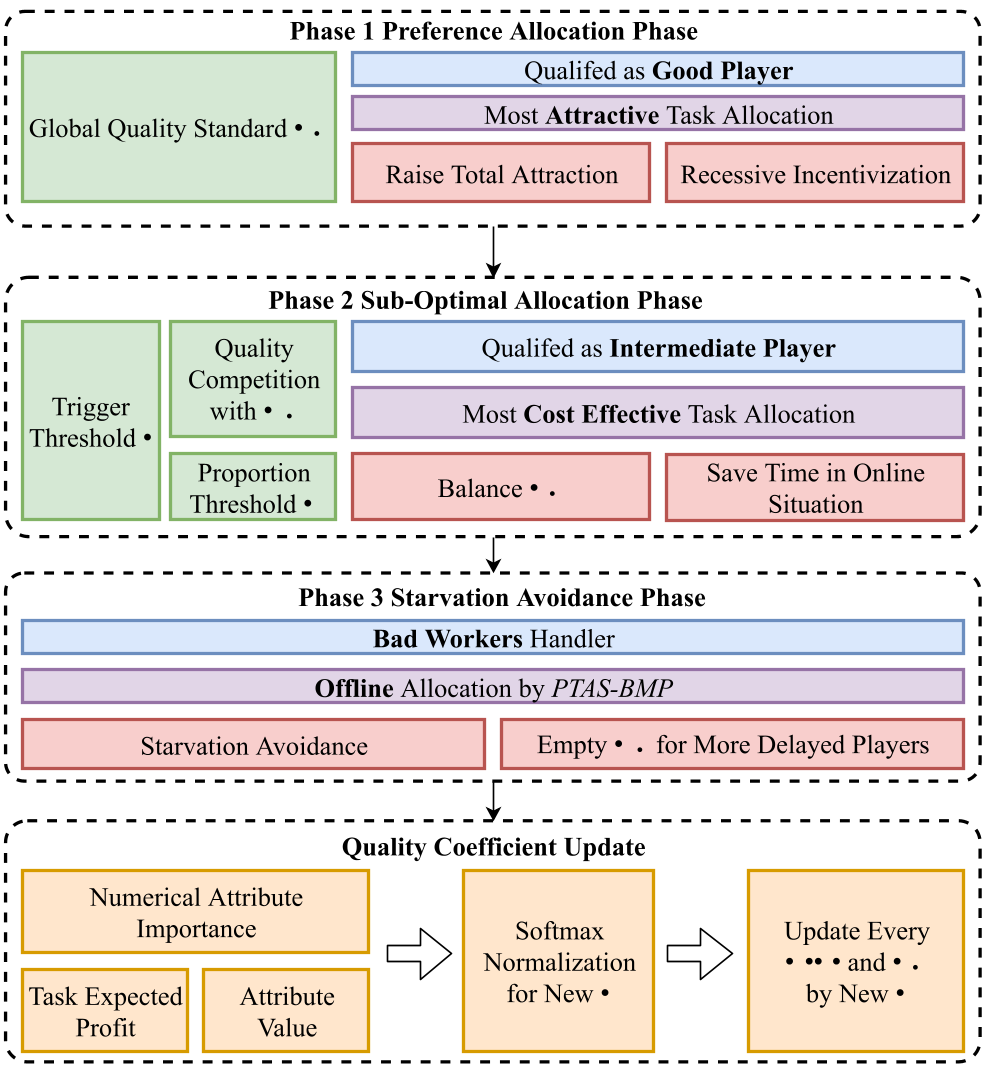
As shown in the architecture, when a player arrives, IGATA processes them through:
- Phase 1 (Preference Allocation): High-quality players get first pick of the most "attractive" tasks. This rewards skill and ensures high-quality output for premium rewards.
- Phase 2 (Sub-Optimal Allocation): Intermediate players are assigned tasks based on cost-performance to maintain platform profitability.
- Phase 3 (Starvation Avoidance): Low-quality/delayed players are handled in batches using a budgeted matching algorithm to ensure no player is left without a task for too long.
3. Dynamic Learning (EM-based Update)
IGATA doesn't just guess which attributes matter. It uses an Expectation-Maximization (EM) inspired algorithm to update the importance of in-game features based on the profit actually realized, effectively "learning" who the best workers are in real-time.
Experimental Proof: WoW and PUBG
The framework was tested on massive datasets from World of Warcraft (WoWAH) and PUBG.
- Total Attraction: IGATA achieved a 500% improvement over traditional direct allocation (DIR) and profit-oriented (PRF) strategies.
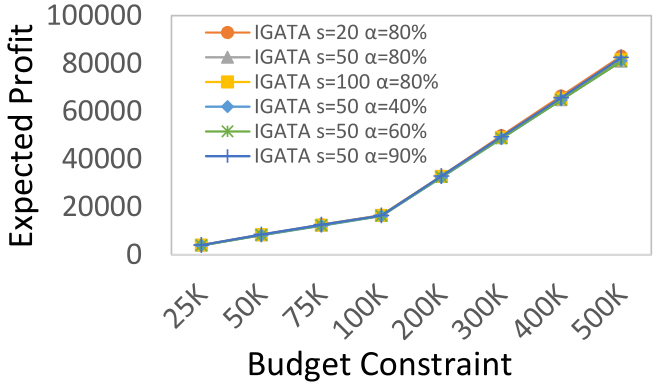
- Profitability: Despite prioritizing player preference, the psychological "discount" (players accept lower universal rewards for high-attraction items) actually resulted in 3x higher profits than static experience-based models.
Deep Insights & Conclusion
IGATA proves that Psychology > Brute Force in crowdsourcing. By treating workers as "players with preferences" rather than just "processing units," the framework solves the data quality problem at its root: motivation.
Limitations: The current model assumes immediate task completion and doesn't account for players who might start a task but never finish it—a common behavior in mobile gaming that future iterations will need to address.
The Takeaway: For AI and data companies, IGATA suggests that the future of data labeling isn't just a better UI, but integration into existing digital ecosystems where users are already highly engaged.