
IKUM: Bridging the Gap Between Web Content Semantics and User Behavior
IKUM: An Integrated Web Personalization Platform Based on Content Structures and User Behavior
IKUM is an integrated web personalization platform that combines web usage mining with semantic content structures to deliver customized user experiences. It introduces the Concept-Log (C-Log) and utilizes a sequence tree-based recommendation engine to provide contextually relevant content.
TL;DR
The IKUM (I-KnowUMine) project introduces a unified framework for web personalization that moves beyond simple clickstream tracking. By enriching server logs with semantic metadata—creating what the authors call C-Logs—the system provides recommendations that are not just based on where users went, but what they were actually looking for.
Background: Beyond Simple Log Mining
In the early 2000s, web personalization was largely a reactive process. Developers looked at "Who clicked what" to guess "What's next." However, this approach has a major Inductive Bias flaw: it ignores the meaning of the content. If a new page is added to a site, usage-based systems won't recommend it because it has no history. IKUM solves this by treating web pages as instances of concepts within a domain taxonomy.
Methodology: The Anatomy of a Contextualization Server
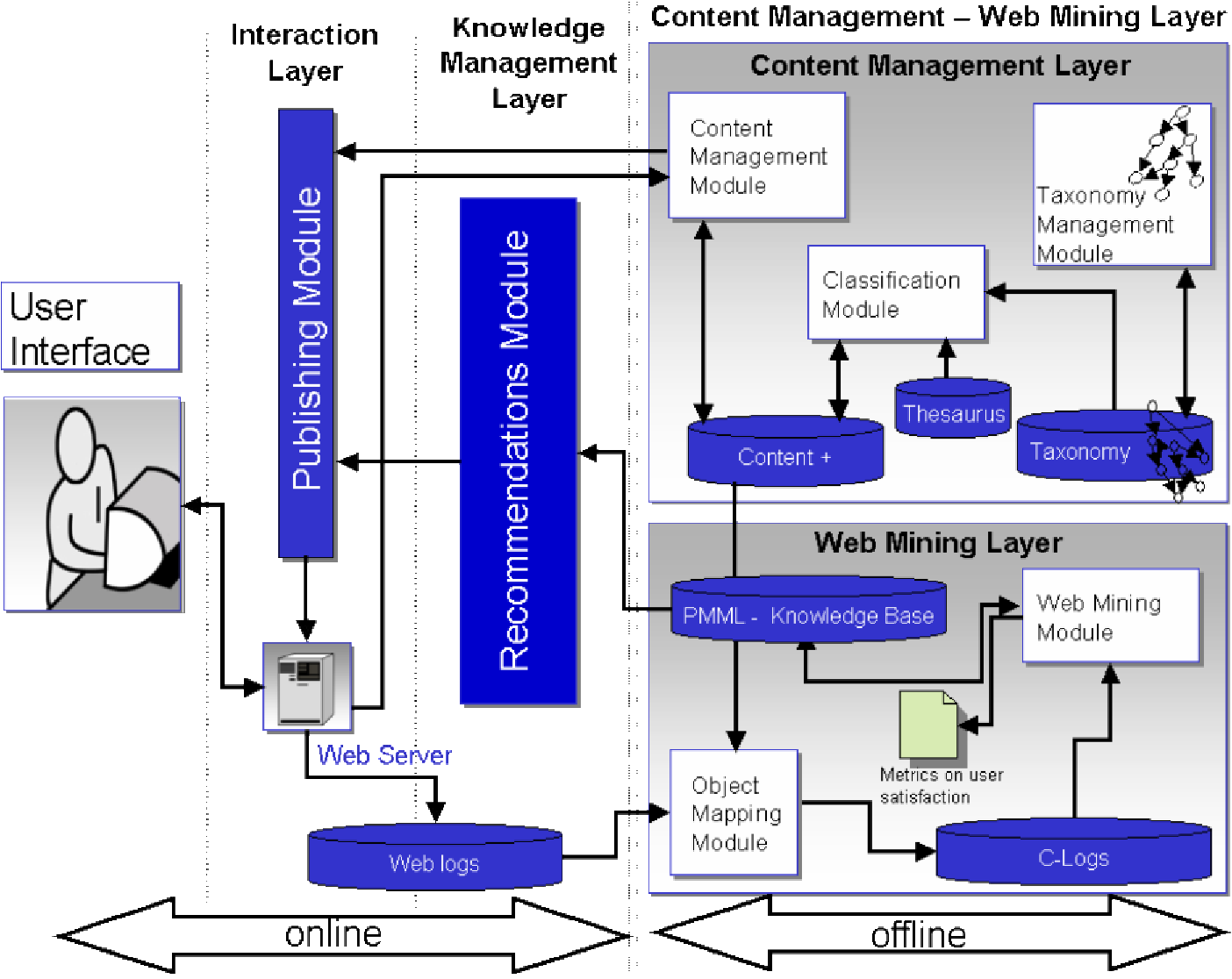
The IKUM architecture is structured into four distinct layers, ensuring a separation of concerns between raw data collection and high-level knowledge deployment.
1. Semantic Tagging via "Anchor-Windows"
Instead of just looking at the text on a page, IKUM looks at:
- Inlinks/Outlinks: How other pages describe the current page.
- Anchor-Window: The 100 characters before and after a link, which often contain the most descriptive keywords.
- Thesaurus Mapping: Using WordNet and the Wu & Palmer similarity measure to map raw keywords to a formal RDF-based taxonomy.
2. The Sequence Tree Engine
Standard association rules can be flat and static. IKUM uses Capri, an algorithm that generates a tree-based representation of user paths. This allows the system to calculate recommendation scores based on:
- Recency: Weighting the most recent clicks higher to capture the user's immediate intent.
- Sequence Length: Balancing specific long-path matches against broader short-path generalizations.
Experiments & Results
The system was tested on the DB-NET academic website. The researchers compared "Original Recommendations" (pure usage-based) against "Semantic Recommendations."
| Recommendation Set | Original Usefulness | Semantic Usefulness |
|---|---|---|
| Set B (New Content) | 1.27 | 2.09 |
| Set C (Mixed) | 2.09 | 2.36 |
| Total Average | 1.9 | 2.0 |
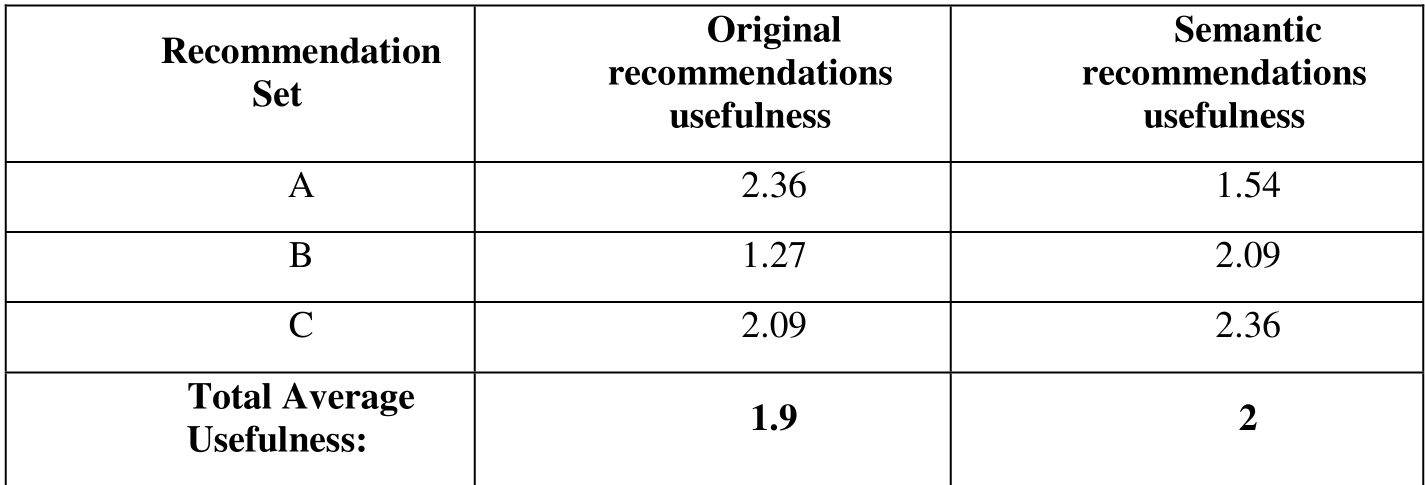
Core Insight: The semantic approach significantly outperformed the baseline in "Set B." Why? Because Set B included new pages. Pure usage mining couldn't "see" them, but IKUM's semantic classifier identified them as relevant to the user's current conceptual path.
Critical Analysis: Why This Matters
The true value of IKUM lies in its Conformance to Standards. By using PMML (Predictive Model Markup Language) and SOAP, it was designed to be modular. You could swap the classification engine or the sequence miner without rebuilding the entire portal.
Limitations
- Multilingualism: The system relies heavily on WordNet, making it difficult to apply to non-English or multi-lingual sites without a translation layer.
- Computational Overhead: Real-time semantic mapping of every user request into a sequence tree can be taxing for high-traffic environments.
Future Outlook
While IKUM was a pioneer in using Taxonomies, modern AI has shifted toward Neural Embeddings (like BERT or Ada). However, the fundamental logic remains the same: combining the structure of knowledge with the randomness of user behavior is the only way to build truly "intelligent" web interfaces.