
The Iliou Method: Engineering 100% Accuracy in Suicide Risk Prediction
Iliou Machine Learning Data Preprocessing Method for Suicide Prediction from Family History
The paper introduces the Iliou Preprocessing Method, a novel data transformation technique designed to enhance machine learning performance in predicting suicide risk based on family history. Using a dataset of 360 students, the method achieved a perfect 100% classification accuracy with the Multilayer Perceptron (MLP) classifier, significantly outperforming traditional Principal Component Analysis (PCA).
TL;DR
Predicting suicidal behavior from family history is a high-stakes challenge where "standard" data handling often falls short. This paper presents the Iliou Preprocessing Method, a data transformation technique that shatters the performance ceiling of traditional methods. While Principal Component Analysis (PCA) struggled to reach 72% accuracy on the study's dataset, the Iliou method enabled a 100% success rate in identifying high-risk individuals using a Multilayer Perceptron (MLP).
The "Noise" Problem in Psychiatric Data
Suicide prediction is hindered by the Inductive Bias of many models when faced with real-world clinical data. Attributes like family history of psychopathology, substance abuse, or trauma are binary or categorical but carry heavy psychological weight. Standard preprocessing treats these as mere numbers, often failing to capture the underlying "risk signal."
The authors argue that existing methods like PCA are too generic; they reduce dimensionality by seeking maximum variance but may discard the subtle interactions between family history variables that are vital for clinical accuracy.
Methodology: Beyond Simple Normalization
The core of the Iliou Method lies in its unique approach to statistical centering. Instead of just scaling features, the method utilizes a multi-step transformation involving the calculation of global means and medians relative to specific class outcomes.
The Transformation Logic:
- Central Tendency Calculation: The algorithm computes
Total_MeanandTotal_Medianfor the classes. - Refinement: It calculates the difference between these global statistics and the class-specific row values.
- Feature Reconstruction: The original data is replaced by these "residual" values, which emphasize how much a specific patient's profile deviates from the norm of suicidal vs. non-suicidal patterns.
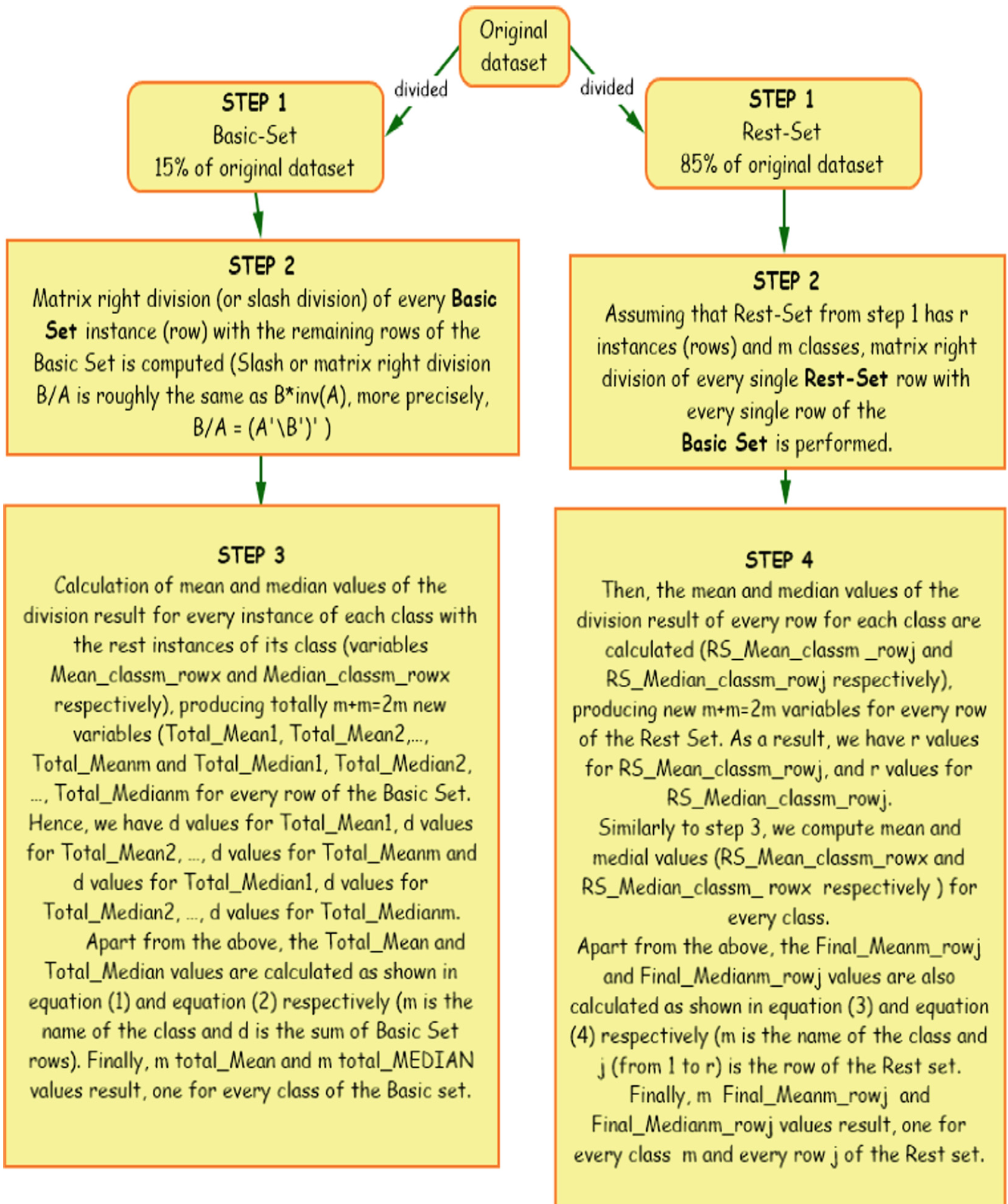 Note: The flowchart depicts the integration of cleaning, transformation, and reduction within the Iliou framework.
Experimental Showdown: Iliou vs. PCA
The researchers tested three scenarios across 10 different algorithms (including J48, Random Forest, SMO, and Naive Bayes):
- Raw Dataset: Baseline performance.
- PCA Preprocessed: Standard dimensionality reduction.
- Iliou Preprocessed: The proposed method.
Key Results:
- MLP Power: The Multilayer Perceptron reached a perfect 1.0 AUC and 100% Accuracy when paired with Iliou.
- Consistency: Across nearly all classifiers (except HMM), the Iliou method provided a significant "lift" in Kappa statistics and the Matthews Correlation Coefficient (MCC), indicating the results were not due to random chance.
- Failure of PCA: Interestingly, PCA sometimes performed worse than the raw dataset, highlighting that generic variance-based reduction can be detrimental in clinical diagnostic tasks.
 Table showing the 100% performance metrics for MLP using the Iliou method.
Critical Insight: Why Does It Work?
The Iliou method functions as a feature enhancer. By centering the data around class-specific means/medians, it effectively performs an "informed" transformation. It reduces the internal noise of the 360-student dataset, making the decision boundary so clear that even simpler classifiers like IB1 (k-Nearest Neighbors) jump from 68% to 98% accuracy.
Conclusion & Future Outlook
The study proves that the way we prepare data is often more important than the model we choose. For clinical practitioners, the Iliou method provides a blueprint for transforming "messy" family history records into a high-precision screening tool.
Limitations: While 100% accuracy is remarkable, it was achieved on a relatively small cohort (n=360). The next frontier will be testing this method on massive Electronic Health Record (EHR) databases to ensure these results generalize across diverse populations and broader demographics.
Takeaway: In the fight against suicide, the Iliou method offers a statistically robust way to ensure that silent family history signals are heard loud and clear by AI.