
Accelerating Social Harmony: An ILS Approach to Structural Balance in Signed Networks
An ILS algorithm to evaluate structural balance in signed social networks
The paper introduces a hybrid Iterated Local Search (ILS) metaheuristic to solve the Correlation Clustering (CC) problem for evaluating structural balance in signed social networks. By optimizing a partition to minimize "imbalance" (positive cut edges and negative uncut edges), the algorithm achieves state-of-the-art efficiency, significantly outperforming previous GRASP-based methods in execution time while maintaining solution quality.
TL;DR
This research tackles the computational bottleneck of measuring "social tension" in large networks. By implementing an Iterated Local Search (ILS) metaheuristic, the authors provide a way to partition social groups (minimizing conflict) up to 3x faster than previous methods, scaling the analysis to networks with 10,000 nodes and beyond.
The Background: Why Structural Balance Matters
Social systems follow a "cognitive consistency" principle: the friend of my friend is my friend; the enemy of my enemy is my friend. When a network violates these rules (e.g., two friends hating each other), it creates structural imbalance or tension.
Mathematically, this is modeled as the Correlation Clustering (CC) Problem on signed graphs (where edges are '+' for friends and '-' for enemies). The goal is to find a partition that minimizes Imbalance ():
- Positive Cut Edges: Friends separated into different groups.
- Negative Uncut Edges: Enemies forced into the same group.
The Challenge: The Scalability Wall
While the concept is intuitive, the math is hard. Exact solvers (ILP) crash on networks with more than 40 people. Previous metaheuristics like GRASP (Greedy Randomized Adaptive Search Procedure) were better but still struggled with the sheer size of modern social datasets like Slashdot or Epinions.
Methodology: The Power of Iterated Local Search
The authors' insight is that Iterated Local Search (ILS) is superior to simple random restarts because it doesn't "start from scratch." Instead, it performs a Perturbation (a "kick") to a known good solution and refines it.
1. The Architecture
The algorithm follows a four-stage cycle:
- Construction: A greedy randomized start.
- VND (Variable Neighborhood Descent): Systematic exploration of internal local optima.
- Perturbation: Randomly shuffling vertices to jump to a new region of the search space.
- Acceptance: Deciding whether the new local optimum is worth keeping.
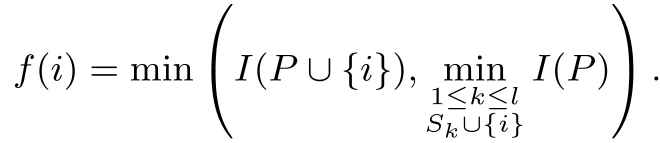 The objective function used in the construction phase to measure the impact of adding a vertex to a cluster.
2. Parallelization
To handle 10,000+ nodes, the authors implemented Parallel VND. They split the neighborhood exploration across multiple CPUs, allowing the "search slaves" to find improvements simultaneously.
Experimental Proof: Speed vs. Quality
The researchers tested their ILS against GRASP on three datasets: small historical networks, UN General Assembly (UNGA) voting records, and Slashdot crawl data.
| Metric | GRASP (10k nodes) | ILS (10k nodes) | Improvement |
|---|---|---|---|
| Solution Quality | 20594.6 | 20594.8 | Identical |
| Avg. Time (s) | 7200.49 | 2782.59 | ~2.6x Speedup |
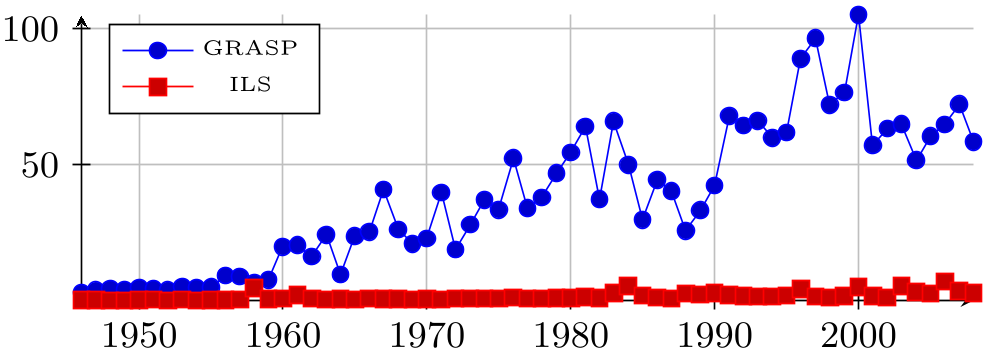 Comparison of execution time on UNGA instances showing ILS (lower line) consistently beating GRASP.
Real-World Insight: Geopolitical Bipolarity
The paper concludes with a fascinating case study on the UN General Assembly. The algorithm correctly mapped:
- 1946: The formation of the Eastern Bloc (Soviet Union and satellites).
- 1962: The height of the Cold War, showing two distinct clusters (US-aligned vs. USSR-aligned).
- 2006: The isolation of Israel and the USA in specialized voting blocks.
Critical Perspective
While ILS shows impressive efficiency, its performance is sensitive to the perturbMax parameter. If the "kick" is too weak, the algorithm stays stuck; if too strong, it becomes no better than a random search. Future work should look into Adaptive Perturbations that change intensity based on the search landscape's "ruggedness."
Conclusion
This ILS implementation successfully bridges the gap between social theory and big data. By optimizing the local search transitions rather than just the restarts, the authors provide a robust tool for sociologists to quantify conflict in the digital age.
Key Takeaway
For developers building social recommendation or community detection systems: don't just restart your heuristics—iterate and perturb.