
SIAA: Decoding Image Aesthetics through the Lens of Social Behavior
Image Aesthetics Assessment Based on User Social Behavior
This paper introduces Social-sensed Image Aesthetics Assessment (SIAA), a novel framework that integrates user cognitive information derived from social behaviors into the aesthetic evaluation process. By leveraging a multi-branch ResNet-50 architecture and transfer learning, SIAA achieves state-of-the-art performance, notably reaching 93.0% accuracy on the AVA benchmark.
TL;DR
Image aesthetics assessment has long been treated as a pure computer vision problem. However, the SIAA (Social-sensed Image Aesthetics Assessment) framework challenges this by arguing that aesthetics is fundamentally a cognitive activity. By sensing user cognition through social behaviors (like tagging and sharing) and transferring this knowledge to general web images, SIAA achieves a remarkable 93.0% accuracy on the AVA dataset, outperforming visual-only SOTA models.
The Missing Piece: Human Cognition
Why do some high-resolution, perfectly composed photos feel "soulless," while others capture global attention? The missing link is Human Cognition. Existing methods—ranging from handcrafted features (Rule of Thirds) to Deep CNNs—focus only on pixels.
The authors identify two massive hurdles in moving beyond pixels:
- Uncertainty: Social interactions (labels, likes) are often casual and noisy.
- Data Scarcity: Most images on the web don't come with social metadata.
Methodology: Sensing the Invisible
SIAA bridges this gap using a three-stage pipeline:
1. Handling Uncertainty via Social Distribution
Instead of treating every "Like" or "Tag" as an absolute truth, the authors use Affinity Propagation Clustering. They establish a similarity graph between users and assign a reliability score using a PageRank-based iterative update. This transforms noisy individual actions into a stable Social Distribution across clusters of users, groups, and tags.
2. Social Behavior Detector (The Transfer Learning Bridge)
To handle images without social data, SIAA trains a multi-branch ResNet-50 on 50,000 Flickr images. This network learns to predict the "Social Distribution" from pixels alone.
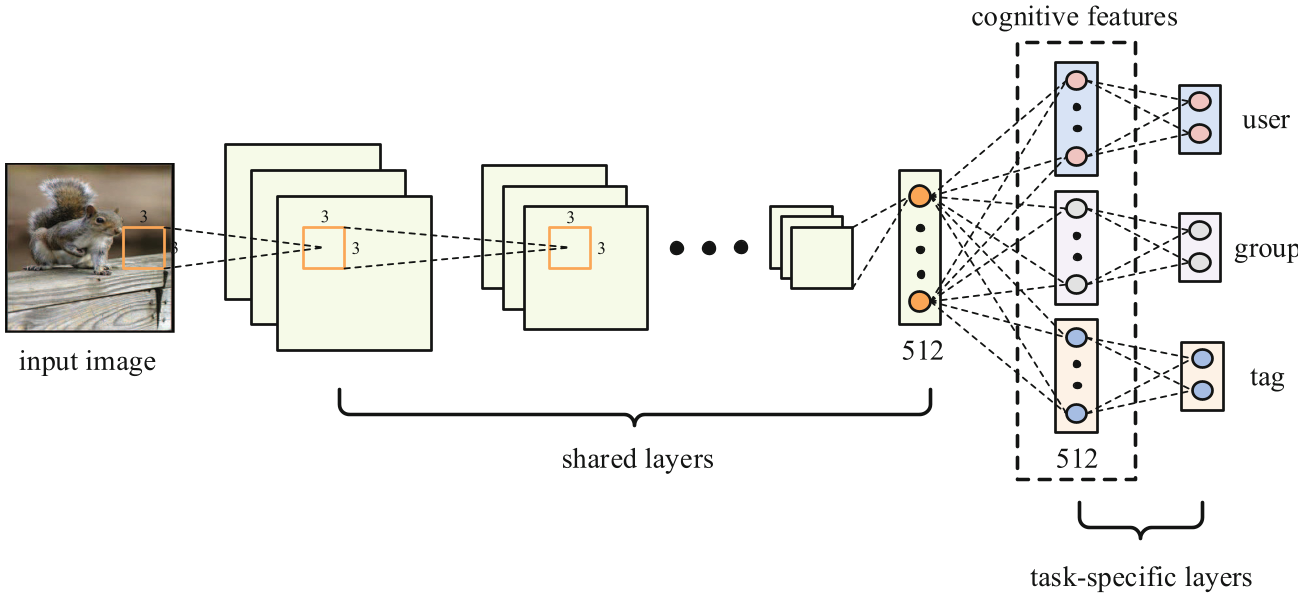 Figure 1: The multi-branch network extracts cognitive features from the hidden layers of the social behavior branches.
3. Feature Fusion
Finally, the "Cognitive Features" (internal activations from the social detector) are fused with "Visual Features" (standard ImageNet-pretrained ResNet) in a dedicated fusion sub-network. This allows the model to "see" the image while "thinking" about how a social community might react to it.
Experimental Battlefront: SOTA Comparison
The model was tested against heavyweights like DCNN and DMA-Net on the massive AVA dataset and the CUHKPQ dataset.
Key Results:
- Direct Performance: SIAA reached 0.938 AUC, surpassing the previous best (DCNN at 0.880).
- Robustness: In cross-dataset testing (Training on AVA, testing on CUHKPQ), while other models saw accuracy drop to near-random levels (0.25 - 0.59), SIAA maintained a robust 0.730.
 Table 1: Performance comparison on the AVA dataset.
The Power of "Social" Features
Ablation studies revealed that F-Cognition (User Favoring), G-Cognition (Group Sharing), and T-Cognition (Tagging) all individually outperformed purely visual models. When combined, they provide a multi-faceted view of aesthetic value.
Critical Insight & Future Outlook
The genius of SIAA lies in its recognition that social behavior is a proxy for human psychology. By using transfer learning, the authors essentially "hallucinate" social context for images that have none, providing the model with a socio-cognitive "gut feeling" about an image's beauty.
Limitations: The model relies on the initial Flickr dataset for its "social sense." If the social trends of 2024 differ drastically from the training data, the cognitive features might become outdated.
Future Work: The authors aim to move toward Personalized Aesthetics, recognizing that "beauty is in the eye of the beholder." This will require modeling individual user preferences rather than just broad social clusters.