
Visual Trust: Automated Privacy Negotiation for Multi-User Photo Sharing
Image Analysis for Privacy Assessment in Social Networks
The paper introduces an automated tool for privacy policy assessment in social networks, specifically targeting multi-user photos. It utilizes the "Image Analysis for Privacy Assessment" framework to dynamically estimate trust between users based on visual cues, achieving a close approximation of real-world human trust relationships.
TL;DR
Sharing a group photo on social media often creates a "privacy tug-of-war" between the person who uploads it and the people appearing in it. This paper presents a novel framework that uses Image Analysis and the IBM Cloud Visual Recognition Service to automatically calculate trust between users. By analyzing visual cues like emotional expressions and physical proximity, the system suggests a privacy policy that respects the boundaries of everyone involved.
Background: The Privacy Paradox in Group Photos
In the era of Instagram and Facebook, privacy is no longer a solo endeavor. When you post a photo of a party, you aren't just managing your privacy—you are managing the privacy of everyone in the frame. Current social networks force a "one size fits all" policy or require tedious manual tagging and approval. The core insight of this research is that the image itself contains the metadata needed to solve this: if two people are smiling and standing close together, the level of trust (and thus the allowable audience) is likely higher than if they are distant and neutral.
Methodology: From Pixels to Trust
The proposed system operates through three primary modules:
- Image Feature Extraction: Using IBM’s visual recognition, the system identifies faces and extracts key social signals:
- Proximity: Distance between individuals in the photo.
- Sentiment: Detection of happiness, neutrality, or other emotions.
- Context: The type of photo (e.g., close-up vs. landscape).
- Trust Estimation: These features feed into a metric that updates every time a new photo is uploaded, building a dynamic "trust map" between users.
- Privacy Policy Recommendation: The system calculates a trust threshold. For a photo with co-owners A, B, and C, the audience is automatically restricted to the friends who meet the most restrictive trust requirement across all three people.
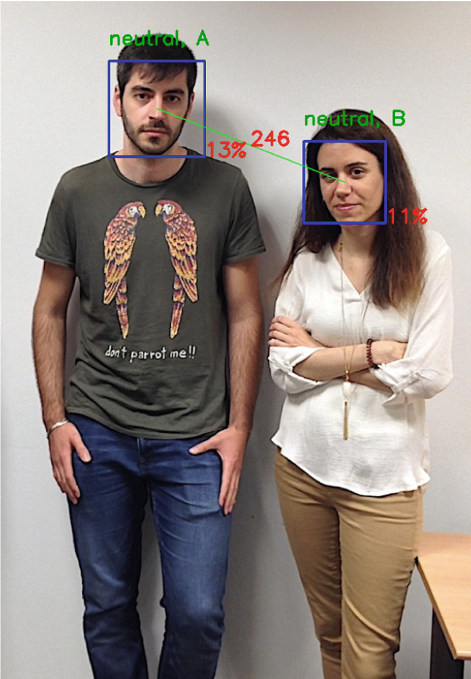 Figure 1: Visual markers used for trust estimation, including identifiers, emotions, and distance metrics.
Experiments and "Asymmetric" Trust
The authors tested their model using 40 photos across 4 users. One of the most fascinating findings is the Asymmetry of Trust. In human psychology, I might trust you more than you trust me. The researchers found that their image-based metric mirrors this reality. For example, if User A is often seen smiling in photos with User B, but User B remains neutral, the trust scores calculated between them will differ, reflecting the nuanced nature of human relationships.
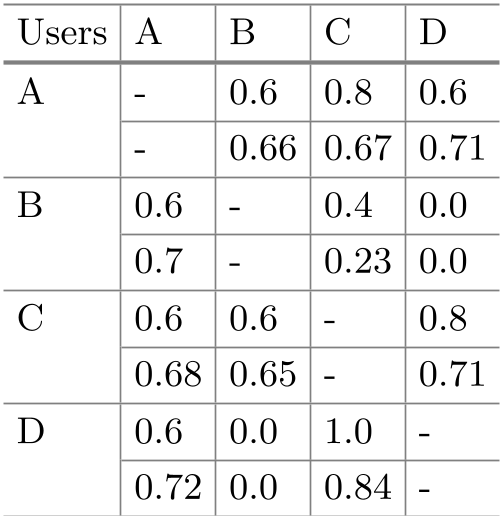 Table 1: Comparison between calculated trust (lower values in cells) and real trust scores (upper values) showing high alignment.
Critical Insight & Future Outlook
While current social trust metrics focus on "Digital Exhaust" (likes, comments), this work argues that Visual Social Signals are equally powerful. However, a potential limitation is the reliance on third-party vision APIs which might have biases in emotion detection or struggle with low-light/crowded images.
As we move toward the "Metaverse" and more immersive social spaces, the ability for a system to "read the room" and protect user privacy without manual intervention will become a cornerstone of digital safety. This tool is a significant step toward a more "socially intelligent" internet.
Summary
- Task: Automatic privacy policy generation for group photos.
- Key Innovation: Using image-based sentiment and proximity as a proxy for social trust.
- Impact: Simplifies the negotiation of privacy between multiple users, moving beyond the binary "Public/Private" settings of today.