
EmotionGCN: Decoding the Spectrum of Feelings via Graph Convolutional Networks
Image Emotion Distribution Learning with Graph Convolutional Networks
The paper introduces EmotionGCN, a framework for Image Emotion Distribution Learning (IEDL) that utilizes Graph Convolutional Networks to model the inherent correlations between different emotion categories. By combining a CNN feature extractor with a GCN-based weight generator, the model achieves state-of-the-art performance on the FlickrLDL and TwitterLDL datasets.
TL;DR
Human emotions are rarely binary or isolated; they exist as a distribution. This paper proposes EmotionGCN, a novel architecture that uses Graph Convolutional Networks (GCN) to model the relationships between different emotional states. By integrating psychological models like Mikels’ wheel into the learning process, the model outperforms traditional CNNs in predicting how people collectively feel about an image.
The "Single Label" Fallacy in Affective Computing
In traditional Computer Vision, an image of a dog is simply "a dog." However, in Affective Image Content Analysis (AICA), an image of a sunset might evoke "Contentment" for one viewer but "Sadness" or "Awe" for another.
The core challenge of Image Emotion Distribution Learning (IEDL) is that existing methods treat labels as independent buckets. They ignore the nuance that "Amusement" and "Excitement" are neighbors in psychological space, while "Anger" and "Contentment" are polar opposites. Failing to model these correlations leads to "noisy" predictions that don't align with human psychology.
Methodology: Bridging Pixels and Psychology
The authors break the problem into two distinct yet collaborative parts:
- Feature Extraction (The "What"): A ResNet-50 backbone processes the raw pixels into a high-dimensional feature vector ().
- Weight Generation (The "Relationship"): Instead of a standard fully connected layer, a GCN takes a graph of emotion correlations () and initial semantic embeddings (). It generates a weight matrix () where weights for similar emotions are mathematically constrained to be related.
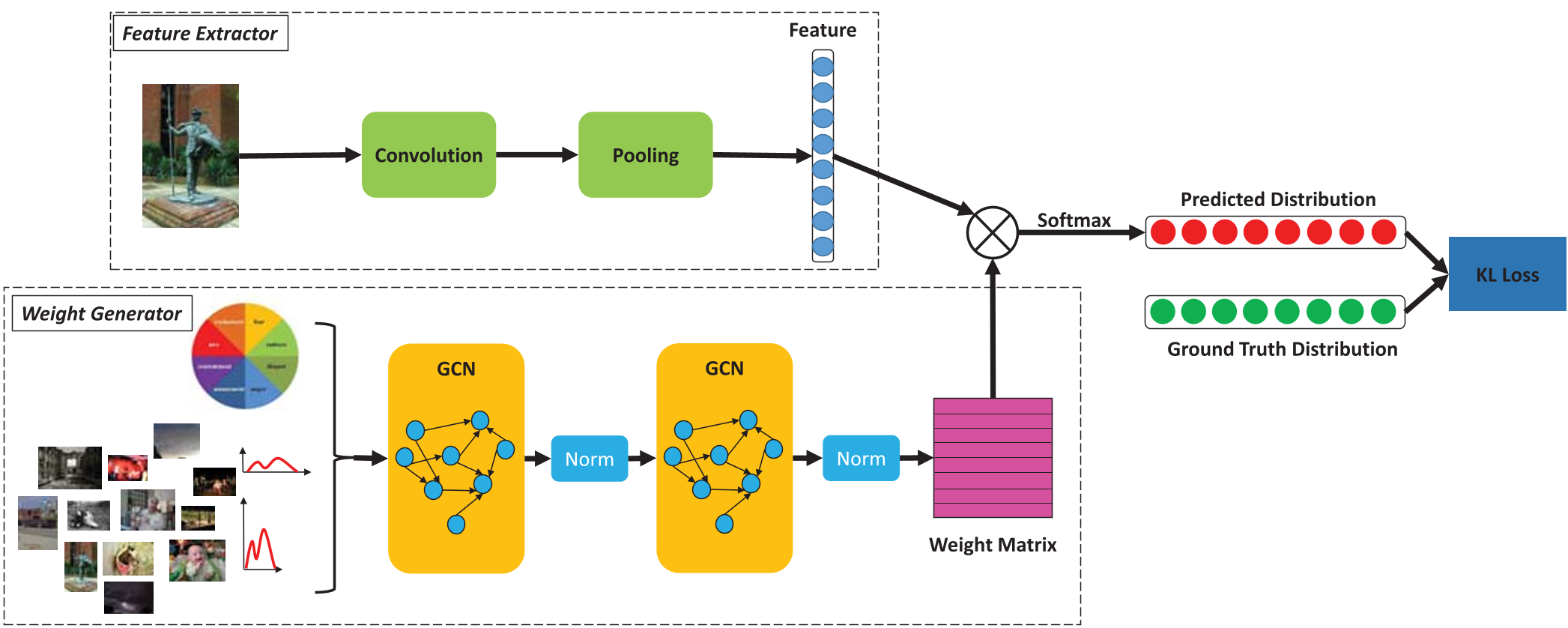 Figure 1: The architecture of EmotionGCN showing the integration of visual features and the graph-based weight generator.
The Secret Sauce: The Correlation Matrix
The GCN relies on an adjacency matrix representing how emotions relate. The paper explores two sources:
- Mikels’ Emotion Wheel: A psychological model where distances between emotions (e.g., Awe vs. Disgust) are calculated based on their positions on a circular manifold.
- Data-Driven Mining: Calculating the conditional probability of co-occurrence directly from the training labels.
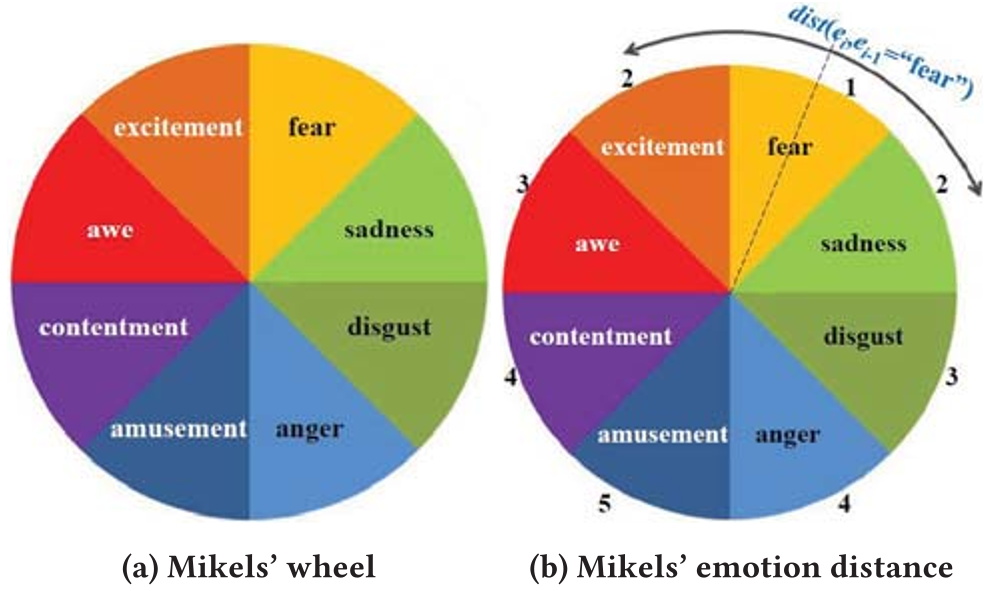 Figure 2: Mikels’ emotion wheel, providing a structural prior for emotion distances.
Experimental Validation
The model was tested on FlickrLDL and TwitterLDL, the two largest benchmarks for this task.
1. Superior Distribution Matching
By using the KL Divergence as the primary loss function, EmotionGCN achieved scores significantly lower than the previous SOTA (Multi-task CNN). Lower KL divergence indicates that the predicted probability "shape" more closely mimics the human-annotated ground truth.
2. Feature Space Alignment
Using t-SNE visualization, the researchers proved that EmotionGCN clusters similar emotions better than standard CNNs. For instance, "Disgust" and "Fear" (highly related) are kept in close proximity in the feature space, whereas they are scattered in models that ignore the graph structure.
 Figure 3: Qualitative results comparing Ground Truth vs. Multi-task CNN vs. EmotionGCN.
Critical Insight & Outlook
The genius of EmotionGCN lies in its Inductive Bias. By forcing the network to "know" about the relationship between "Amusement" and "Joy" through the GCN, the model requires less data to learn complex emotional nuances.
Limitations: The current model uses a static correlation matrix. In the future, "Dynamic Graphs" that adapt based on the image content itself (e.g., an image with a specific layout might trigger unique emotion correlations) could push the accuracy even further.
Final Takeaway: If you are building AI that interacts with humans (social robots, recommendation engines, or mental health tech), viewing emotions as a structured distribution rather than a flat list is no longer optional—it is the new standard.