
EfficientNet Enhanced: Boosting Adult Content Detection with Sharpness and Color Optimization
Image Enhancement Effects On Adult Content Classification
This study investigates the impact of various image enhancement techniques on adult content classification using the EfficientNet-B3 architecture and transfer learning. By evaluating Sharpness Enhancement, Colour Vividness, and Histogram Equalization across a custom 5-class dataset, the authors demonstrate that targeted preprocessing can significantly boost classification performance.
TL;DR
Filtering sensitive digital media at scale is a massive challenge for social platforms. This paper demonstrates that by simply applying Sharpness Enhancement as a preprocessing step, a transfer-learned EfficientNet-B3 model can achieve a 6.2% jump in test accuracy, hitting 93.7% and outperforming established open-source alternatives like NudeNet.
Background & Motivation: Scaling the "Moral Filter"
With over 3.8 billion global social media users, human moderation is no longer feasible. While Deep Learning—specifically Convolutional Neural Networks (CNNs)—has become the standard for image classification, the "Adult Content" domain is uniquely difficult. Lighting, skin tone variations, and the fine line between "artistic/neutral drawings" and "pornographic content" require models to have a high sensitivity to specific edges and color distributions. The authors argue that instead of just building deeper models, we should focus on how we prepare the data to make these features "pop" for the algorithm.
Methodology: The Art of Preprocessing
The researchers built a comprehensive dataset of 27,673 images categorized into five classes: Neutral, Drawings, Racy, Pornographic Drawing, and Pornographic Photo. They then tested three specific image processing "levers":
- Sharpness Enhancement: Using a convolution-based process to subtract a softened version of the image from the original, leaving only the hard edges. This helps the model distinguish object boundaries (like human forms) from complex backgrounds.
- Colour Enhancement: Increasing color vividness to make skin tones more distinctive.
- Histogram Equalization: A standard technique to spread color distribution across a wider scale.
Architectural Backbone
The study utilizes EfficientNet-B3. This model was selected because it balances complexity (10.7M parameters) with inference efficiency, utilizing depth-wise and point-wise convolutions to optimize compute.
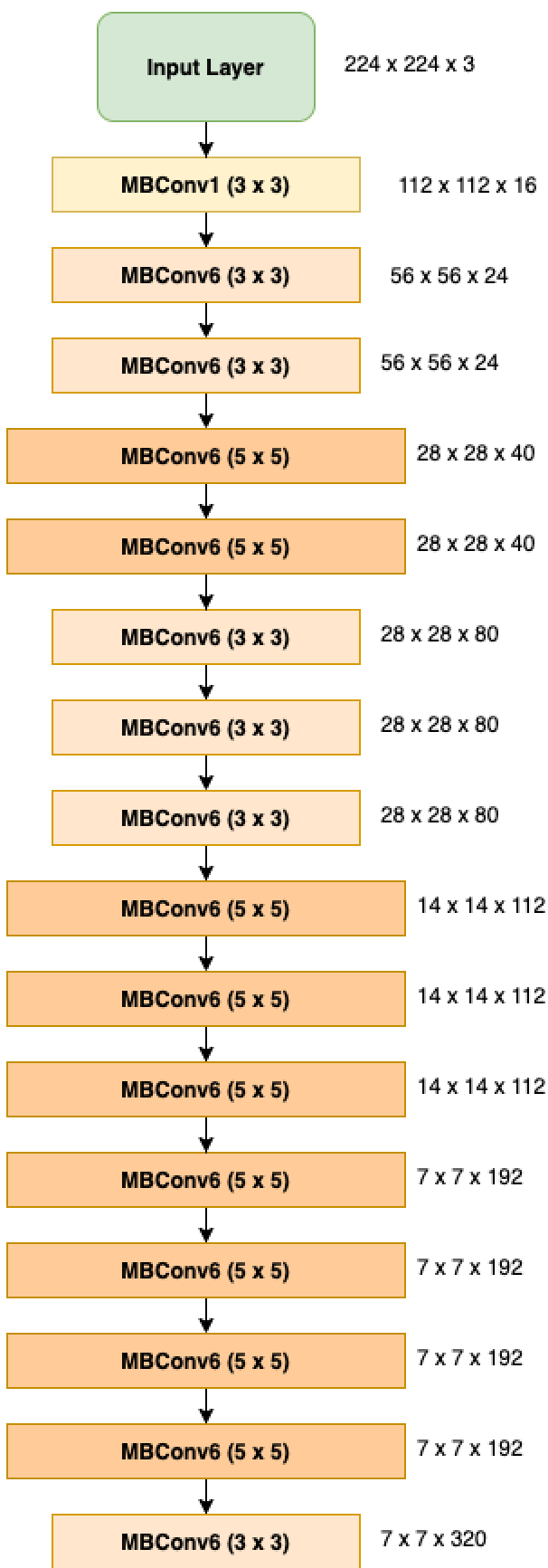 Figure 1: The EfficientNet-B0 base model, which B3 scales up through depth, width, and resolution.
Experimental Results: Sharpness is King
The results from Table II in the paper reveal a surprising truth: More preprocessing isn't always better.
- The Baseline: Standard EfficientNet-B3 achieved 87.5% test accuracy.
- Histogram Equalization: Actually lowered accuracy to 86.0%. By equalizing colors, it smoothed out the very differences the model used to distinguish classes.
- Sharpness Enhancement: The clear winner. Accuracy jumped to 93.7%. Sharpness makes the "region of interest" (ROI) stand out, significantly reducing over-fitting.
- Combined Methods: Interestingly, combining color and sharpness (90.8%) performed worse than sharpness alone, likely due to feature overlap and noise introduction.
| Method | Test Accuracy | Precision | F1 Score (Avg) |
|---|---|---|---|
| Base Model | 0.875 | 0.878 | 0.91 |
| Sharpness Enhancement | 0.937 | 0.943 | 0.95 |
| NudeNet (Public) | - | - | 0.93 |
| Google Cloud Vision | - | - | 0.98 |
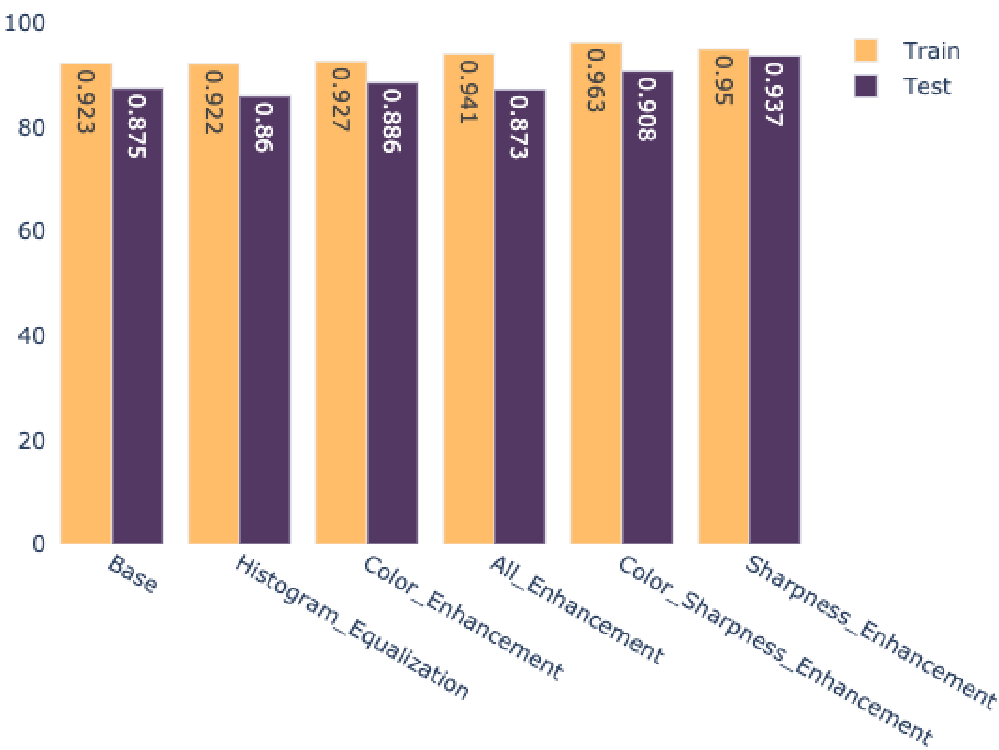 Figure 2: Comparison of training and testing accuracies across different enhancement strategies.
Critical Insight & Conclusion
The study highlights a vital lesson in Technical AI: Data quality via feature engineering often yields higher ROI than model architectural tweaks.
For adult content classification, the physical edges of objects are the most discriminative features. Sharpness enhancement essentially provides the CNN with a "high-pass filter" that highlights these boundaries, leading to better generalization. While the model still lags slightly behind Google's proprietary Cloud Vision API, achieving an F1-score of 0.95 with a significantly smaller, bespoke model is a major win for platforms looking for cost-effective, high-performing self-hosted solutions.
Future Work
The authors suggest moving beyond simple sharpness into Edge Enhancement algorithms and exploring how these preprocessing steps impact video frame analysis, where motion blur often degrades classification accuracy.