
Image Matters: How Alibaba Scales Visual User Modeling to Billions of Behaviors
Image Maers: Visually Modeling User Behaviors Using Advanced Model Server
Alibaba researchers propose the Deep Image CTR Model (DICM) and a distributed training framework called Advanced Model Server (AMS) to incorporate massive user behavior images into Click-Through Rate (CTR) prediction. DICM leverages visual preferences by jointly modeling ad images and hundreds of historical behavior images, achieving significant SOTA improvements on Taobao's advertising system.
TL;DR
In e-commerce, a picture is worth a thousand IDs. Alibaba's DICM (Deep Image CTR Model) moves beyond simple ID-based tracking by directly "looking" at the images of items users have clicked in the past. To make this computationally feasible, they introduced Advanced Model Server (AMS), a distributed training paradigm that processes images where they are stored, reducing data transmission by over 30x.
The Problem: The "Blindness" of ID-based Models
Traditional CTR models see the world through IDs (e.g., item_id: 12345). While effective, IDs have zero semantic meaning. If a user clicks on three different "minimalist white sneakers" with different IDs, an ID-only model might fail to see the visual pattern.
The challenge? A typical Taobao user has hundreds of historical behaviors. Including raw images for every behavior in a training batch would explode storage and bandwidth requirements, making daily model updates—the lifeblood of production systems—impossible.
Methodology: Advanced Model Server (AMS)
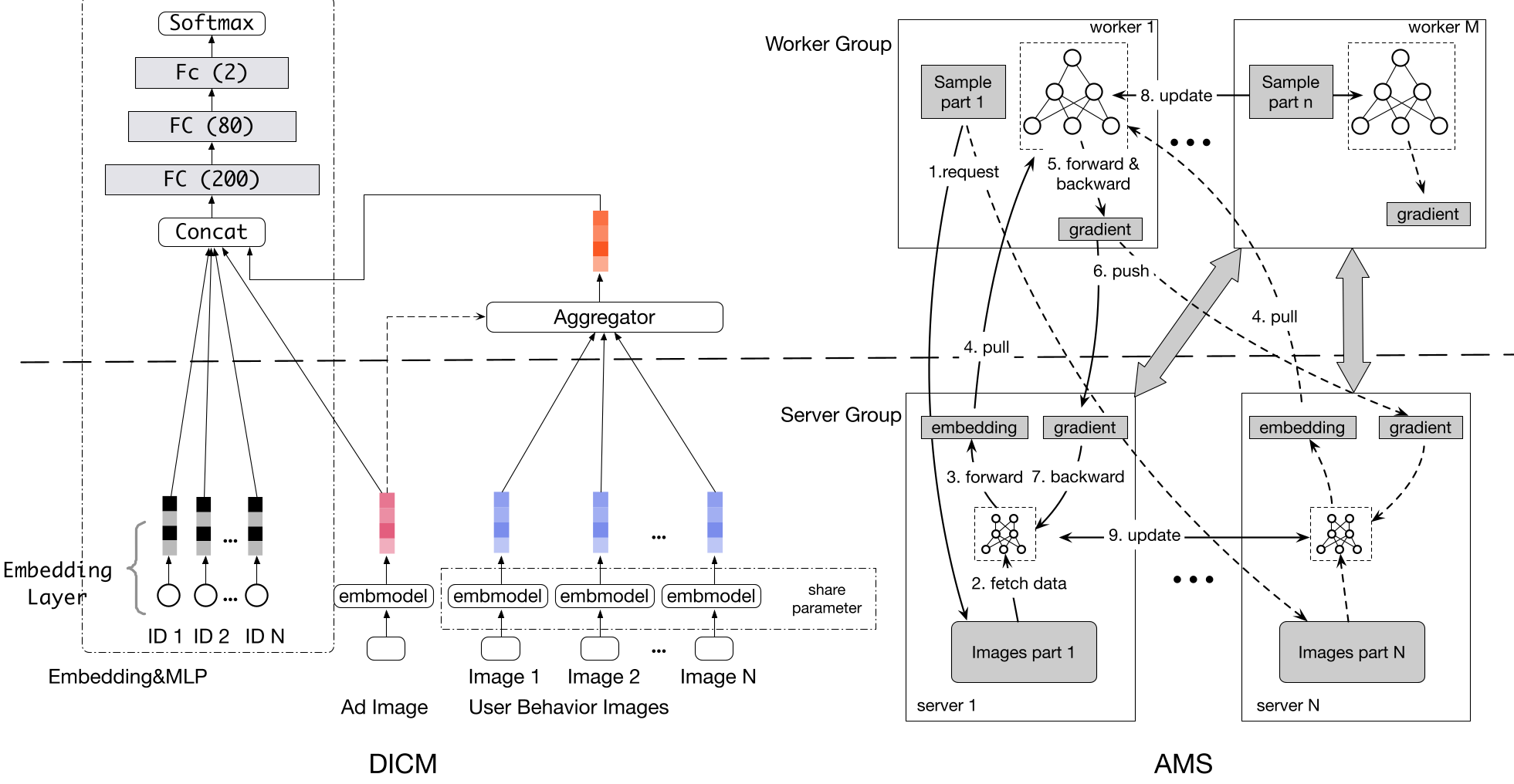
The core innovation isn't just the model, but the infrastructure. Standard Parameter Servers (PS) treat servers as "dumb" key-value stores. Alibaba's AMS turns servers into "smart" nodes that host a shared Image Descriptor Model.
1. The Distributed Workflow
Instead of worker nodes pulling massive raw images, the process is inverted:
- Server-Side Embedding: The server node computes the high-level semantic vector (12-D) from the raw image (4096-D) using a learnable VGG-based sub-model.
- Low-Bandwidth Transmission: Only the 12-D vectors are sent to the workers.
- Unified Learning: Gradients flow back from workers to servers, updating the image descriptor globally.
2. MultiQueryAttentivePooling
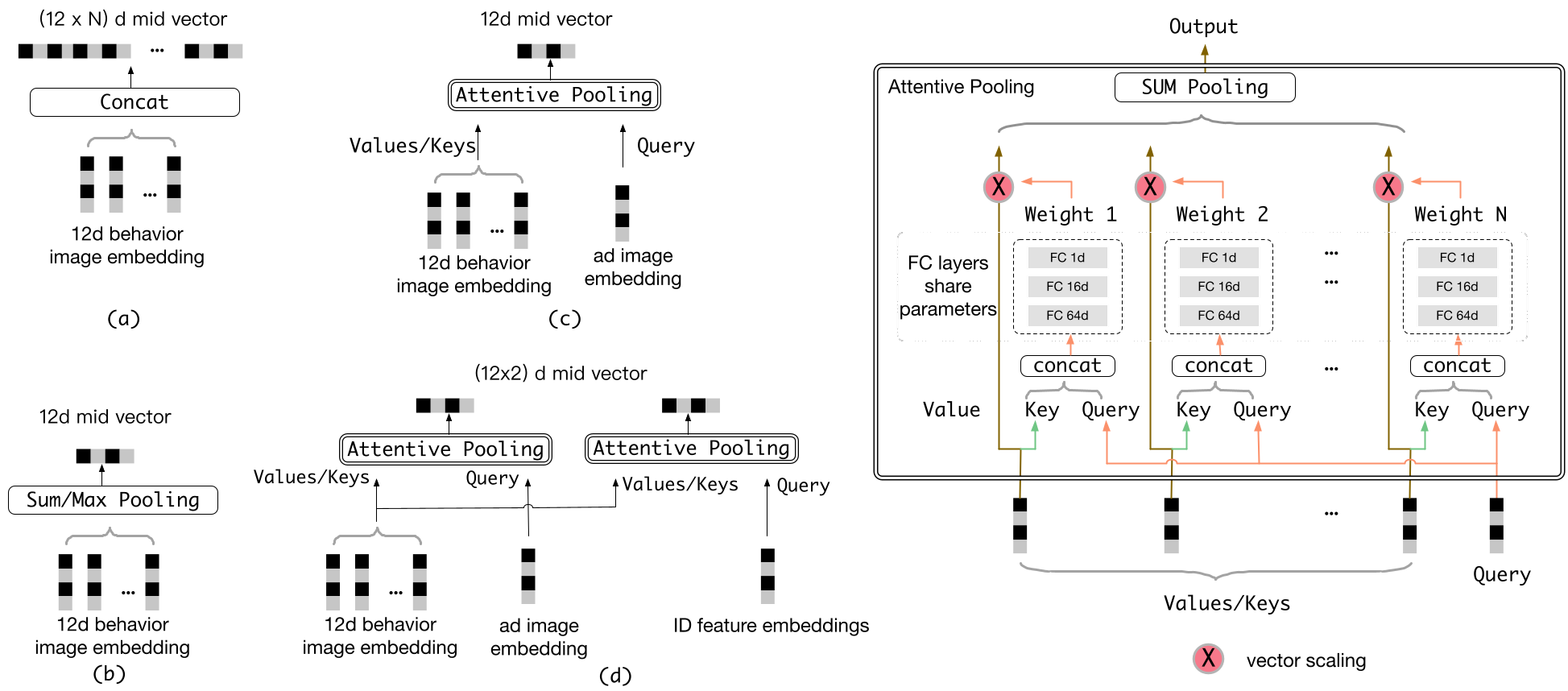
Not all past behaviors are relevant to the current ad. If a user is looking at a "Keyboard" ad, their past clicks on "Keycaps" should matter more than "Apples." The DICM uses two attention queries:
- Visual Query: Using the candidate ad's image.
- ID Query: Using the candidate ad's category/ID. This dual-channel attention captures both explicit category matches and implicit visual styles.
Experiments and Results
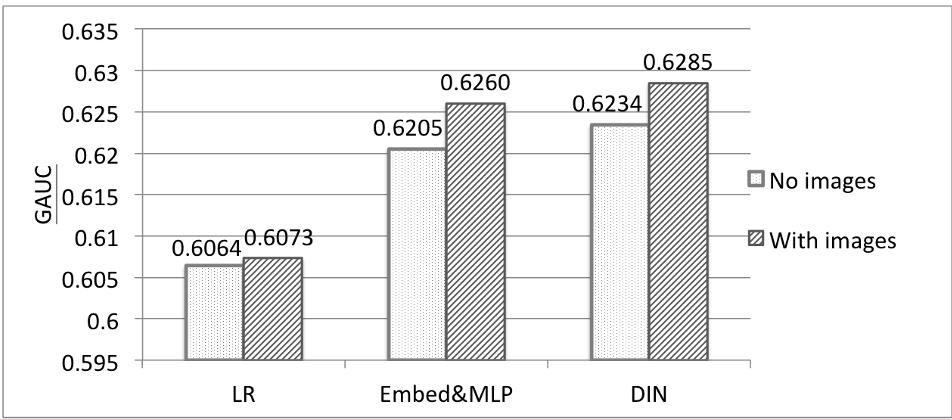
The authors conducted massive ablation studies to prove that "images actually matter."
- Joint Gain: Combining behavior images and ad images provided a gain (+0.0055 AUC) larger than the sum of their individual parts, proving a "synergy" between user visual taste and ad appearance.
- Scalability: Using AMS, they reduced communication per mini-batch from 5.1GB to just 158MB.
- Production Impact: In a 7-day A/B test on Taobao, the model increased revenue (eCPM) by 5.7% and total sales (GPM) by 5.9%.
Deep Insight & Conclusion
The genius of this paper lies in acknowledging that AI architecture must bend to hardware constraints. By moving the "embedding" logic to the server side (AMS), Alibaba unlocked the ability to use multimodal data that was previously "too heavy" for real-time industrial training.
Limitations: The VGG-16 backbone used is somewhat dated by today's Transformer-heavy standards, and the "fixed part vs. trainable part" split is a heuristic trade-off. However, the AMS framework itself is future-proof and can carry any modern Vision Transformer (ViT) or Multimodal LLM as the sub-model.
Takeaway for Engineers: If your data is too big to move to the model, move the model's head to the data.