
Beyond Functions: Unlocking the Power of Service Imagery in Social Networks
Exploring Imagery-driven Service Framework on Social Network Service
This paper introduces an Imagery-driven Service Framework for Social Network Services (SNS), shifting the focus from functional utility to the psychological and emotional "meaning" behind user interactions. By synthesizing service science and design-driven innovation, the study establishes a holistic framework categorized by cognitive, emotional, and social-cultural value dimensions to explain sustainable user participation in virtual communities.
TL;DR
In a world where new social apps rise and fall overnight, what actually keeps a community alive? This paper argues that it isn't just "features"—it's Service Imagery. By shifting from a "Technology-push" to a "Meaning-push" model, the authors provide a framework to understand the emotional and psychological blueprints that drive sustainable user engagement in Social Network Services (SNS).
The "Meaning" Gap in Social Networks
Why do we check Facebook or Instagram even when there's no "new" functional utility? Traditional service science often treats users as rational actors seeking efficiency. However, SNS users are driven by hidden behavioral patterns—curiosity, peeking, and a need for social presence.
The authors identify a critical gap: existing research over-emphasizes the how (technology) and neglects the why (meaning). They suggest that for radical innovation to occur, a service must change what it means to the user, not just what it does.
Methodology: The Imagery-driven Framework
The core of this research is the Imagery-driven Service Framework. It's built on two pillars:
- Information Process Theory: How service signals are encoded into mental representations and stored for future retrieval.
- Perception Theory: How users organize sensory data into a holistic "Gestalt" imagery that is more significant than the sum of its parts.
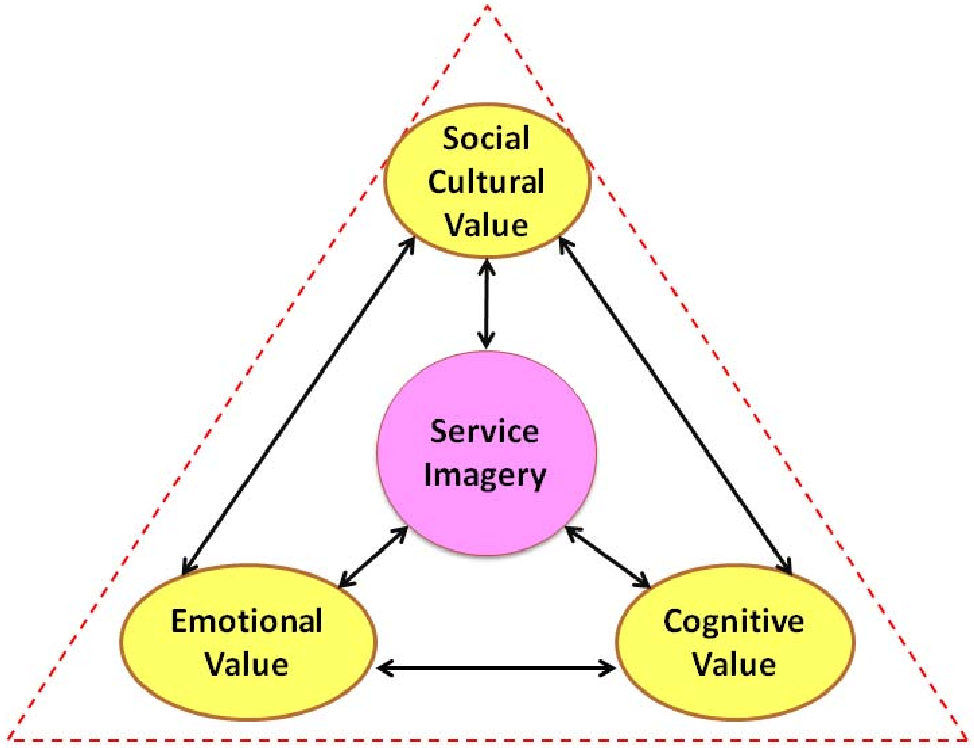 Figure: The conceptual framework connecting Individual Perception with Cognitive, Emotional, and Social-Cultural values.
The researchers distinguish between:
- Service Impression: The vague feeling after a single encounter.
- Service Image: The internal knowledge of service features.
- Service Imagery: The collective figurative description that embodies the spiritual, emotional, and social value of the service.
Insights from the Field: Technology vs. Meaning
Through in-depth interviews, the study maps specific SNS behaviors to their underlying "driven-force."
- Technology-push Factors: Things like "convenience," "accessibility," and "keeping up with trends." While these get users onto the platform, they are often superficial.
- Meaning-push Factors: These are the true "stickiness" drivers. For example, "Empathic experience" (finding consensus with strangers) and "Sense of belonging" (viewing a virtual room as a real living space) are radical innovations in how people perceive their social world.
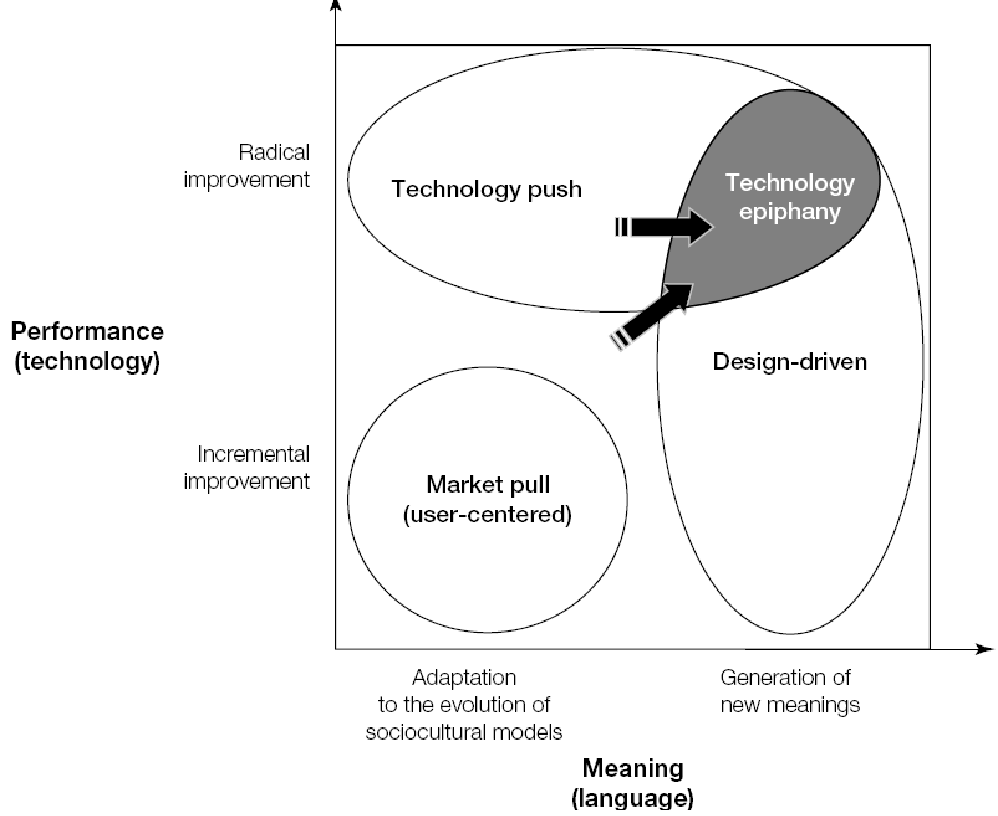 Figure: Adapted from Verganti (2010), showing the intersection of Technology and Meaning.
Key Value Dimensions:
- Cognitive: Information exchange and joint idea sharing.
- Emotional: Support, caring, and happiness sharing (turning virtual "Likes" into psychological satisfaction).
- Social-Cultural: Creating a "cross-regional living space" where group identity transcends physical distance.
Critical Analysis & Future Outlook
This paper serves as a vital reminder that in the age of AI and algorithmic feeds, the human element of meaning remains the ultimate competitive advantage.
Limitations: The study relies on a small qualitative sample (6 participants). While deep, it lacks the quantitative scale to prove these imageries are universal across different cultures or demographics.
Future Work: The framework provides a blueprint for "Service Roadmaps." Future product designers could use this to intentionally design for "Caring" or "Deeping Kinship" rather than just "Daily Active Users" (DAU). As we move into the Metaverse, the ability to shape "Service Imagery" will be the difference between a deserted digital wasteland and a thriving community.
Conclusion
Innovation is not just about faster code; it's about deeper meaning. By understanding Service Imagery, SNS providers can move from being simple tools to becoming essential "living spaces" in the minds of their users.