
Beyond the Echo Chamber: Mapping the 'Imagined Audience' in Digital Politics
From Interaction to Participation: The Role of the Imagined Audience in Social Media Community Detection and an Application to Political Communication on Twitter
The paper introduces the Topical Audience Model (TAM), a novel multiplex network layer that captures "participation" dynamics rather than just "interaction" (retweets/replies). By mapping users who share hashtags into a flattened Jaccard-weighted graph, it uncovers cross-ideological communities that traditional interaction-based methods miss.
TL;DR
Most social media research focuses on who you talk to (mentions) or who you agree with (retweets). This paper argues we are missing a vital dimension: who you participate with. By introducing the Topical Audience Model (TAM), the authors demonstrate that using hashtags creates a shared "imagined audience" that often bridges political divides, revealing a more nuanced, less polarized public sphere than previously thought.
The "Interaction" Bias in Community Detection
In network science, we usually build graphs based on explicit signals—API-accessible actions like a "Like" or a "@mention." While these are easy to measure, they suffer from interaction bias. They primarily capture high-engagement behaviors which, especially in politics, tend to be highly polarized.
The authors argue that there is an "invisible audience." When a politician tweets with #dkpol (Danish politics), they aren't just labeling a topic; they are entering a room. Everyone else in that room, regardless of whether they reply to each other, is part of a shared participatory event. Ignoring this "participation" data means our community detection algorithms are essentially blind to the actual public debate.
Methodology: Building the Topical Audience Model (TAM)
The core innovation is the construction of a new layer for multiplex networks. Here is how it works:
- Topical Cliques: For every hashtag, the authors create a clique (a fully connected subgraph) where every user who used that hashtag is connected to every other user. This represents the "broadcast" nature of the hashtag channel.
- Weighted Flattening: Since a user might use many hashtags, these layers are flattened into a single weighted graph. The strength of a connection between two users and is calculated using the Jaccard coefficient:
This ensures that the weight reflects the proportional similarity of their topical interests, rather than just raw volume.
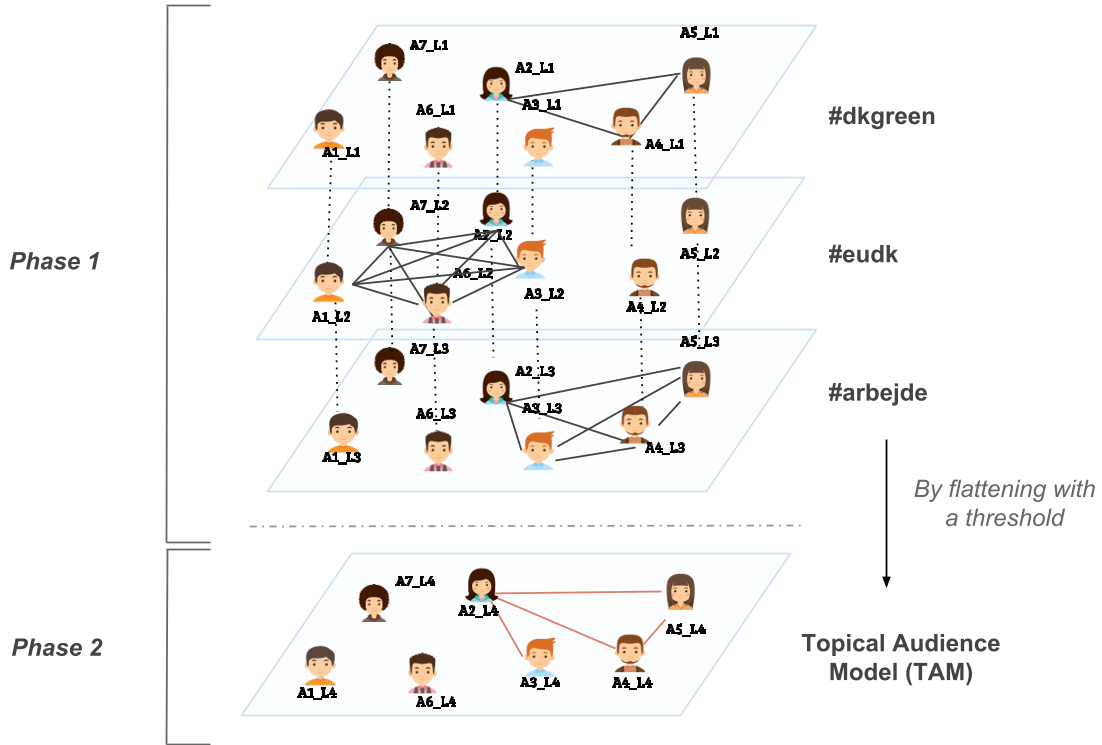 Fig 1: A multiplex structure where different layers represent different modes of interaction/participation.
Case Study: The 2015 Danish Election
The researchers tested this on a dataset of Danish politicians. They compared a "Retweet-only" network against a multiplex network that included the TAM layer.
Key Findings:
- Polarization is Selective: If you only look at Retweets, the "Red Block" and "Blue Block" coalitions are almost entirely separate.
- Participation is Pluralistic: When the TAM layer is added, the algorithm (Generalized Louvain) finds communities that are "coalition-mixed."
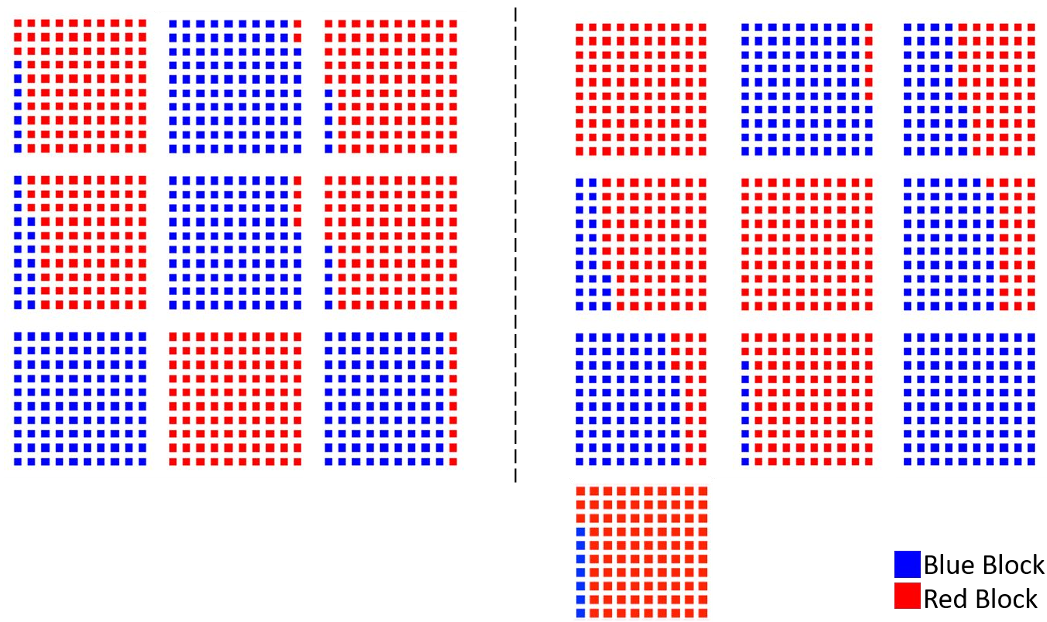 Fig 5: (a) shows the polarized retweet network; (b) shows how the TAM layer merges blocks into shared communities based on participation.
Critical Insight: The "Hidden" Public Sphere
Why does this matter? For years, the narrative has been that social media is a series of fragmented echo chambers. This paper provides a quantitative counter-narrative. It suggests that while we might not endorse each other (retweet), we are frequently debating in the same space.
The fact that NMI (Normalized Mutual Information) scores dropped when adding the TAM layer is actually a success—it proves that political party affiliation is not the only thing driving community formation on Twitter. Shared interest in specific policy topics (taxation, healthcare, immigration) brings opposing politicians into the same "imagined audience."
Limitations and Future Work
The model currently assumes topical stability. In reality, political topics are highly temporal—a scandal today is replaced by a policy debate tomorrow. The authors suggest that future iterations should incorporate temporal multiplexing (time-stamped layers) to see how these participation communities evolve over the course of a campaign.
Conclusion
This work moves us from "Interaction" to "Participation." By mathematically modeling the "imagined audience" through hashtags, we can finally begin to map the digital public sphere as it truly exists: not just as a set of isolated islands, but as a complex, overlapping landscape of shared attention and debate.