
Turning Your Phone into a Periscope: Real-Time NLOS Imaging with Consumer LiDAR
Imaging Hidden Objects with Consumer LiDAR via Motion Induced Sampling
This paper introduces a system for Non-Line-of-Sight (NLOS) imaging using smartphone-grade, consumer LiDAR. It proposes a Motion-Induced Aperture Sampling (MAS) model and a multi-frame fusion strategy to enable 3D reconstruction, tracking, and camera localization of hidden objects using low-cost hardware (< $100).
TL;DR
Researchers from MIT and Dartmouth have broken the requirement for $10,000+ lab equipment to see around corners. By leveraging the Motion-Induced Aperture Sampling (MAS) model and Particle Filtering, they demonstrate that the low-cost LiDAR found in smartphones can perform non-line-of-sight (NLOS) 3D reconstruction, multi-object tracking, and even camera localization by treating walls as "virtual mirrors."
The "Invisible" Challenge
NLOS imaging—the ability to see objects hidden behind a wall—usually relies on high-end Single-Photon Avalanche Diodes (SPADs) and ultrafast lasers. Consumer LiDARs (like those in an iPhone or a robot vacuum) are significantly hobbled by:
- Low SNR: Eye-safety regulations limit laser power.
- Poor Resolution: Only a few hundred "pixels" compared to megapixels in lab setups.
- Motion Blur: Handheld movement and object movement usually ruin the delicate time-of-flight signals.
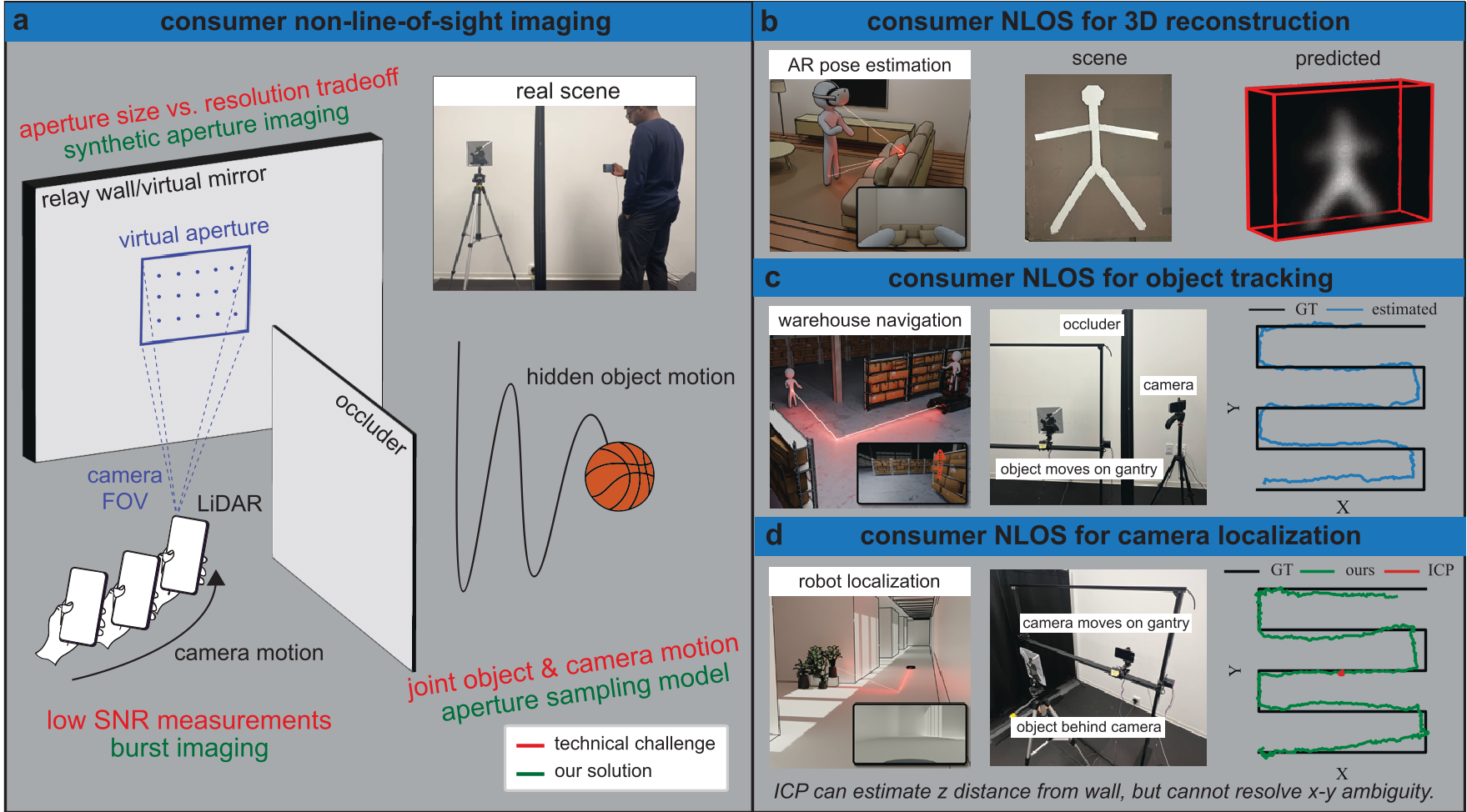
Methodology: High-End Math for Low-End Hardware
The core innovation is the Motion-Induced Aperture Sampling (MAS) model. It uses the Light-Cone Transform (LCT)—a mathematical framework that treats time-of-flight measurements as a 3D convolution.
1. The Physics Intuition
The authors realized that as a camera moves, it creates a "Synthetic Aperture." Instead of one static, blurry view, the moving camera samples the wall at different points. By aligning these "looks" in the LCT-transformed space, they can improve signal quality (SNR) and resolution simultaneously.
2. Particle Filtering for Tracking
Since consumer signals are too noisy for simple 3D back-projection, the team used a Particle Filter.
- Propagation: Guess where the hidden object moved.
- Evaluation: Compare the "rendered" expected signal (from the model) to the actual noisy sensor data.
- Resampling: Keep the guesses that match the data.
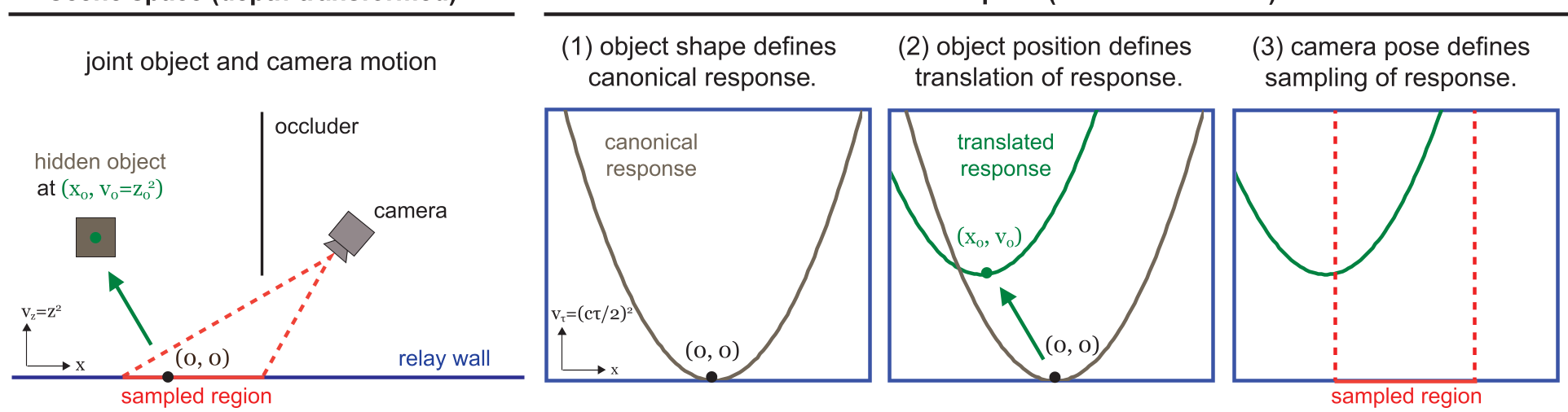
Breaking Visual Dead Ends: Camera Localization
One of the most impressive applications is Camera Localization. Standard visual odometry (like ARKit) fails when looking at a blank white wall because there are no features to track. However, this system "looks" at the hidden objects around the corner and uses them as fixed anchors to determine the camera's position.
Experimental Results
The researchers tested their theory using the ST VL53L8CX (a ~$10 sensor).
- Tracking Accuracy: Achieved a mean error of 4.7 cm.
- Real-time Performance: The particle filter enables online processing at 30Hz, making it viable for robotics.
- Versatility: While optimized for retroreflective objects, it surprisingly works for diffuse (regular) surfaces like human hands and mannequins, albeit with lower SNR.
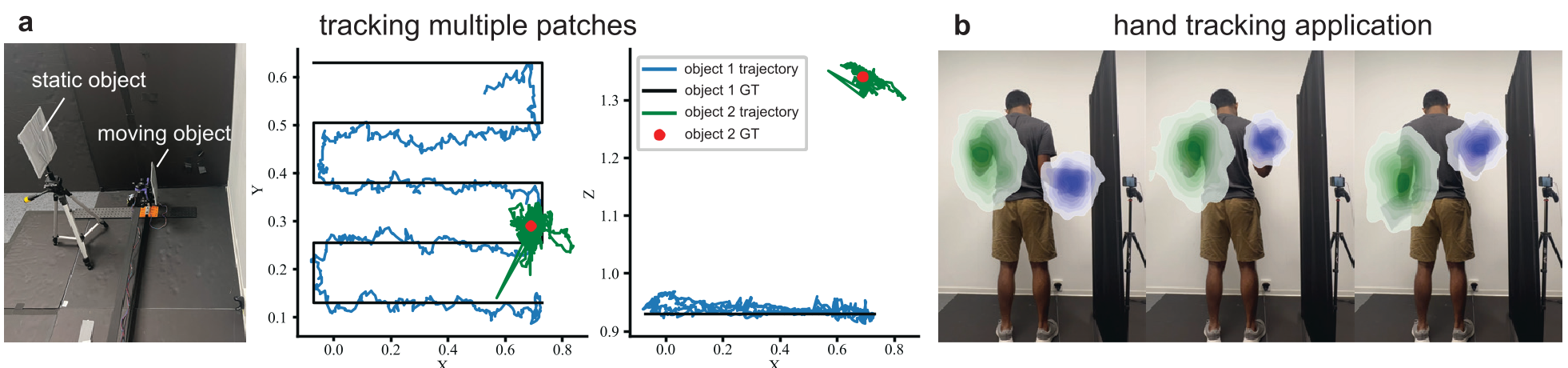
Professional Insight & Conclusion
This paper represents a shift in philosophy. Instead of asking "how do we build better sensors?", it asks "how do we use motion as a prior to overcome bad sensors?".
Takeaway: By combining Synthetic Aperture Physics with Bayesian Filtering, the authors have democratized NLOS. We are moving toward a future where a Roomba can "see" a person coming around a corner before they are visible, or an AR headset can track your body pose even when your hands are slightly out of the camera's view.
Limitations: The model currently assumes rigid-body translation. Future work will need to tackle complex rotations and non-rigid deformations (like a walking person) using deep learning to learn more robust score functions.