
Consumer LiDAR: Turning Every Smartphone into a Through-Wall Sensor
Imaging Hidden Objects with Consumer LiDAR via Motion Induced Sampling
The paper introduces a framework for Non-Line-of-Sight (NLOS) imaging using smartphone-grade LiDAR by treating motion as a sampling mechanism. By proposing the Motion-Induced Aperture Sampling (MAS) model and a particle filtering strategy, the authors achieve real-time 3D reconstruction, multi-object tracking, and camera localization on low-cost consumer hardware.
TL;DR
Researchers from MIT and Dartmouth have unlocked Non-Line-of-Sight (NLOS) imaging—the ability to see around corners—for everyday consumer devices. By treating the natural motion of a handheld smartphone as a "synthetic aperture," their new Motion-Induced Aperture Sampling (MAS) model allows cheap, low-resolution LiDAR sensors to reconstruct hidden 3D shapes and track moving objects in real-time.
Status: A major step toward "plug-and-play" NLOS, moving away from 100 off-the-shelf sensors.
The Bottleneck: Why Your Phone Can't See Around Corners (Yet)
NLOS imaging works by using a visible surface (like a wall) as a "virtual mirror." We fire a laser at the wall, it bounces to a hidden object, returns to the wall, and finally hits our sensor.
While research-grade systems use ultra-expensive hardware to detect these faint "third-bounce" photons, consumer LiDAR (like those in the iPhone or AR headsets) faces three massive hurdles:
- Low SNR: Power is limited for eye safety, making signals incredibly faint.
- Low Resolution: Consumer sensors often have only ~100 pixels, compared to megapixels in standard cameras.
- Motion Blur: Real-world use involves shaky hands and moving targets, which traditional NLOS algorithms (designed for static tripods) cannot handle.
Methodology: The Motion-Induced Aperture Sampling (MAS) Model
The breakthrough lies in changing how we view motion. Instead of seeing motion as a source of "blur" to be avoided, the authors treat it as a sampling advantage.
1. The Physics: Light-Cone Transform (LCT)
The authors utilize the Light-Cone Transform, a mathematical framework that reshapes the complex time-of-flight data into a 3D volume where the relationship between the object and the measurement becomes a simple convolution.
2. The MAS Model
The MAS model (Eq. 3 in the paper) decomposes the signal into three parts:
- Object Shape: Represented by a time-independent "Canonical STIR."
- Object Position: Handled as a 3D translation.
- Camera Pose: Acts as a spatial sampling function on the virtual mirror.
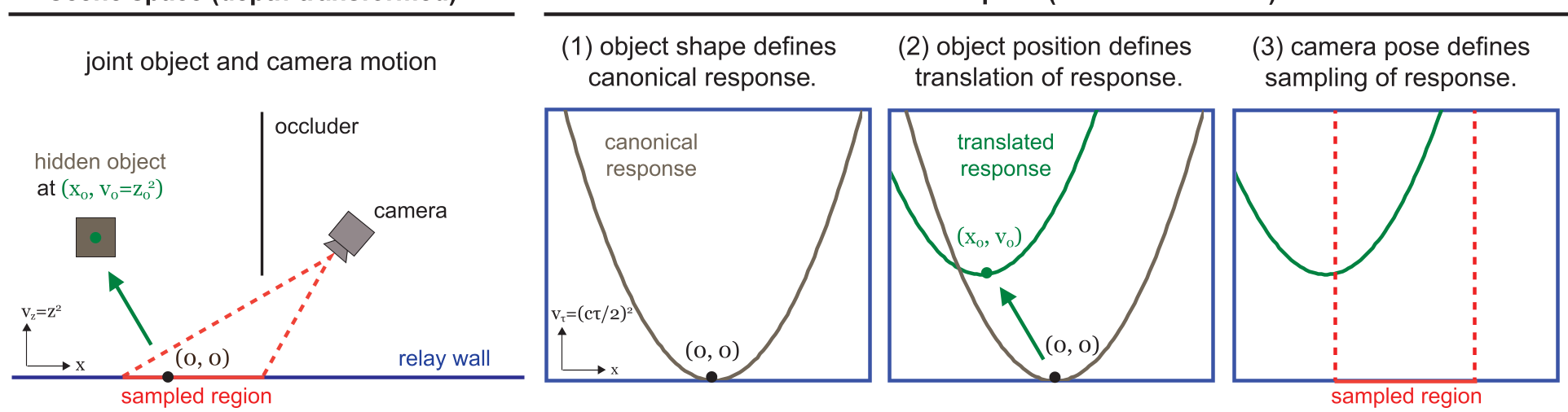 Figure: The MAS model unifies object geometry and joint camera-object motion into a single rendering equation.
3. Solving the Inverse Problem: Particle Filtering
To make this work in real-time on a mobile processor, they avoid heavy iterative solvers. Instead, they use a Particle Filter. By maintaining a "cloud" of 1,000 possible object positions (particles) and scoring them against the actual LiDAR data, the system can "track" objects even when individual frames are too noisy to see anything clearly.
Experimental Results: High-Performance NLOS on a Budget
The team tested their approach using a smartphone-grade LiDAR (ST VL53L8CX).
- 3D Tracking: They achieved an average tracking error of just 4.7 cm.
- Multi-Object Sensing: The system can simultaneously track multiple hidden targets, such as a person's left and right hands around a corner.
- Camera Localization: In environments where traditional visual SLAM fails (like a blank white hallway), the system used hidden objects as "landmarks" to determine the camera's position.
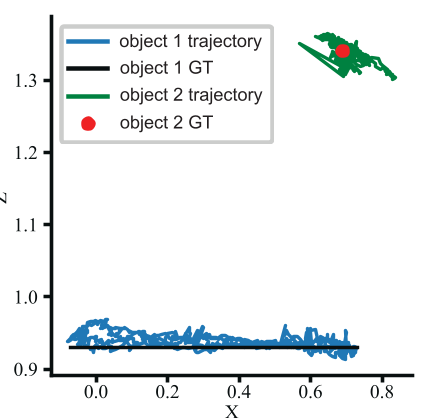 Figure: Real-time tracking of multiple objects and hand gestures using only indirect light reflections.
Deep Insights: The Future of "Opportunistic Mapping"
The most profound insight here is the concept of Multi-Bounce Light as Opportunistic Blur. In line-of-sight scenarios, sparse LiDAR pixels cause "aliasing" (missing detail). However, the "bounce" off a wall naturally blurs the signal before it reaches the sensor. This blur acts as an optical anti-aliasing filter, actually making it easier to recover the rough shape of an object with very few pixels.
Limitations
- Retroreflectivity: While it works on diffuse objects, the best results still require retroreflective materials (like safety vests).
- Handcrafted Scores: The current "score function" for the particle filter is manual. Future iterations could use Deep Learning to recognize complex material properties.
Conclusion
This research marks the transition of NLOS from a "physics curiosity" to a "computational photography feature." By leveraging the sensor's own movement, we can now extract rich information from the shadows. For warehouse robots navigating blind corners or AR glasses tracking a user's body, the "unseen" world is finally coming into focus.
Takeaway: Motion is not the enemy of clear imaging; it is the sensor’s best tool for super-resolution.