
Non-Line-of-Sight Imaging Goes Mobile: Turning Your Smartphone into a Periscope
Imaging Hidden Objects with Consumer LiDAR via Motion Induced Sampling
This paper introduces a multi-frame fusion strategy for non-line-of-sight (NLOS) imaging using consumer-grade LiDAR (e.g., smartphones). By proposing the Motion-induced Aperture Sampling (MAS) model and utilizing particle filtering, the authors achieve real-time 3D reconstruction, multi-object tracking, and camera localization using hidden objects as landmarks.
1. Executive Summary
TL;DR: MIT and Dartmouth researchers have unlocked the ability to "see around corners" using the cheap, low-resolution LiDAR found in modern smartphones. By moving the sensor and using a clever mathematical model called Motion-induced Aperture Sampling (MAS), they fuse noisy, low-quality frames into clear 3D reconstructions and real-time tracking of hidden objects.
Background Positioning: While NLOS imaging has traditionally been a "lab-only" feat requiring 100 consumer domain**. It moves away from "one-shot" reconstruction toward Temporal Multi-frame Fusion, transforming NLOS from a specialized physics experiment into a robust computer vision task.
2. Problem & Motivation: The "Consumer-Grade" Bottleneck
Existing NLOS methods assume "idealized" conditions: stationary high-power lasers and picosecond-accurate detectors. Consumer LiDAR (like those in iPhones or STMicroelectronics sensors) breaks these assumptions in three ways:
- Low SNR: Power is limited for eye safety; exposure is short to avoid blur.
- Resolution Trade-off: High-speed chips can't handle dense spatial sampling at low power.
- Dynamic Chaos: In the real world, both the camera (handheld) and the hidden object are moving.
The authors' insight? Motion isn't a bug; it's a feature. Just as Burst Photography improves low-light photos and Synthetic Aperture Radar (SAR) improves resolution through motion, the movement of a handheld LiDAR can be used to "synthesize" a much larger and more sensitive virtual lens.
3. Methodology: Reimagining the Light-Cone Transform (LCT)
The core of the paper is the MAS Model. It builds on the existing Light-Cone Transform, which treats NLOS measurements as a 3D convolution between the object's shape and a "Light Cone" kernel.
The Mathematical Intuition
In the LCT-transformed space, a shift in the object's position translates directly to a shift in the measured signal. The authors decompose the problem into:
- Canonical STIR (): The "signature" of the object shape at a reference position.
- Object Shift (): The time-varying 3D position.
- Camera Pose (): The sampling coordinates on the wall.
By treating the object shape as a known prior (e.g., tracking a person who just walked behind a wall), the problem reduces from a complex 3D reconstruction into an efficient Particle Filtering task.
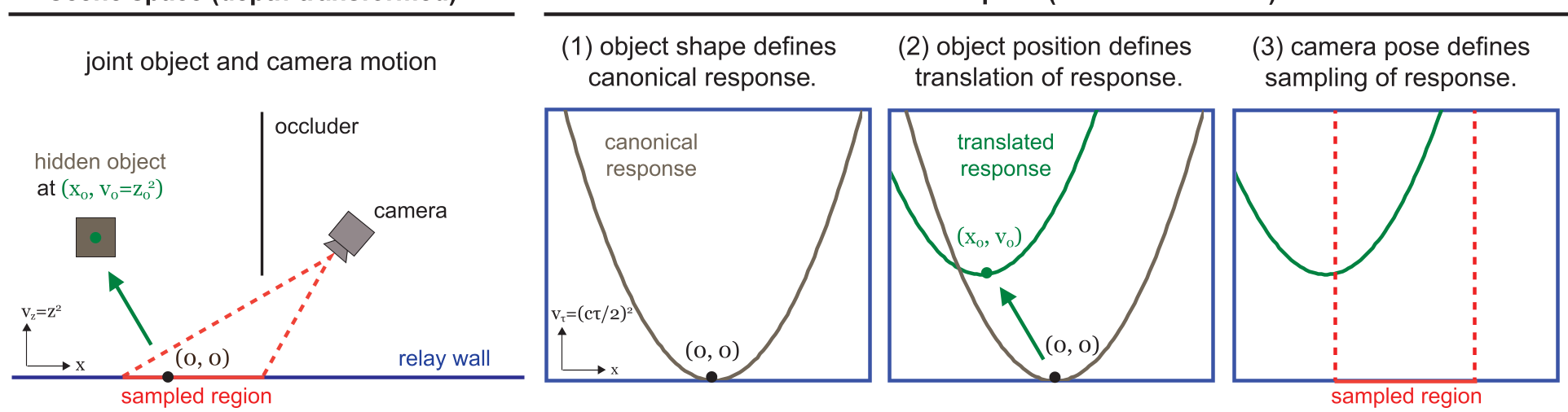 Figure: The MAS model unifies object shape, motion, and camera pose into a single measurement framework.
4. Real-Time Execution: Particle Filtering
Instead of solving a massive inverse problem for every frame, the authors use a Particle Filter.
- Propagation: Predict where the object (or camera) might be based on previous movement.
- Evaluation: Compare the "rendered" guess (via the MAS model) to the actual noisy raw sensor data.
- Resampling: Keep the guesses that match the data and discard the rest.
This loop allows for real-time 30Hz performance on mobile hardware, supporting multiple objects and identifying their 3D trajectories with surprising accuracy.
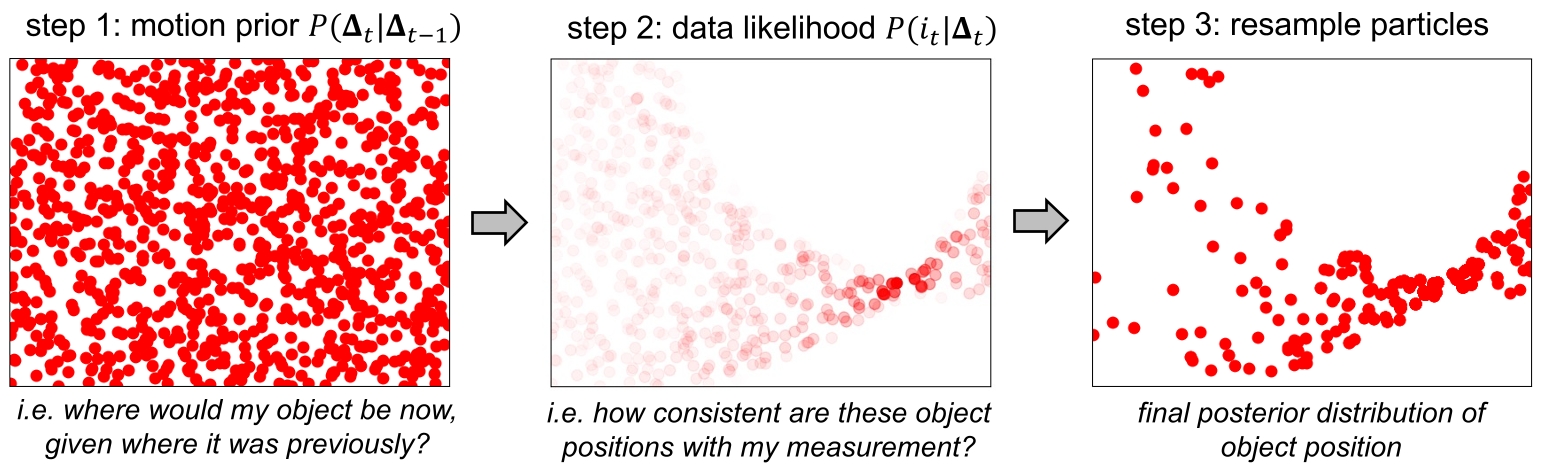 Figure: The particle filter allows the system to remain robust even when 90% of the signal is noise.
5. Experiments: Tracking and Localizing
The authors tested the system on three main fronts:
- 3D Reconstruction: Rebuilding the shape of hidden mannequins using handheld scanning.
- Tracking: Tracking a hidden person's hands or moving objects around corners.
- Camera Localization: Using a hidden object as a "land-mark" to navigate. This is a breakthrough for robotics moving through featureless hallways—if the floor has no texture, the robot can "look" around the corner at a hidden object to find its way.
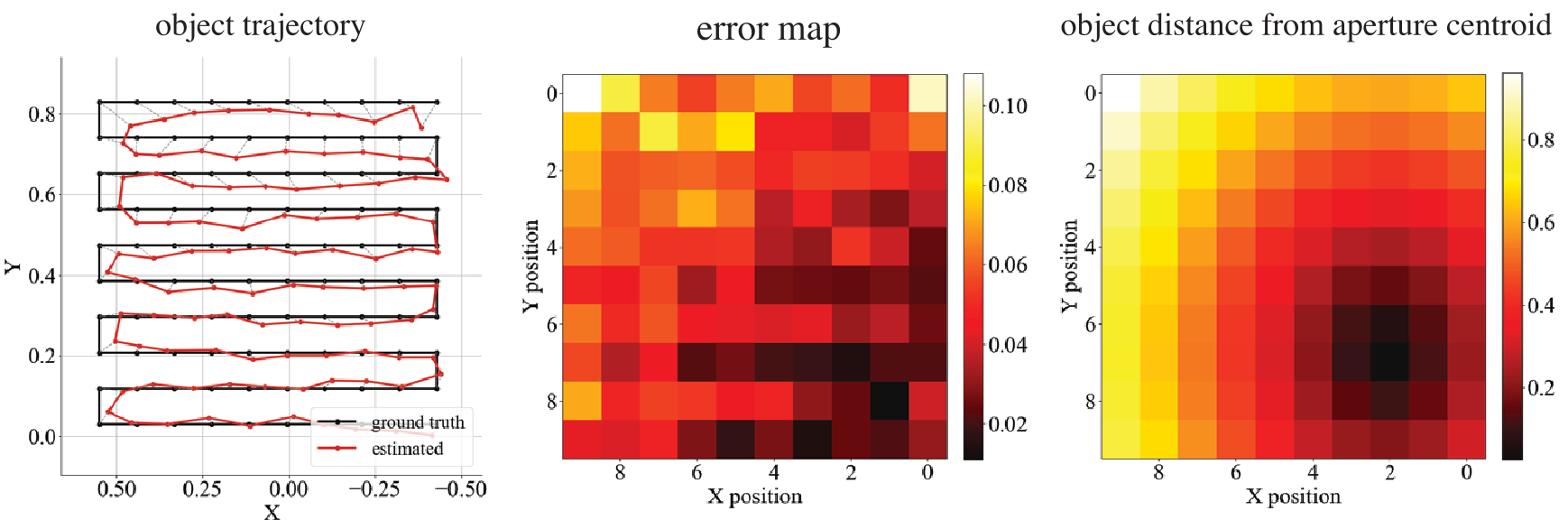 Figure: Comparison showing that error increases as the object moves further from the "virtual aperture" on the wall, but remains within a few centimeters.
6. Critical Analysis & Conclusion
Takeaway: This is a seminal step for "Plug-and-Play" NLOS. By moving the complexity from the hardware to the algorithm (multi-frame fusion), the authors have proven that NLOS sensing is a software-solvable problem.
Limitations:
- Retroreflectivity: Much of the high-accuracy data relies on retroreflective materials (like high-vis tape). While it works on diffuse surfaces (like skin/clothing), the SNR drops significantly.
- Shape Priors: For efficient tracking, you need to know what you are looking for. Solving for shape, motion, and pose simultaneously (NLOS-SLAM) remains the "holy grail."
Future Outlook: We are likely to see these algorithms integrated into AR headsets (to track the user's body parts that are out of direct sight) and warehouse robots (to prevent collisions before they happen).
Note: Imagery and formulas are based on the original publication "Imaging Hidden Objects with Consumer LiDAR via Motion Induced Sampling" (Somasundaram et al., 2024).