
Seeing the Unseen: Democratizing NLOS Imaging with Consumer LiDAR
Imaging Hidden Objects with Consumer LiDAR via Motion Induced Sampling
The paper introduces a framework for Non-Line-of-Sight (NLOS) imaging using smartphone-grade, consumer LiDAR sensors. By proposing a multi-frame fusion strategy and the Motion-Induced Aperture Sampling (MAS) model, the authors achieve 3D reconstruction, tracking, and camera localization of hidden objects, transforming low-cost devices into "plug-and-play" NLOS systems.
TL;DR
Researchers have unlocked the ability to see around corners using the same LiDAR sensors found in modern smartphones. By moving away from "single-shot" captures and embracing multi-frame fusion via a new Motion-Induced Aperture Sampling (MAS) model, they can track moving objects and localize cameras using reflections from hidden walls—all in real-time on hardware costing less than $100.
Background: The "Lab-to-Pocket" Challenge
Non-Line-of-Sight (NLOS) imaging has long been the "holy grail" of computational photography, involving the capture of light that has bounced three times (Laser Wall Object Wall Sensor). Until now, this required bulky femtosecond lasers and stationary, expensive SPAD (Single-Photon Avalanche Diode) detectors.
The transition to consumer hardware (like the iPhone's LiDAR) faces three massive hurdles:
- Low SNR: Eye-safety regulations limit laser power.
- Sparse Resolution: Consumer chips often have only ~100 detector pixels.
- Motion Paradox: Handheld use introduces camera shake and object movement, which typically destroys the delicate timing information needed for NLOS.
The Core Insight: Motion-Induced Aperture Sampling (MAS)
The researchers realized that motion is not a bug; it’s a feature. Inspired by Synthetic Aperture Radar (SAR), they use the movement of the handheld camera to "sweep" the wall, effectively creating a much larger virtual lens (aperture).
The MAS Model
The technical heart of the paper is the MAS model. It utilizes the Light-Cone Transform (LCT), which simplifies the complex math of light travel into a 3D convolution. Under this model, an object’s motion in the real world translates directly to a predictable shift in the measurement space.
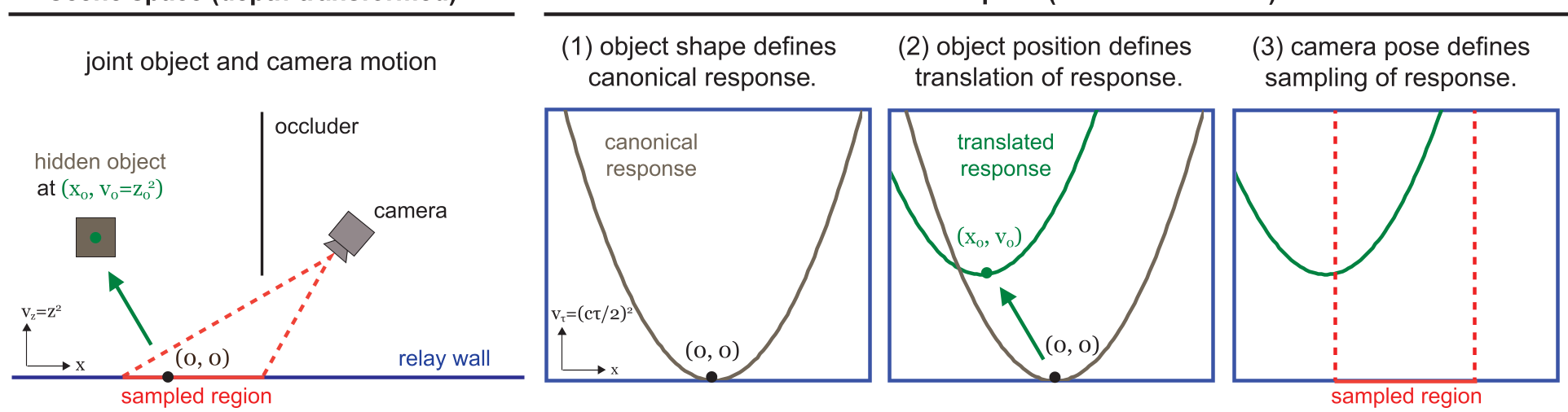 Figure: The MAS model decouples the time-independent object shape from time-dependent object motion and camera pose.
Methodology: Particle Filtering for Real-Time Inference
Solving for object shape, object position, and camera pose simultaneously is a nightmare of non-convex optimization. To make it work at 30 FPS, the authors use a Particle Filter.
- Propagation: Guess where the hidden object moved based on a motion prior.
- Evaluation: Render a "fake" measurement using the MAS model for each guess and compare it to the actual LiDAR data.
- Resampling: Keep the guesses that match the data and discard the rest.
This Bayesian approach is brilliant because it naturally models uncertainty. If an object is far away, the particles spread out, showing a larger region of ambiguity.
Experimental Breakthroughs
The authors demonstrated three primary use cases that were previously impossible on mobile hardware:
- Hidden Object Tracking: Tracking a person's hand or a moving object around a corner with centimeter-level accuracy.
- NLOS Camera Localization: Navigating in a room with featureless white walls by "looking" at a hidden object around the corner to determine the camera's position.
- 3D Reconstruction: Using handheld motion to scan and reveal the shape of a hidden mannequin.
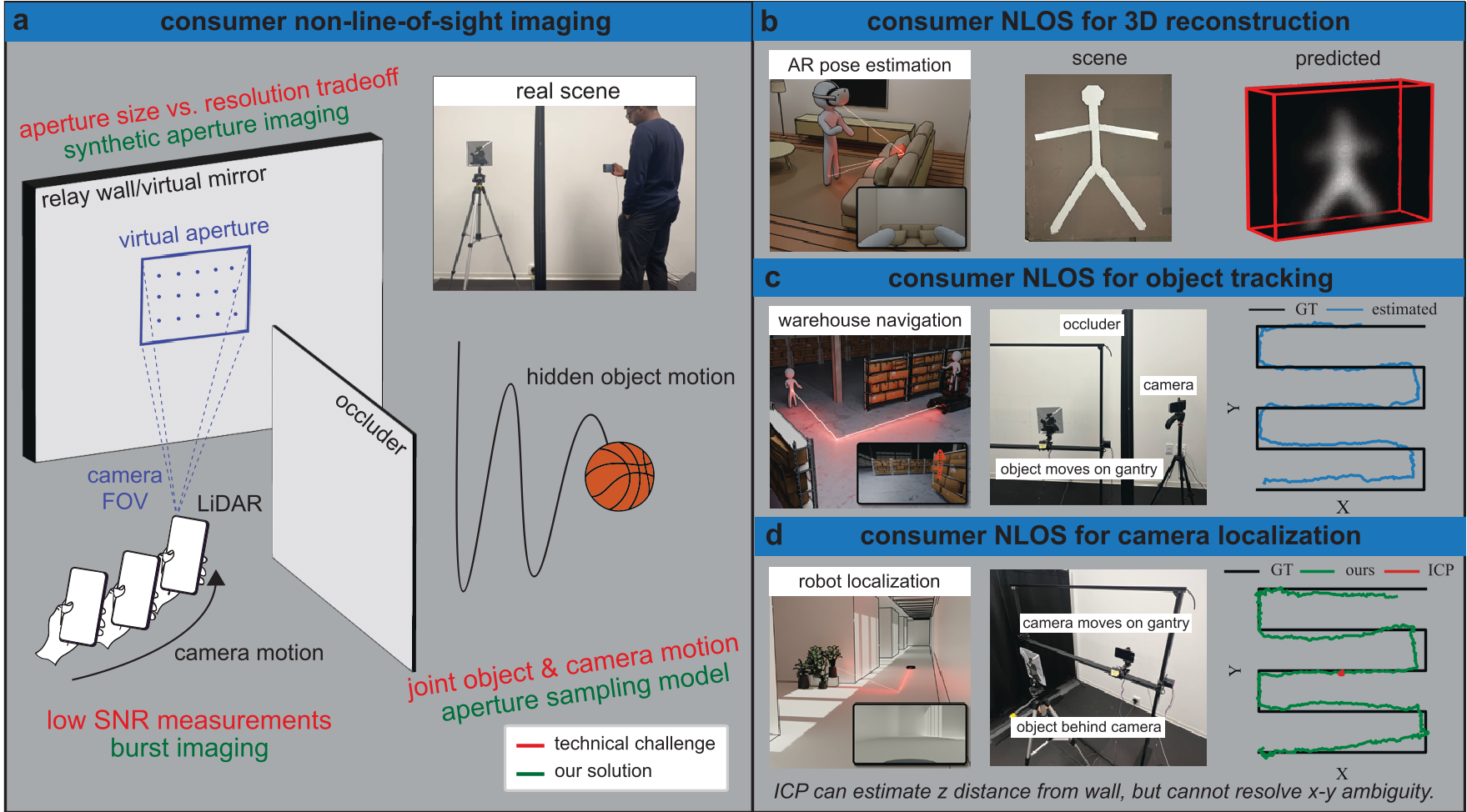 Figure: (Top) Scanning a hidden mannequin. (Bottom) Real-time tracking of hidden objects.
Performance & Comparisons
Unlike traditional "Backprojection" methods—which are computationally heavy and sensitive to noise—the particle filtering approach proved significantly more robust. In quantitative tests using a mechanical gantry, the system achieved a 4.7 cm average error, proving that consumer-grade SPADs (like the ST VL53L8CX) are more than capable of handling high-level NLOS tasks.
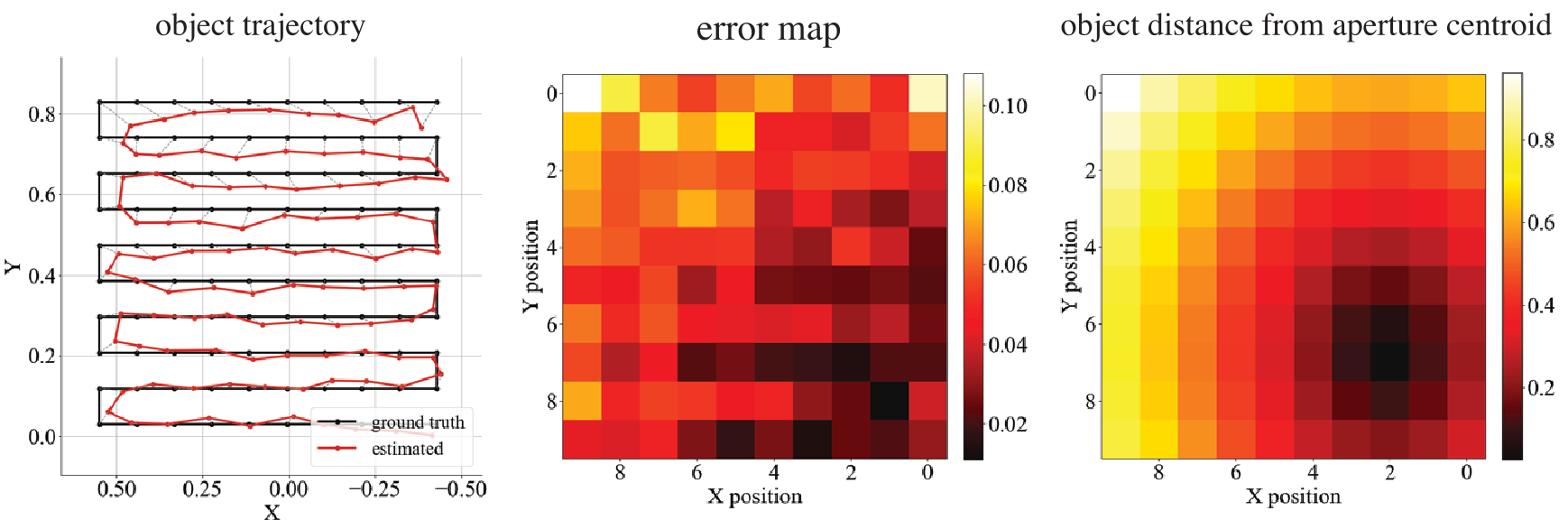 Figure: Spatial error maps show that tracking accuracy is highest when the object is closer to the "virtual aperture" on the wall.
Critical Insight & Future Outlook
This work marks a shift toward "Plug-and-Play" NLOS. By releasing their code and demonstrating compatibility with $100 off-the-shelf sensors, the authors are inviting the wider robotics and AR/VR communities to start using multi-bounce light.
Limitations: The model currently assumes rigid-body translations. It struggles with complex rotations (pitch/yaw) or non-rigid deformations (like a person changing posture). Future iterations might integrate Neural Radiance Fields (NeRFs) or deep learning to learn "score functions" that handle complex material reflections (BRDFs) better than handcrafted math.
Verdict: This is a landmark paper that proves NLOS imaging isn't just a lab curiosity—it's coming to your smartphone.