
Turning Smartphones into Periscopes: Practical NLOS Imaging via Motion-Induced Sampling
Imaging Hidden Objects with Consumer LiDAR via Motion Induced Sampling
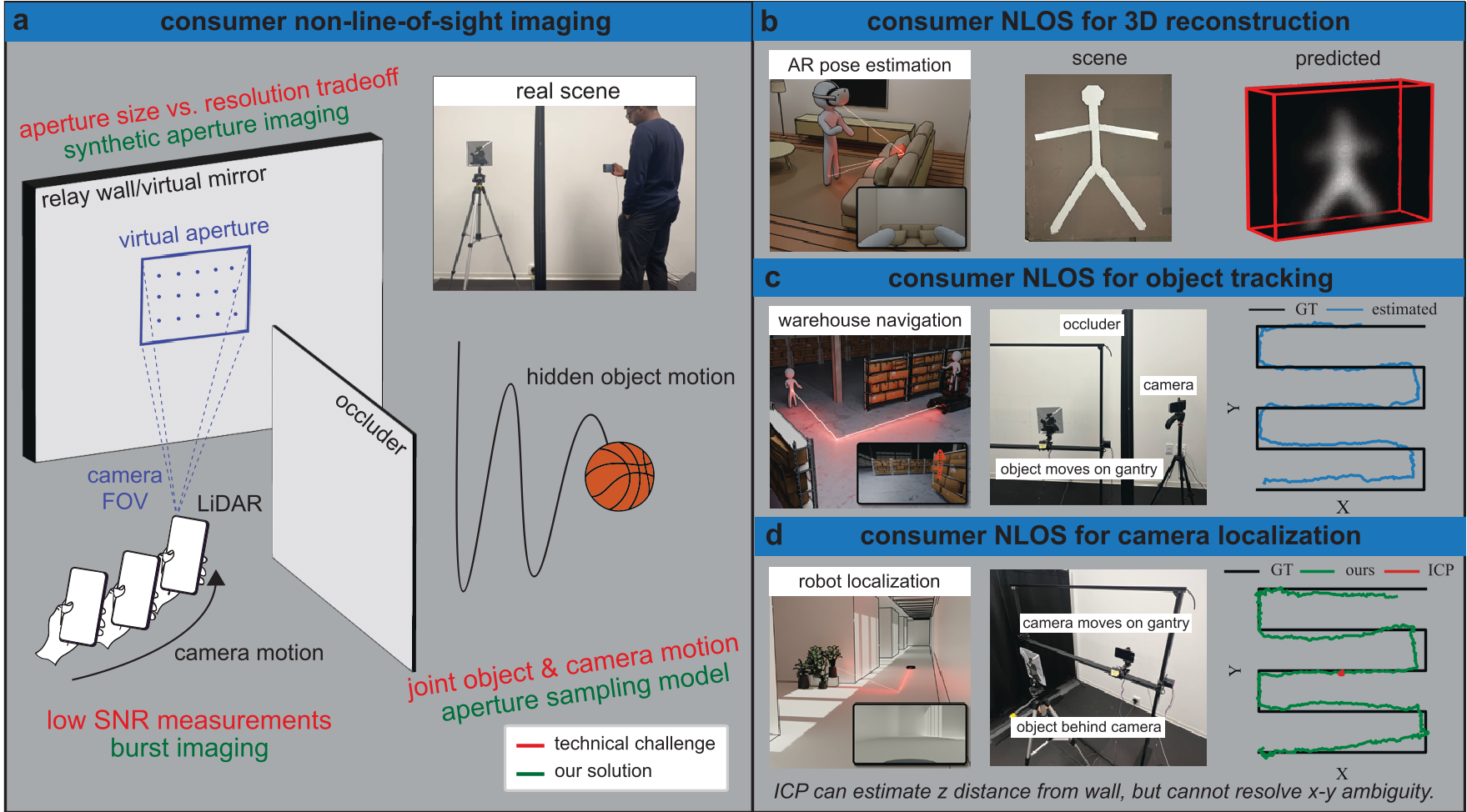
This paper introduces a real-time Non-Line-of-Sight (NLOS) imaging framework for consumer-grade LiDAR (e.g., smartphones), achieving 3D reconstruction, multi-object tracking, and camera localization. By proposing the Motion-Induced Aperture Sampling (MAS) model and a particle filtering strategy, the authors overcome the low SNR and spatial resolution limitations of off-the-shelf single-photon sensors.
TL;DR
Researchers from MIT and Dartmouth have cracked the code for bringing Non-Line-of-Sight (NLOS) imaging—previously a "lab-only" feat—to everyday consumer devices. By treating camera and object motion as a feature rather than a bug, their Motion-Induced Aperture Sampling (MAS) model allows a $100 smartphone LiDAR to see around corners in real-time.
Academic Context: This is a pivotal "democratization" paper. It moves NLOS from the "expensive hardware/ideal conditions" coordinate to the "commodity hardware/unstructured motion" coordinate.
The Problem: The "Quality Gap" in Consumer LiDAR
NLOS imaging works by using a wall as a "virtual mirror," capturing the tiny amount of light that bounces from the laser to the wall, to a hidden object, and back.
While research-grade LiDARs use picosecond-accurate lasers and high-power emitters, consumer devices (like those in iPhones or AR headsets) suffer from:
- Low SNR: Emitters are weak to satisfy eye-safety regulations.
- Low Spatial Resolution: Only ~100 pixels (compared to megapixels in labs).
- Motion Blur: Handheld capture and moving targets normally smear the signal.
Methodology: The MAS Model and Particle Filtering
The core insight is the Motion-Induced Aperture Sampling (MAS) model. The authors realized that the Light-Cone Transform (LCT) provides a convolutional relationship between object shape and measurements.
1. The Physics: MAS Model
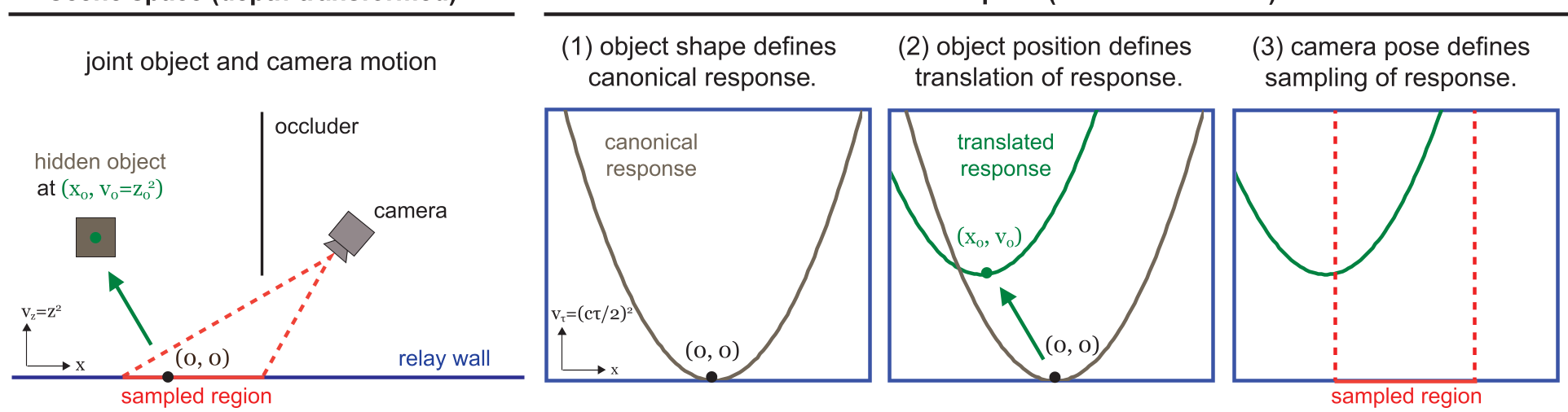
Under LCT transformation, the space-time impulse response (STIR) of an object becomes shift-invariant. This means:
- Object Shape determines a "Canonical STIR."
- Object Motion simply translates/shifts that STIR.
- Camera Pose determines where we sample that shifted STIR on the wall.
By decoupling these, they can render a "predicted" measurement for any hypothetical object position extremely fast using simple indexing.
2. The Algorithm: Particle Filtering
To handle the extreme noise, they don't try to "solve" the reconstruction in one go. Instead, they use a Particle Filter.
- Propagation: Guess where the object might be based on a motion prior (e.g., constant velocity).
- Evaluation: Compare the actual noisy LiDAR frame to a rendered version of the object at each "guessed" position.
- Resampling: Keep the guesses that match the data and discard the rest.
Experimental Breakthroughs
The authors demonstrated three "superpowers" for consumer LiDAR:
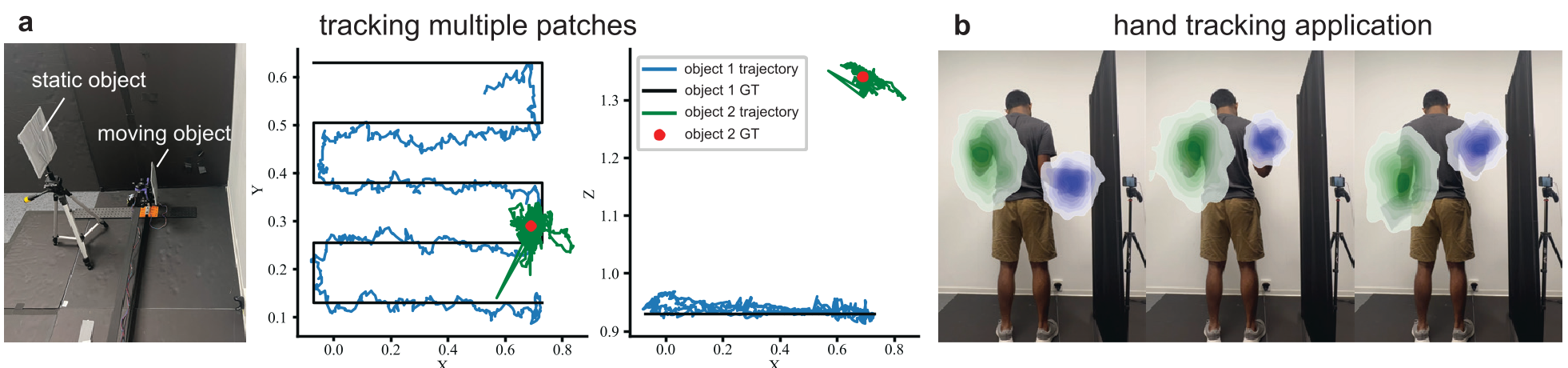
- 3D Tracking: Tracking a hidden patch with 4.7 cm accuracy. Even when the object is diffuse (non-retroreflective), the model holds up, though SNR drops.
- Multi-Object Tracking: By clustering particles, the system can distinguish between multiple hidden targets, such as tracking two hands out of sight.
- NLOS Localization: Using a hidden object as a "landmark" to localize a camera. This is a game-changer for robots in featureless environments (like white hallways) where standard SLAM fails.
Critical Insight & Future Outlook
The beauty of this work lies in Multi-frame Fusion. Just as "Burst Photography" on your phone combines many noisy photos to make one clear night shot, MAS combines many noisy LiDAR frames to "see" a hidden object.
Limitations
- Reflectance Assumptions: The best results still require some retroreflective surfaces or high-contrast objects.
- Handcrafted Scores: Currently uses a dot-product score; the authors suggest that Neural Networks could learn a more robust "similarity score" in the future.
Conclusion
This paper proves that NLOS is no longer a "billionaire's science." With the release of their code and the use of off-the-shelf sensors like the ST VL53L8CX, we are entering the era of plug-and-play NLOS, where a Roomba or a smartphone can naturally perceive the world beyond its line of sight.