
Turning Smartphones into Periscopes: Real-Time NLOS Imaging with Consumer LiDAR
Imaging Hidden Objects with Consumer LiDAR via Motion Induced Sampling
This paper introduces a system for Non-Line-of-Sight (NLOS) imaging using off-the-shelf consumer LiDAR (e.g., smartphones). By proposing a Motion-induced Aperture Sampling (MAS) model and a multi-frame fusion strategy, the authors achieve 3D reconstruction, multi-object tracking, and camera localization using hidden objects with low-cost ( < $100) hardware.
TL;DR
Researchers from MIT and Dartmouth have unlocked the ability for standard smartphone LiDARs to "see around corners." By treating the natural motion of a handheld device as a synthetic aperture and applying a novel Motion-induced Aperture Sampling (MAS) model, they demonstrate 3D reconstruction and tracking of hidden objects using sensors costing less than $100.
Field Positioning: This is a seminal "democratization" paper. It moves Non-Line-of-Sight (NLOS) imaging from the realm of $100k lab setups into the "plug-and-play" consumer electronics category.
The Problem: The High Cost of Seeing the Unseen
For over a decade, NLOS imaging has been the "holy grail" of computational photography. The logic is simple: light bounces off a wall (a "relay surface"), hits a hidden object, returns to the wall, and finally enters the camera. By timing these "third-bounce" photons, we can reconstruct the hidden world.
However, the execution is brutal. Prior SOTA methods required:
- High Power: Lab lasers that aren't eye-safe.
- Extreme Stability: Static setups to avoid motion blur.
- High Resolution: High-density scanning that takes minutes or hours per frame.
Consumer LiDAR (like those in iPhones or Roombas) fails here across the board. They have low laser power, low pixel counts (~100 pixels), and are constantly moving.
Methodology: Motion is Not a Bug, It's a Feature
The core insight of this paper is that camera motion—usually the enemy of sharp imaging—can be used to synthesize a larger virtual sensor.
1. The MAS Model (Motion-induced Aperture Sampling)
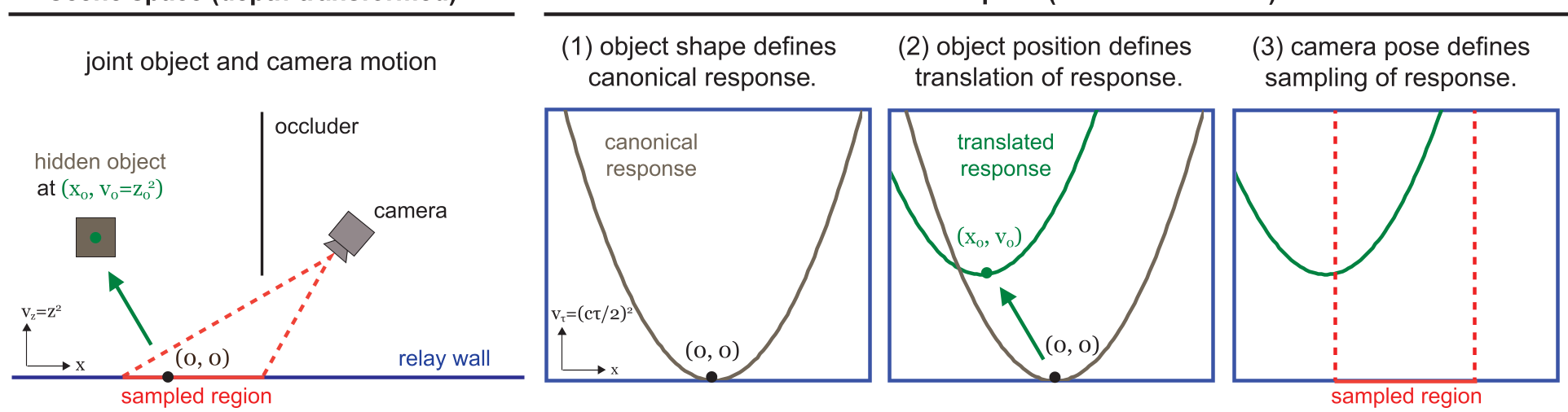
The authors leverage the Light-Cone Transform (LCT), which maps transient time-of-flight data into a 3D volume where light transport behaves like a convolution. They decompose the signal into:
- Canonical STIR: The time-independent "signature" of the object's shape.
- Time-dependent Shift: The translation caused by object or camera movement.
2. Particle Filtering for Tracking
Instead of solving a complex inverse problem for every frame, the authors use a Particle Filter. This mimics how robots localized themselves (Monte Carlo Localization). Each "particle" represents a hypothesis of the object's position. By rendering a predicted measurement for each particle and comparing it to the actual noisy LiDAR data, the system converges on the true location in real-time.
Key Capabilities & Results
The paper demonstrates three "superpowers" for consumer LiDAR:
- 3D Reconstruction: By moving a phone in a scanning motion, they create a "Synthetic Aperture" that drastically improves the resolution of hidden mannequins.
- 3D Tracking: They track hidden moving patches and human hands with ~4.7cm accuracy.
- NLOS Localization: Imagine a robot in a room with white, featureless walls. Standard cameras are "blind" here. This system uses the signal from a hidden object in the next room to determine the robot's current coordinates.
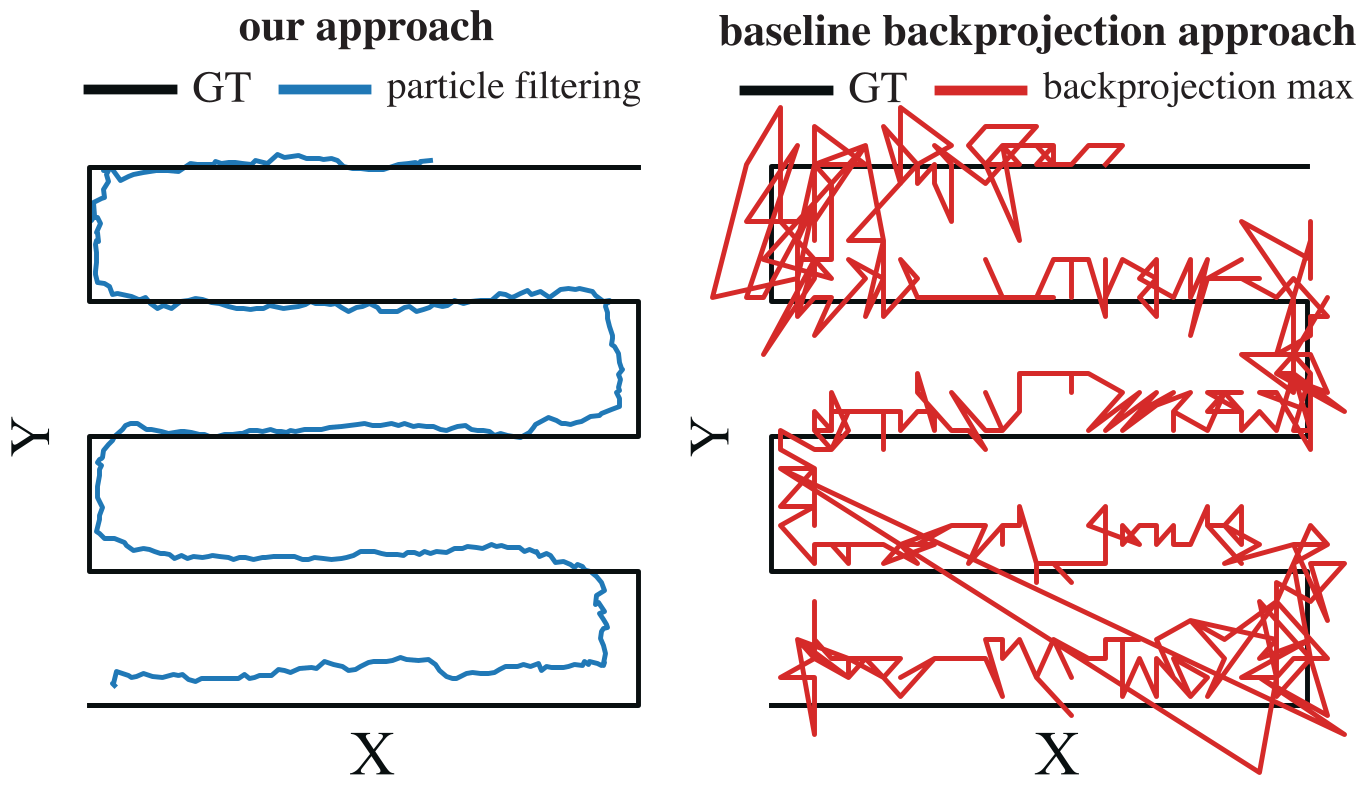 In the figure above, the authors compare their Particle Filtering approach against standard backprojection. Notice how the PF method (Blue) remains stable and robust to noise while the baseline (Yellow/Red) fluctuates wildly.
Deep Insight: Multi-Bounce light as "Opportunistic Blur"
One of the most profound theoretical claims in the paper is that multi-bounce light acts as a natural anti-aliasing filter. Because the relay wall scatters light, it effectively "blurs" the object's shape before the sensor's sparse pixels sample it. For low-resolution sensors, this "opportunistic blur" prevents aliasing, allowing for a more accurate (albeit softer) reconstruction of the object's silhouette than direct line-of-sight sensing might allow with the same pixel count.
Critical Analysis & Future Work
Limitations:
- The model currently struggles with complex rotations (pitch/yaw) of the hidden object.
- It assumes a largely retroreflective or "cooperative" surface for maximum range, though it still works reasonably well on diffuse surfaces.
The Takeaway: We are entering an era where NLOS is no longer a "lab trick." As SPAD sensors become standard in mobile hardware, the ability to see around corners will shift from high-end defense tech to standard features in AR gaming and indoor robotic navigation.
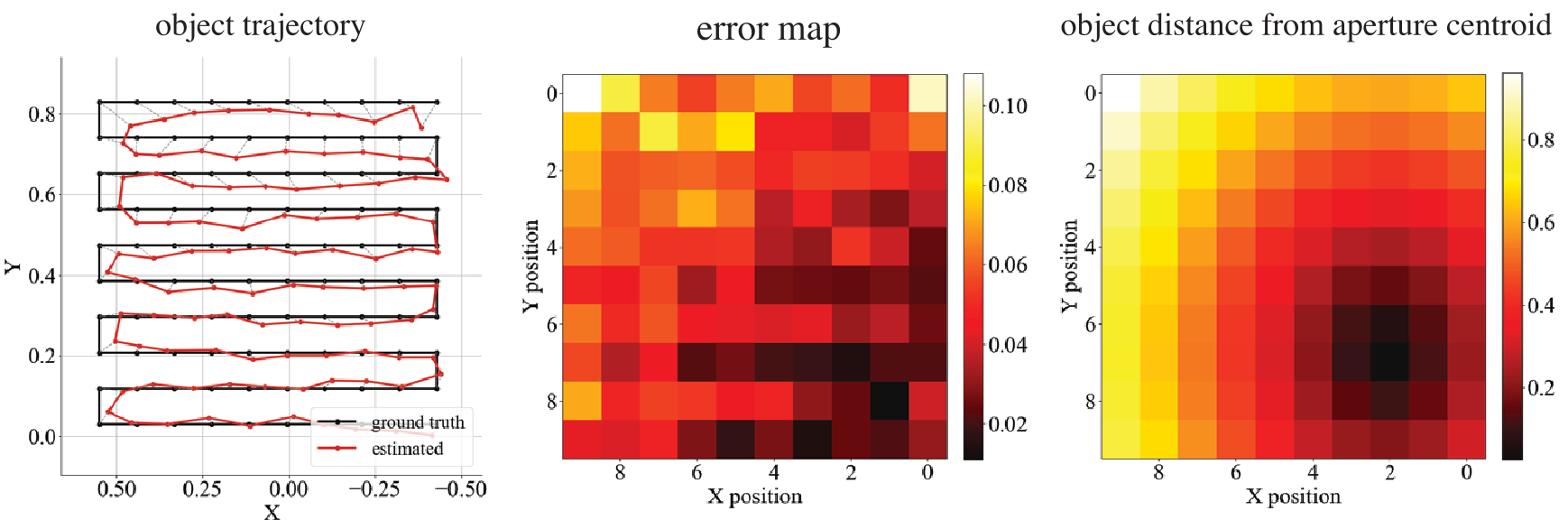 Quantitative results show that error increases as the object moves further from the center of the 'virtual mirror,' a fundamental geometric constraint of NLOS physics.