
Seeing Around Corners with Your Phone: Democratizing NLOS Imaging via MAS
Imaging Hidden Objects with Consumer LiDAR via Motion Induced Sampling
The paper introduces a "plug-and-play" Non-Line-of-Sight (NLOS) imaging framework using consumer-grade LiDAR (e.g., smartphones). By proposing the Motion-Induced Aperture Sampling (MAS) model and a particle-filtering-based multi-frame fusion strategy, it achieves 3D reconstruction, tracking, and camera localization of hidden objects with low-cost () hardware.
TL;DR
Non-Line-of-Sight (NLOS) imaging—the ability to see objects hidden behind walls—has transitioned from 100 smartphone sensors. By treating handheld motion as a "synthetic aperture" and using particle filters for multi-frame fusion, this paper enables real-time 3D tracking and reconstruction of hidden objects using the noisy, low-resolution LiDAR found in modern consumer electronics.
Background: Breaking the "Lab-Only" Curse
For the past decade, NLOS imaging has been the "magic trick" of computational photography. Researchers used femtosecond lasers and ultra-sensitive SPAD (Single-Photon Avalanche Diode) detectors to capture light bouncing off walls to reconstruct hidden scenes. However, these systems were "divas"—they required precise calibration, immense power, and static environments.
Consumer LiDARs (like those in the iPhone or ST VL53L8CX) are the polar opposite:
- Low Power: Eye-safety constraints mean very few photons return from a second or third bounce.
- Low Resolution: Often just 10x10 or 8x8 pixels.
- Motion: Handheld devices are never perfectly still, causing massive motion blur in traditional time-of-flight integrations.
The Core Insight: Motion-Induced Aperture Sampling (MAS)
Instead of viewing camera and object motion as a nuisance, the authors recognize it as a sampling advantage.
The technical heart of the paper is the MAS Model. By applying the Light-Cone Transform (LCT), they convert the problem into a 3D convolution. The breakthrough is a decomposition that separates:
- Canonical STIR: The "signature" of the object's shape (time-independent).
- Object Shift: The time-dependent translation of that signature.
- Camera Sampling: The spatial points on the wall where the LiDAR "peeks" into that signature.
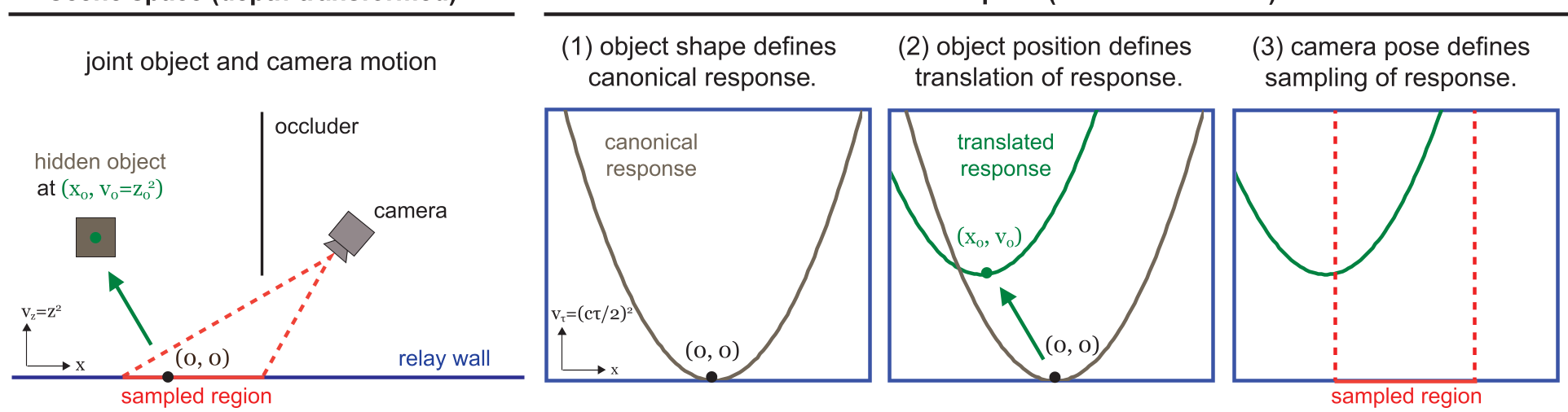 Figure: The MAS model treats motion as a way to sample the 'Light Cone' across different spatial and temporal coordinates.
Methodology: High-Speed Tracking with Particle Filters
Because the signal from a single frame of a consumer LiDAR is so noisy, the authors don't try to "solve" the reconstruction in one go. Instead, they use a Particle Filter.
- Propagation: Guess where the hidden object moved based on a motion prior (e.g., constant velocity).
- Evaluation (The Math): Use the MAS model to "render" what the LiDAR should see if the object were at that guessed position, then compare it to the actual noisy frame.
- Resampling: Keep the "guesses" that match the data and kill the ones that don't.
This allows for Real-Time 3D Tracking. Even if the object is hidden, the system maintains a probability distribution of its location, effectively "seeing" it through the wall with 4.7 cm accuracy.
Experimental Validation
The authors tested this on a variety of scenarios, from tracking moving hands in NLOS to localizing a camera in a "white room" (where standard SLAM fails) by using a hidden object as an anchor.
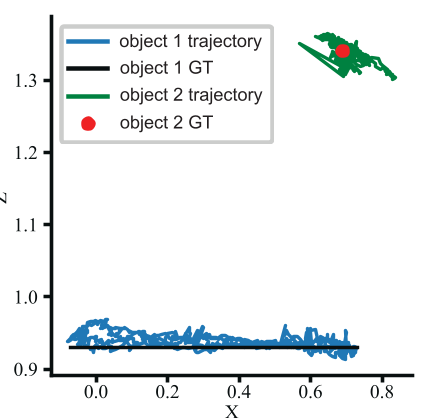 Figure: Multi-object tracking results showing the system can distinguish between static landmarks and moving targets.
They even showed that while the math assumes "retroreflective" targets (like high-vis vests), it works empirically on "diffuse" objects (like human skin or mannequins), albeit with reduced SNR.
Critical Analysis & Real-World Impact
Why this matters
This isn't just a marginal improvement; it's a paradigm shift. By moving to a multi-frame fusion approach (similar to "Burst Photography" on your iPhone), they've made NLOS robust enough for actual consumer products.
- Robotics: A vacuum robot could "see" a person coming around a corner before they collide.
- AR/VR: Headsets could track a user’s body pose even when limbs are self-occluded.
Limitations
The model currently struggles with rotations (pitch and yaw) of the hidden object, as this changes which parts of the object are visible to the wall (occlusion). It also relies on a "known" object shape for the highest tracking accuracy.
Conclusion (Takeaway)
The paper proves that NLOS imaging is no longer a luxury of high-end physics labs. With the right mathematical "lens"—specifically the MAS model—the noisy, sparse data from a $100 sensor is more than enough to reveal the hidden world.
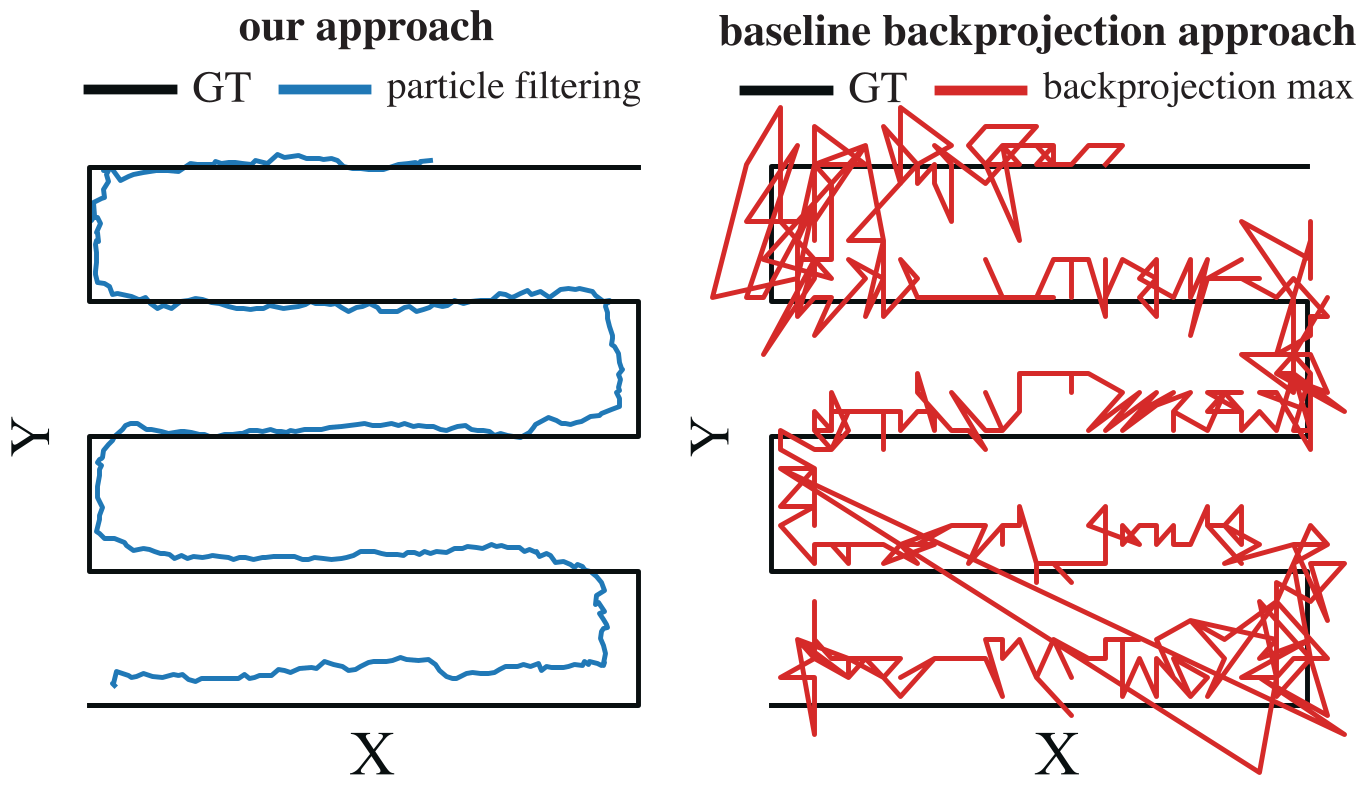 Figure: Comparison between the proposed method and traditional backprojection, highlighting the noise-robustness of the MAS approach.