
Seeing Around Corners with Your Phone: The Dawn of Consumer NLOS Imaging
Imaging Hidden Objects with Consumer LiDAR via Motion Induced Sampling
This paper introduces a system for Non-Line-of-Sight (NLOS) imaging using smartphone-grade commodity LiDAR. By proposing the Motion-Induced Aperture Sampling (MAS) model and a multi-frame fusion strategy, it achieves real-time 3D reconstruction, multi-object tracking, and camera localization by treating nearby diffuse surfaces as "virtual mirrors."
TL;DR
Researchers have unlocked the ability to image hidden objects using the tiny, low-power LiDAR sensors found in modern smartphones. By combining a new mathematical model (MAS) with Particle Filtering, they can track moving objects around corners and localize cameras in blank rooms—all in real-time with $100 hardware.
The Motivation: Moving NLOS from the Lab to the Pocket
Non-Line-of-Sight (NLOS) imaging has long been the "holy grail" of computational photography. Historically, this required picosecond-accurate lasers and detectors costing tens of thousands of dollars. While these lab-grade systems could "see" through walls or around corners, they were fragile and required stationary setups.
Consumer LiDARs, however, are everywhere—from iPhones to Roombas. But they are "bad" for NLOS in three ways:
- Low Power: Laser output is restricted for eye safety, leading to horrific SNR.
- Low Resolution: Sensors often have as few as 64-100 pixels.
- Motion: Handheld use introduces blur that breaks standard reconstruction algorithms.
This paper tackles these "bugs" by treating them as "features," using motion to synthesize a larger virtual aperture.
Methodology: The MAS Model and Particle Filtering
The core breakthrough is the Motion-Induced Aperture Sampling (MAS) model.
1. The Light-Cone Transform (LCT) Intuition
The authors build upon the LCT, which maps 3D scene space into measurement space. In this transformed space, the relationship between a hidden object's albedo and the measured signal is a simple 3D convolution.
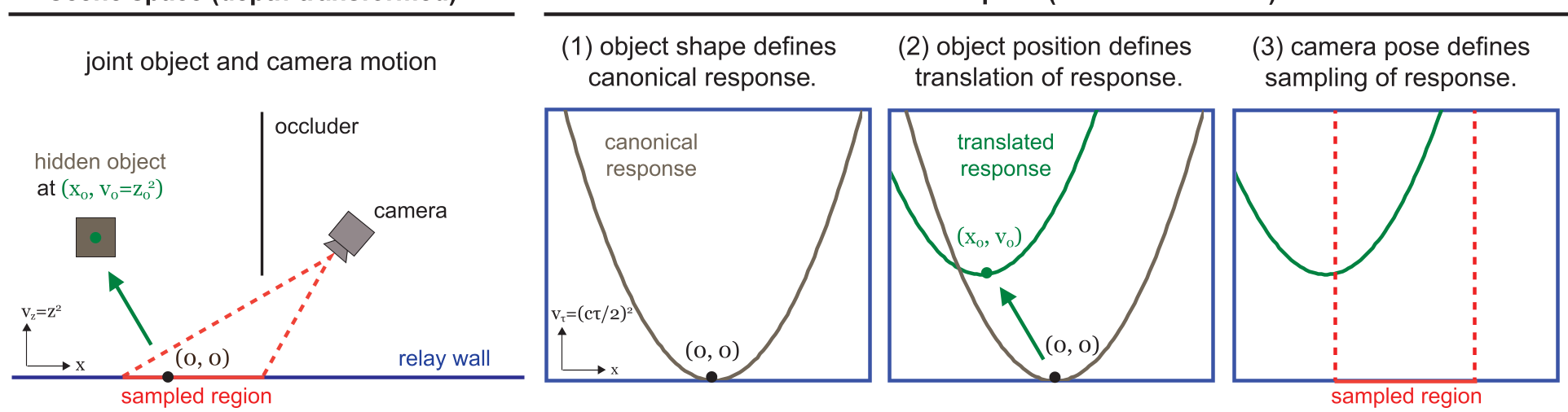
The MAS model decouples these effects:
- Object Shape: Defines a "Canonical Space-Time Impulse Response (STIR)."
- Object/Camera Motion: Acts as a spatial sampling function that shifts and probes this STIR.
2. Particle Filtering: Probability over Pure Math
Instead of trying to solve a complex inverse problem (which is computationally heavy), the authors use Particle Filtering.
- Propagation: Guess where the object/camera moved.
- Evaluation: Use the MAS model to "render" what the LiDAR should see if the guess were true.
- Resampling: Keep the guesses that match the real sensor data.
This allows the system to handle the high uncertainty of consumer sensors by maintaining a probability cloud of where the hidden object might be.
Experimental Results: Real-World Performance
The team tested their approach using smartphone-grade sensors on three tasks:
1. 3D Reconstruction
By moving the camera (natural handheld jitter), the system captures various viewpoints of a hidden "virtual mirror" (a wall). This synthesizes a larger aperture, allowing for a coherent 3D reconstruction of a hidden mannequin.
2. Single and Multi-Object Tracking
The system can track hidden people or hands in real-time. Even with diffuse (non-reflective) objects, the particle filter remains robust.

3. Camera Localization
In a "white room" where traditional cameras fail to find features, the LiDAR "looks" around the corner at a hidden object to find its own position.
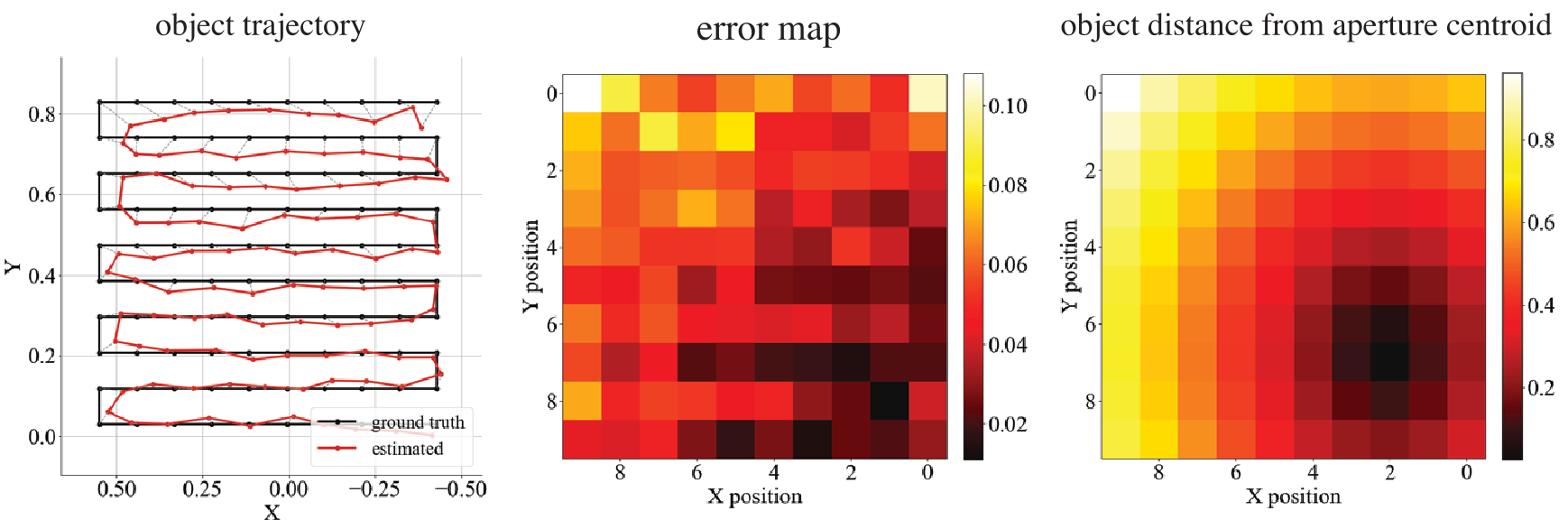 Figure: The tracking error (avg 4.7cm) is closely tied to the distance from the virtual aperture, demonstrating the predictable physics of the system.
Critical Analysis & Future Outlook
Why it works: It shifts the burden from Hardware (expensive lasers) to Software (probabilistic fusion). By assuming one of the three variables (shape, motion, or pose) is known, they make an "impossible" problem tractable for mobile processors.
Limitations:
- Priors required: You usually need to know the shape of the object you are tracking.
- Reflectance: While it works on diffuse surfaces, SNR drops significantly compared to retroreflective targets.
Conclusion: This isn't just a paper about "seeing around corners"—it's a manifesto for Plug-and-Play NLOS. It proves that the hardware in our pockets is already capable of superhuman perception; we just needed the right math to unlock it.