
Imaging Hidden Objects with Consumer LiDAR: The Dawn of Plug-and-Play NLOS
Imaging Hidden Objects with Consumer LiDAR via Motion Induced Sampling
The paper introduces a multi-frame fusion strategy to enable Non-Line-of-Sight (NLOS) imaging using consumer-grade LiDAR (e.g., smartphones). By proposing the Motion-Induced Aperture Sampling (MAS) model, the authors achieve SOTA-level 3D reconstruction, tracking, and localization on hardware costing less than $100.
TL;DR
Researchers from MIT and Dartmouth have broken the "laboratory wall" of Non-Line-of-Sight (NLOS) imaging. By moving away from bulky 100 smartphone LiDARs, they developed a framework called Motion-Induced Aperture Sampling (MAS). This allows your phone to "see" around corners by fusing multiple noisy frames into a coherent 3D reconstruction or real-time tracking signal.
Background: Beyond the Line of Sight
For years, NLOS imaging was a "superpower" reserved for high-end research labs. It works by treating common walls as "virtual mirrors." A laser pulse hits the wall, scatters to a hidden object, bounces back to the wall, and is finally captured by a sensor.
The catch? The signal is incredibly faint (subject to or falloff) and requires picosecond timing. Consumer LiDARs (like those in the iPhone or STMicroelectronics sensors) were thought to be too weak and too low-resolution for this task. This paper changes that narrative.
The Core Challenge: Why is Consumer NLOS Hard?
- Low SNR: Consumer lasers are "eye-safe," meaning very low power. A single measurement frame looks like pure noise.
- Resolution Trade-off: You can have a large scan area or high density, but not both at 30Hz.
- Motion Blur: In mobile scenarios, both the camera and the object are moving, creating a complex mess of spatial and temporal shifts.
Methodology: Motion-Induced Aperture Sampling (MAS)
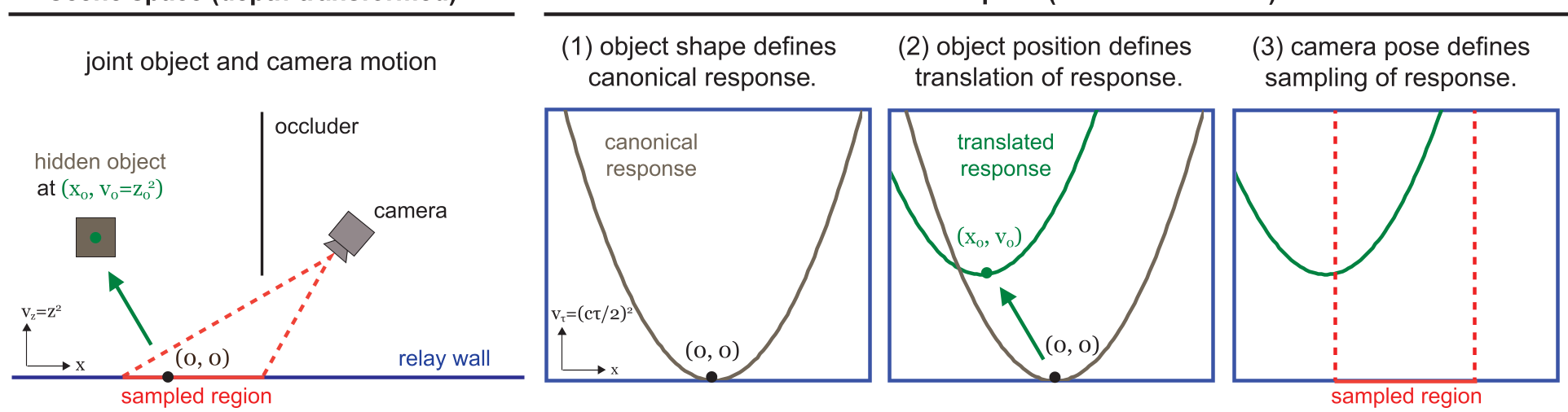
Instead of trying to fix a single frame, the authors utilize a "Burst Photography" mindset. Their key insight is the MAS Model.
Using the Light-Cone Transform (LCT), they prove that a shift in an object's position corresponds to a predictable translation in the "transformed" measurement space. This allows them to decouple the object's permanent shape from its transient motion.
Real-Time Inference via Particle Filtering
To solve for hidden positions without melting a mobile processor, the team uses Particle Filters. They represent the possible location of a hidden object as a "cloud" of 1,000 guesses (particles). As new noisy data comes in, the particles that don't match the measurement are killed off, and those that do match are cloned.

Experimental Breakthroughs
The team demonstrated three powerful applications:
- 3D Reconstruction: Using handheld motion to create a "synthetic aperture," effectively turning a tiny sensor into a massive virtual lens.
- Multi-Object Tracking: Tracking Two hidden objects simultaneously, even identifying human hand gestures around a corner.
- NLOS Localization: Using a hidden static object to help a robot find its own position when it's staring at a blank, featureless white wall.

Key Result:
Using the off-the-shelf ST VL53L8CX sensor, they achieved tracking with a mean error of ~4.7 cm. This is a massive leap for a sensor that fits in a fingernail.
Critical Analysis & Conclusion
Takeaway: This paper proves that algorithmic sophistication (MAS + Particle Filtering) can compensate for hardware limitations. We are moving from "Specialized NLOS" to "Computational NLOS."
Limitations: The model currently prefers retroreflective objects (like safety vests or license plates) to maintain high SNR. While it works on diffuse objects (like human skin or wood), the range and accuracy drop significantly due to the increased signal decay.
Future Outlook: The next step is "Blind NLOS"—solving for object shape, motion, and camera pose simultaneously (NLOS-SLAM). Once that is solved, your vacuum robot or AR glasses won't just see the room; they will see through the walls of the entire house.
Paper Reference: Somasundaram et al., MIT Media Lab. Project Page: sidsoma.com/consumer-nlos/