
Seeing the Unseen: Democratizing NLOS Imaging with Consumer LiDAR
Imaging Hidden Objects with Consumer LiDAR via Motion Induced Sampling
This paper introduces a multi-frame fusion strategy and the Motion-Induced Aperture Sampling (MAS) model to enable Non-Line-of-Sight (NLOS) imaging using consumer-grade LiDAR (e.g., smartphones). By exploiting handheld camera motion and particle filtering, the system achieves real-time 3D reconstruction, multi-object tracking, and camera localization without expensive lab-grade hardware.
TL;DR
Researchers from MIT and Dartmouth have unlocked the ability to see around corners using the $100 LiDAR sensors found in modern smartphones and AR headsets. By introducing the Motion-Induced Aperture Sampling (MAS) model and a real-time particle filtering framework, they’ve bridged the gap between expensive lab-grade equipment and everyday mobile hardware.
The "Invisible" Challenge: Why Consumer LiDAR Fails at NLOS
Non-Line-of-Sight (NLOS) imaging usually works by treating a wall as a "virtual mirror." We bounce a laser off a wall, hit a hidden object, and capture the faint "third-bounce" return.
While research setups use femtosecond lasers and high-end SPAD detectors, consumer LiDARs (like those in an iPhone or a Sony sensor) face three brutal constraints:
- Low SNR: Laser power is capped for eye safety.
- Spatial Sparsity: Instead of scanning millions of points, these sensors often have only ~100 fixed pixels.
- Motion Blur: Handheld devices are never perfectly still; in NLOS, even a millimeter of movement can destroy the phase/timing info required for reconstruction.
The Insight: Motion is a Feature, Not a Bug
The core contribution of this paper is the Motion-Induced Aperture Sampling (MAS) model. Instead of trying to eliminate motion, the authors treat the camera’s movement as a way to "synthetically" increase the aperture size—a concept borrowed from Synthetic Aperture Radar (SAR).
The MAS Model Math
At the heart of the method is the Light-Cone Transform (LCT). The authors prove that an object's rigid-body translation results in a linear shift of its Space-Time Impulse Response (STIR) in a transformed coordinate space ().
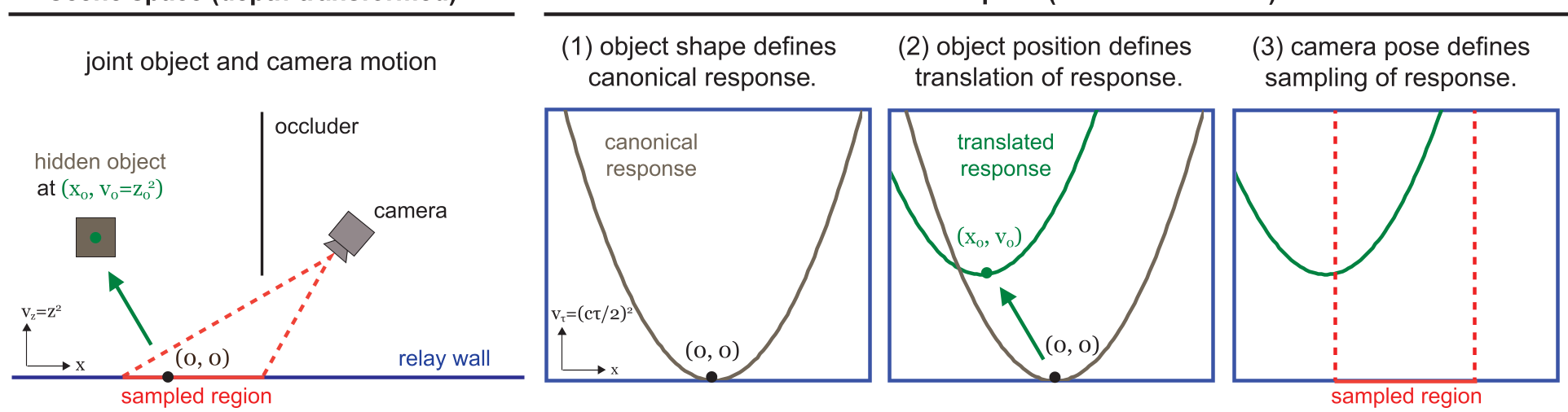 Figure: The MAS model decouples object shape (canonical STIR) from time-dependent motion () and camera sampling ().
By framing the problem this way, the complex physics of NLOS becomes a sampling problem. If we know the object's shape (e.g., a person walking out of a room), we only need to estimate its 3D position.
Real-Time Inference via Particle Filtering
To solve the inverse problem on a mobile processor, the team utilized a Particle Filter.
- Propagation: Moves "particles" (hypothesized object locations) based on a motion prior.
- Evaluation: Renders what the LiDAR should see for each particle using the MAS model and compares it to the actual noisy measurement.
- Resampling: Keeps the hypotheses that match the data.
This approach is far more robust than traditional Back-Projection (BP), which is computationally heavy and collapses under low SNR.
Experimental Breakthroughs
The team tested their algorithms on smartphone-grade sensors in three distinct scenarios:
- 3D Tracking: They tracked hidden objects with a mean error of 4.7 cm, even when the objects were diffuse (non-reflective).
- Multi-Object Tracking: Successfully distinguished and tracked a moving object and a static one simultaneously.
- Camera Localization: This is a "killer app"—using a hidden object as a landmark to localize a camera in a room with completely white, featureless walls where standard SLAM would fail.
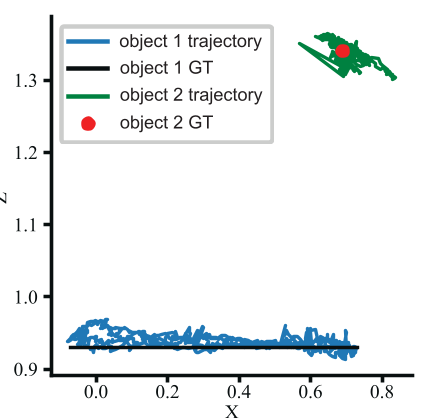 Figure: Multi-object tracking results showing hand tracking and moving platforms.
Critical Analysis & Future Outlook
Takeaway: This is a major step toward "Plug-and-Play" NLOS. By releasing code that works on cheap $100 sensors (like the ST VL53L8CX), the authors have lowered the barrier to entry for the entire robotics and CV community.
Limitations:
- The model currently assumes rigid-body translation. Non-rigid motion (like a person waving arms) would require complex "deformation fields."
- It still performs best with retroreflective materials (like high-vis vests), though the paper proves feasibility with diffuse surfaces.
Future Work: We can expect this to be integrated into "Hidden Landmark SLAM," allowing autonomous warehouse robots to navigate corners safely by "seeing" the reflections of hidden workers on the floor.