
Turning Smartphones into X-Ray Vision: Real-Time NLOS Imaging with Consumer LiDAR
Imaging Hidden Objects with Consumer LiDAR via Motion Induced Sampling
This paper introduces a system for Non-Line-of-Sight (NLOS) imaging using smartphone-grade commodity LiDAR sensors. By employing a novel "Motion-Induced Aperture Sampling" (MAS) model and multi-frame fusion via particle filtering, it achieves real-time 3D reconstruction, tracking, and camera localization of hidden objects using hardware costing less than $100.
TL;DR
Researchers have unlocked the ability for smartphone-grade LiDAR to "see around corners." By treating the wall as a virtual mirror and using a brand-new mathematical model called Motion-Induced Aperture Sampling (MAS), they can track hidden objects and reconstruct 3D shapes in real-time, all while using a device that costs less than $100.
Perspective: From Lab Benches to Your Pocket
For the past decade, Non-Line-of-Sight (NLOS) imaging was a high-budget spectacle. It required femtosecond lasers and Single-Photon Avalanche Diodes (SPADs) that filled entire labs. This paper represents a "democratization" moment—shifting NLOS from specialized hardware to the sensors already embedded in your phone or robot vacuum.
The Problem: The "Dirty" Signal of Consumer LiDAR
Consumer LiDAR sensors (like those found in iPhones or the ST VL53L8CX) are not built for NLOS. They face three massive hurdles:
- Low Laser Power: Eye-safety regulations limit power, leading to abysmal Signal-to-Noise Ratios (SNR).
- Low Resolution: Instead of millions of points, you get a 10x10 grid.
- The Double-Motion Blur: Both the hidden object and your hand (the camera) are moving, creating a chaotic mess of reflections.
Methodology: The MAS Model and Particle Filtering
The core innovation is the Motion-Induced Aperture Sampling (MAS) model. The authors realized that backprojection (the standard NLOS algorithm) fails when things move.
1. The Light-Cone Transform (LCT) Intuition
The MAS model uses the LCT to map 3D scene space into measurement space. In this transformed space, a movement of the object corresponds to an equivalent shift in the measured signal. This mathematical symmetry allows the researchers to pre-compute a "Canonical" Space-Time Impulse Response (STIR)—essentially a 5D "template" of what the object looks like.
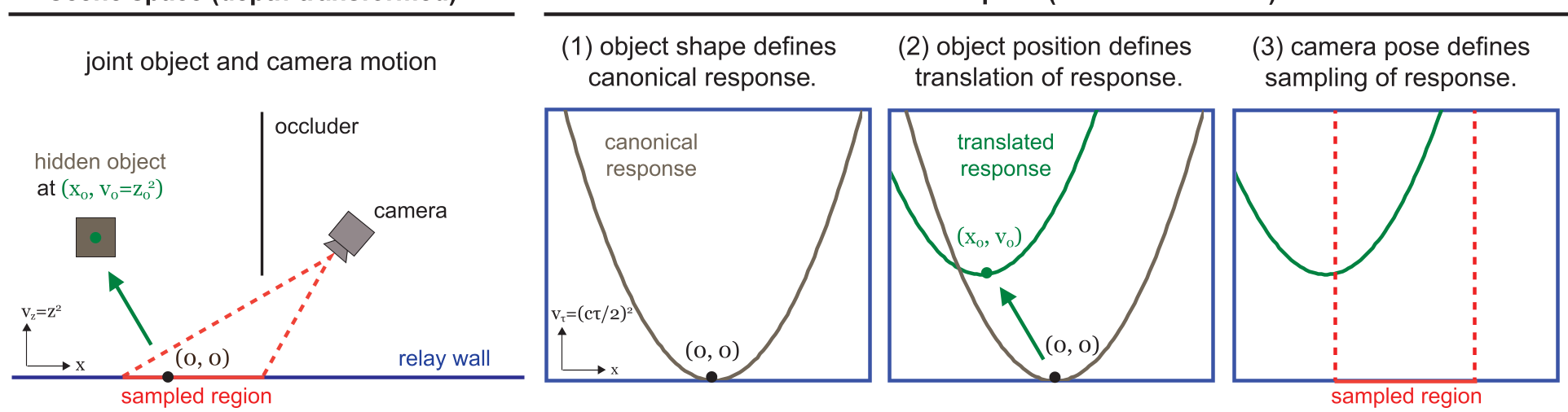 Figure: The MAS model unifies object shape, motion, and camera pose into a single measurement framework.
2. Particle Filtering: Tracking the "Probability"
Because any single frame from a consumer LiDAR is too noisy to find an object, the authors use a Particle Filter.
- Propagation: The system guesses 1,000 possible positions for the hidden object.
- Evaluation: It renders what the sensor should see for those 1,000 guesses and compares it to reality.
- Resampling: It kills off the "bad" guesses and refocuses on the most likely positions.
Experimental Triumphs
The authors demonstrated three world-firsts for consumer-grade hardware:
- 3D Tracking: Tracking moving targets behind a wall at 30Hz.
- 3D Reconstruction: Using the natural "jitter" of a handheld camera to scan a wall (synthetic aperture) and build a 3D model of a mannequin hidden from view.
- NLOS Localization: Using a hidden object as a "landmark" to tell the camera where it is—even when looking at a blank, featureless white wall.
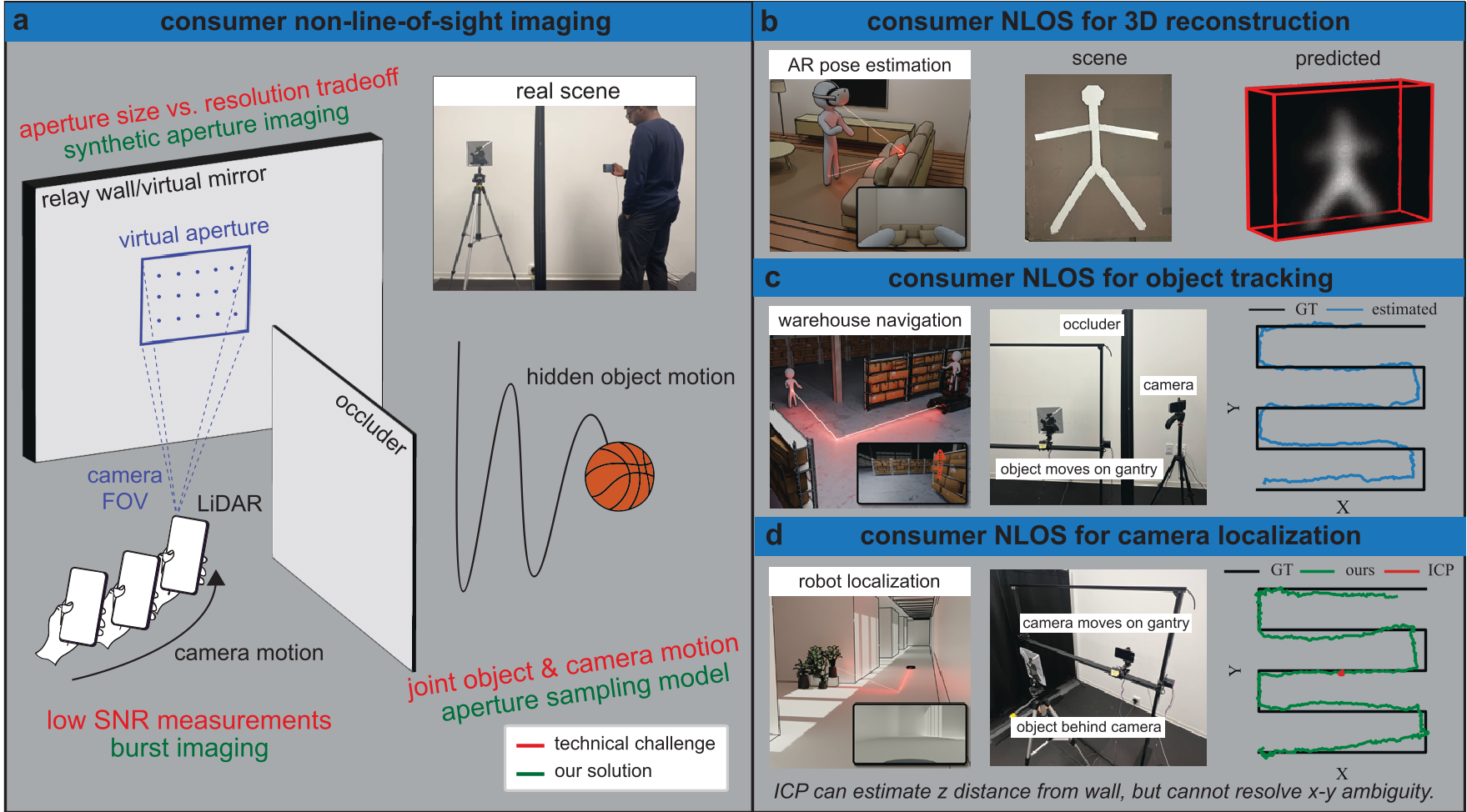 Figure: Applications of the system including tracking, reconstruction, and localization.
Critical Insights & Limitations
- The Power of Priors: This method works so well because it assumes we know one variable (like the object's general shape). This is actually a very realistic constraint—for example, a robot might be looking for a person or another specific robot.
- The Material Constraint: Most experiments used retroreflective material (which reflects light directly back). While the authors showed it works on diffuse (normal) surfaces, the range and accuracy drop significantly.
- Future Impact: This could revolutionize AR/VR (hand tracking outside the camera's view) and warehouse robotics (detecting humans around corners before a collision).
Conclusion
By combining Monte Carlo Localization (from robotics) with Transient Imaging (from physics), this work bridges the gap between theoretical optics and practical mobile sensing. It proves that with the right math, your phone is much more capable of "seeing" than you might have thought.