
MAS: Democratizing NLOS Imaging with $100 Consumer LiDARs
Imaging Hidden Objects with Consumer LiDAR via Motion Induced Sampling
This paper introduces a system for Non-Line-of-Sight (NLOS) imaging using smartphone-grade, low-cost LiDAR sensors. By employing a "Motion-Induced Aperture Sampling" (MAS) model and multi-frame fusion via particle filtering, the authors achieve 3D reconstruction, multi-object tracking, and camera localization of hidden objects with $100 off-the-shelf hardware.
Executive Summary
TL;DR: Researchers from MIT and Dartmouth have unlocked "superhuman" vision for everyday devices. By combining the physics of light-cone transforms with the robustness of particle filtering, they allow smartphone-grade LiDAR to see around corners. They turn a low-resolution, noisy sensor into a high-precision NLOS (Non-Line-of-Sight) tracker and reconstructor by leveraging the very thing that usually breaks imaging: motion.
Positioning: This work is a "democratization" milestone. It bridges the gap between 100 consumer electronics, shifting NLOS from theoretical physics to practical computer vision.
The Problem: Why Your Phone Can't See Around Corners (Yet)
LiDAR sensors on iPhones or Roombas are designed for "Line-of-Sight" (LOS). They bounce light off a wall and measure the return time. While some of that light bounces off the wall, hits a hidden object, returns to the wall, and finally hits the sensor (a "triple bounce"), that signal is buried under mountains of noise.
Current NLOS methods fail on consumer gear because:
- Low SNR: Consumer lasers are weak to ensure eye safety.
- Low Resolution: Instead of megapixel SPADs, consumer units have ~100 pixels.
- Motion Blur: Handheld movement usually destroys the delicate timing needed for NLOS.
The Insight: Motion-Induced Aperture Sampling (MAS)
The researchers realized that instead of fighting motion, they could use it as a feature. This is inspired by Burst Photography (combining shots to kill noise) and Synthetic Aperture Radar (moving a sensor to simulate a giant antenna).
The Physics of the MAS Model
The core mathematical engine is the Light-Cone Transform (LCT). The LCT reveals a beautiful symmetry: a rigid-body translation of an object in 3D space corresponds to a simple shift in a transformed space-time impulse response (STIR).
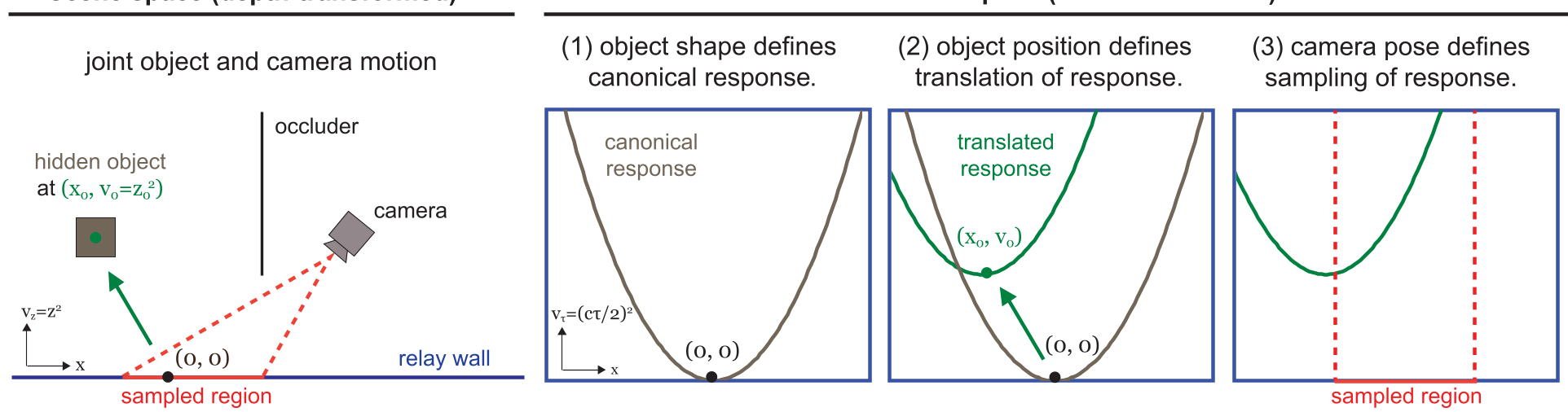
By decoupling the Object Shape (canonical STIR) from Motion (translation ), the authors can "render" what a noisy sensor should see at any given moment.
Methodology: Tracking with Particles
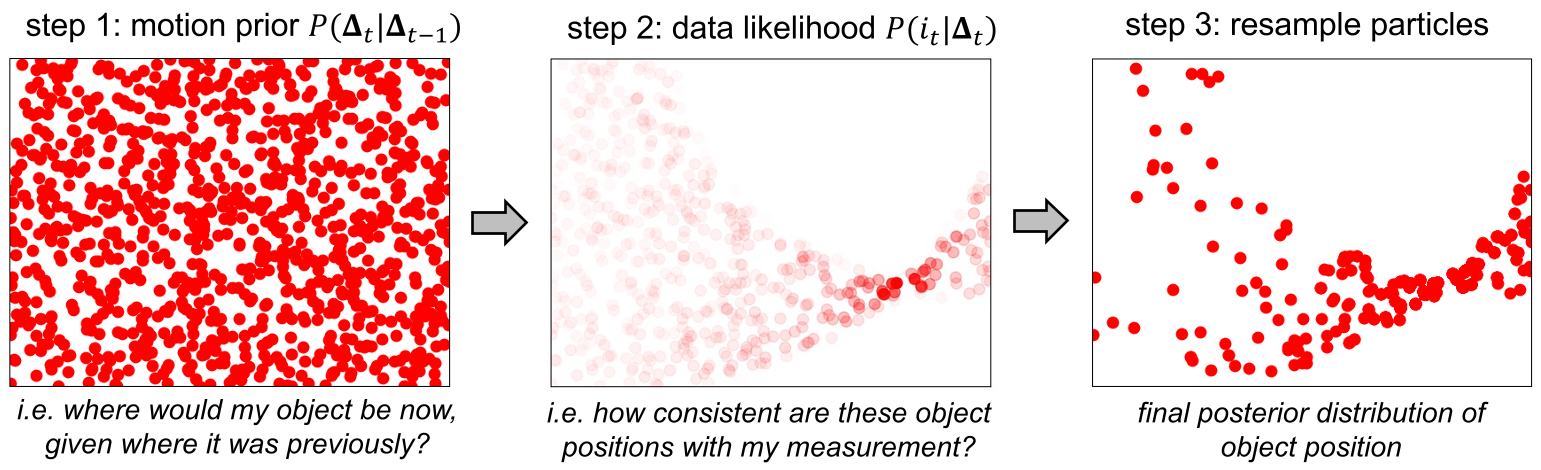
To handle the extreme noise, the system uses a Particle Filter.
- Propagation: It creates 1,000 "guesses" (particles) of where the hidden object is.
- Evaluation: For each guess, it uses the MAS model to simulate a LiDAR measurement and compares it to the real, noisy data.
- Resampling: It kills off guesses that don't match the data and clones those that do.
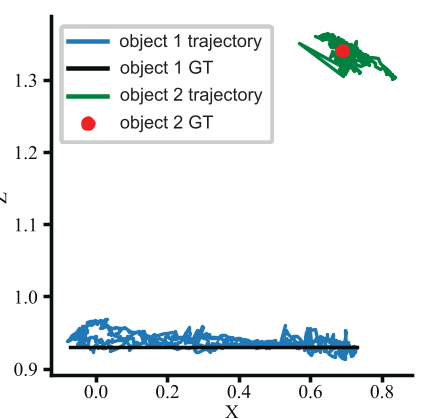
This allows for real-time multi-object tracking, even distinguishing between a left and right hand hidden from view.
Experimental Results: Seeing is Believing
The team tested their algorithms on a standard ST VL53L8CX sensor (found in many robotics kits).
1. 3D Tracking
They achieved sub-5cm accuracy in tracking hidden patches. Critically, the particle filter naturally handles "ambiguity"—when the object is far away, the particle cloud spreads out, showing the system's own uncertainty.
2. Camera Localization
In a genius twist, they used the hidden object as a landmark. If a robot is in a room with perfectly white, flat walls (where standard CV fails), it can "see" a hidden chair around the corner and use its reflection to calculate its own position.
The Verdict: A New Era for Consumer LiDAR
Takeaway: The "Motion-Induced Aperture Sampling" approach proves that we don't need better hardware to achieve NLOS imaging; we need smarter algorithms that exploit temporal redundancy.
Limitations: Currently, the model works best with retroreflective materials (like high-vis vests) or known object shapes. While it can handle diffuse (matte) objects, the SNR drop is significant, requiring longer integration times.
Future Outlook: Expect this to land in AR headsets (to track your body pose without cameras pointing at you) and warehouse robots (to avoid blind-spot collisions). The era of "plug-and-play" around-the-corner vision has arrived.