
Democratizing the "Superpower" of Sight: NLOS Imaging via Consumer LiDAR
Imaging Hidden Objects with Consumer LiDAR via Motion Induced Sampling
This paper introduces a method for Non-Line-of-Sight (NLOS) imaging using consumer-grade smartphone LiDAR. By proposing the Motion-Induced Aperture Sampling (MAS) model and a particle filtering fusion strategy, the authors achieve 3D reconstruction, multi-object tracking, and camera localization of hidden objects using off-the-shelf hardware.
TL;DR
Researchers from MIT and Dartmouth have broken the "laboratory wall" of Non-Line-of-Sight (NLOS) imaging. By exploiting the natural motion of a handheld smartphone and a clever mathematical model called Motion-Induced Aperture Sampling (MAS), they’ve turned $100 consumer LiDAR sensors into tools that can see around corners, track moving people, and localize cameras using hidden landmarks—all in real-time.
The Barrier: Why Your Phone Can't See Around Corners (Yet)
While research-grade NLOS systems have existed for a decade, they usually involve tens of thousands of dollars in femtosecond lasers and ultra-sensitive detectors. Translating this to consumer hardware (like the LiDAR in an iPhone or a robot vacuum) faces three "deal-breaking" hurdles:
- The Power Gap: Consumer lasers must be eye-safe, resulting in an abysmal Signal-to-Noise Ratio (SNR).
- Resolution Trade-off: Mobile chips have limited bandwidth and few pixels (~100 compared to megapixels in standard cameras).
- The Motion Headache: In the real world, both the camera and the hidden object are moving, creating a blurred mess of temporal data.
The Innovation: Motion-Induced Aperture Sampling (MAS)
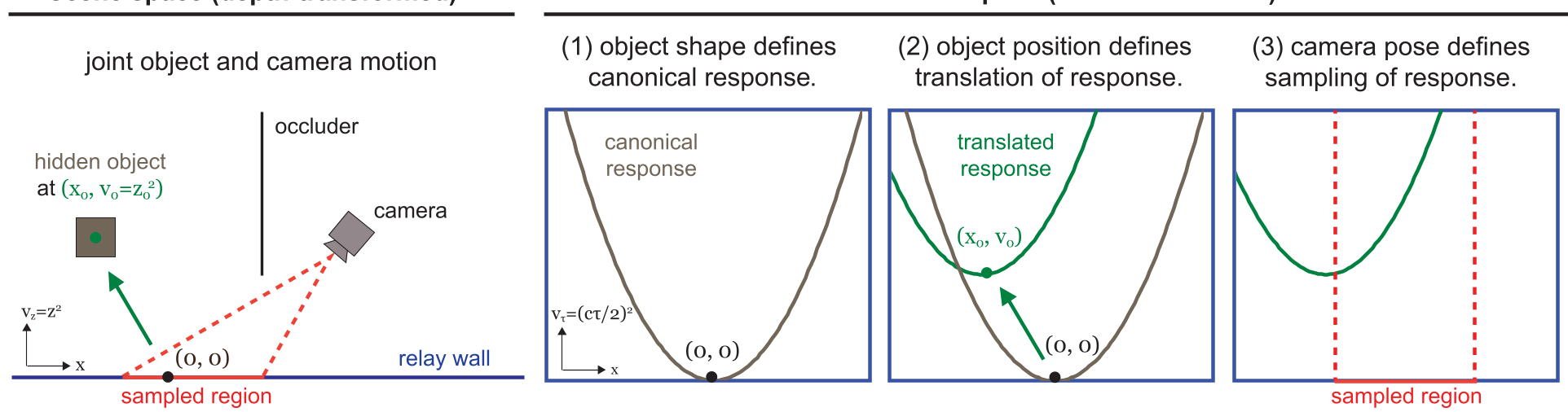
The core insight of this paper is that motion is not a bug; it's a feature. Instead of trying to get a perfect reconstruction from one static frame, the authors use the camera's movement to create a Synthetic Aperture.
1. The Mathematical Intuition
The authors build upon the Light-Cone Transform (LCT). Under LCT, the relationship between a hidden object's shape and the light it reflects is a 3D convolution. The MAS model takes this further by proving that object translation simply results in a shift of the "Canonical Space-Time Impulse Response" (STIR).
2. Particle Filtering for Robustness
To handle the low SNR of consumer sensors, the team used a Particle Filter. Instead of calculating a single position (which is prone to noise), they maintain 1,000 "guesses" (particles). By comparing the actual noisy measurement to a "rendered" version of what each particle would look like, the system converges on the most likely location of the hidden object.

Experimental Breakthroughs
The effectiveness of this "Multi-frame Fusion" was tested across three distinct applications:
- 3D Reconstruction: By moving the phone, the system gathers "viewpoint diversity," allowing it to reconstruct the shape of a hidden mannequin.
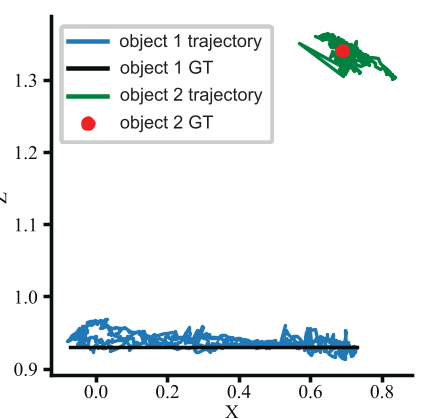
- Multi-Object Tracking: The system could track two hands or objects moving independently behind a wall.
- Camera Localization: If a robot is in a featureless white hallway, it can use the light bouncing off a hidden object (like a chair around the corner) to figure out its own position.
SOTA Comparison
Compared to baseline "Backprojection" methods (which effectively just "guess" based on the last frame), the MAS-based particle filter was significantly more stable and computationally efficient, making it viable for 30Hz real-time mobile processing.
Critical Analysis & Conclusion
Takeaway: This work represents a shift from hardware-heavy NLOS to software-intelligent NLOS. It proves that with the right probabilistic priors (knowing what a person looks like or how they move), we can compensate for "cheap" sensors.
Limitations:
- Retroreflectivity: The model currently works best with retroreflective materials (like safety vests or license plates). Diffuse objects (like plain cloth) still present a significant SNR challenge.
- Shape Priors: For tracking, the system benefits from knowing the object's general shape beforehand.
Future Impact: Imagine a Roomba that doesn't bump into your cat because it "sees" the cat through the reflection on the wall before turning the corner, or an AR headset that tracks your body pose by looking at the floor's reflections. This paper brings us one significant step closer to that reality.
For more technical details, visit the project page at: sidsoma.com/consumer-nlos/