
Imaging the Unseen: Bringing NLOS Capabilities to Consumer LiDAR
Imaging Hidden Objects with Consumer LiDAR via Motion Induced Sampling
The paper introduces a framework for Non-Line-of-Sight (NLOS) imaging using smartphone-grade, low-cost LiDAR sensors. By leveraging a novel Motion-Induced Aperture Sampling (MAS) model and multi-frame fusion, the authors achieve real-time 3D reconstruction, multi-object tracking, and camera localization using hidden objects as landmarks.
TL;DR
Researchers from MIT and Dartmouth have unlocked the ability to "see around corners" using the cheap LiDAR sensors found in modern smartphones. By moving the camera to create a "synthetic aperture" and using Particle Filtering to manage noise, they can track moving hidden objects and navigate featureless rooms by looking at reflections off the wall.
Background: The NLOS Bottleneck
Non-Line-of-Sight (NLOS) imaging has long been the "holy grail" of computational photography—imagine a self-driving car seeing a child around a blind corner or a robot navigating a smoky building. However, for the last decade, this required ultra-fast $50,000 laser systems and clinical lab settings.
The transition to consumer hardware (like the LiDAR in an iPhone or a $100 VL53L8CX sensor) seemed impossible because of:
- Low SNR: Eye-safety regulations limit laser power.
- Low Resolution: Consumer sensors have ~100 pixels, while research setups use thousands.
- Motion Blur: Handheld cameras and moving targets destroy the precise timing needed for light-of-flight math.
The Core Insight: Motion-Induced Aperture Sampling (MAS)
Instead of trying to get a perfect image from a single shot, the authors realized that motion is an asset, not a liability.
They developed the Motion-Induced Aperture Sampling (MAS) model. This mathematical framework uses the Light-Cone Transform (LCT) to treat the relationship between an object's shape and its time-of-flight "echo" as a 3D convolution. Crucially, they proved that an object moving in 3D space is mathematically equivalent to its "echo" shifting in the measured space-time data.
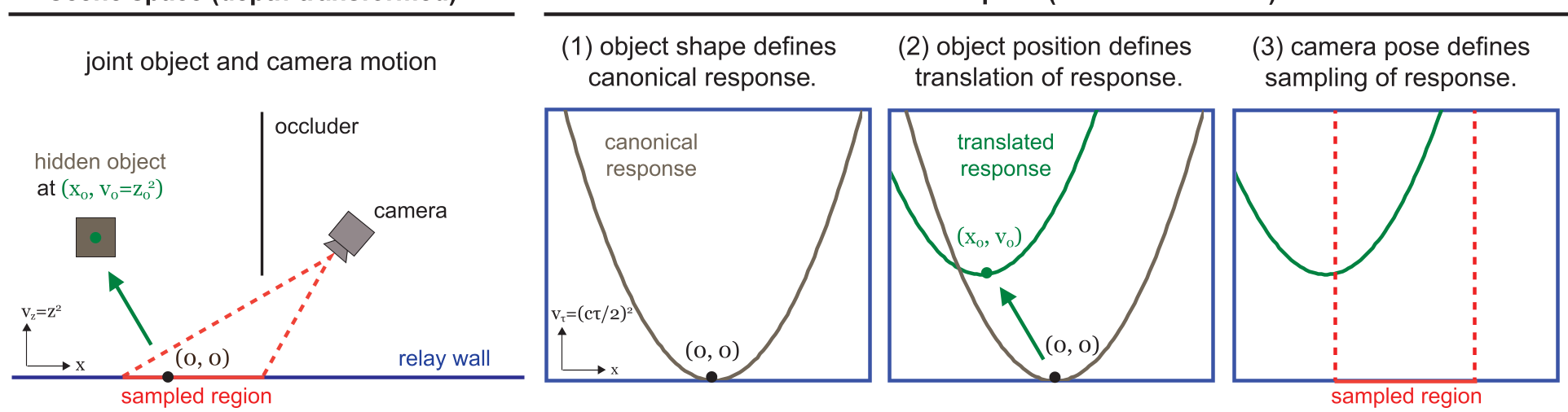 Figure 2: The MAS model decouples object shape (canonical STIR) from time-dependent motion and camera pose.
Methodology: From Physics to Probability
The researchers formulated NLOS imaging as a search for one of three variables:
- Object Tracking: Known shape / pose find position.
- 3D Scanning: Known pose / static scene find shape.
- Localization: Known shape / environment find camera pose.
To handle the extreme noise of consumer sensors, they implemented a Particle Filter. Instead of calculating a single "best guess," the system maintains 1,000 "particles" (hypotheses). Each particle is evaluated against the raw LiDAR data using a score function. This allows the system to resolve ambiguities and leverage "motion priors" (e.g., objects don't teleport; they move smoothly).
 Figure 3: Sequential processing through propagation (prediction), evaluation (measurement), and resampling (selection).
Key Results
The capability was demonstrated across three domains:
- Handheld 3D Reconstruction: By simply waving a smartphone, users can generate a 3D voxel map of a hidden mannequin.
- Multi-Object Tracking: The system successfully tracked two hands moving simultaneously behind a corner in real-time.
- NLOS Localization: Perhaps most impressively, they showed a camera navigating a "white room" with no visible features by using a hidden object's reflection as a landmark.
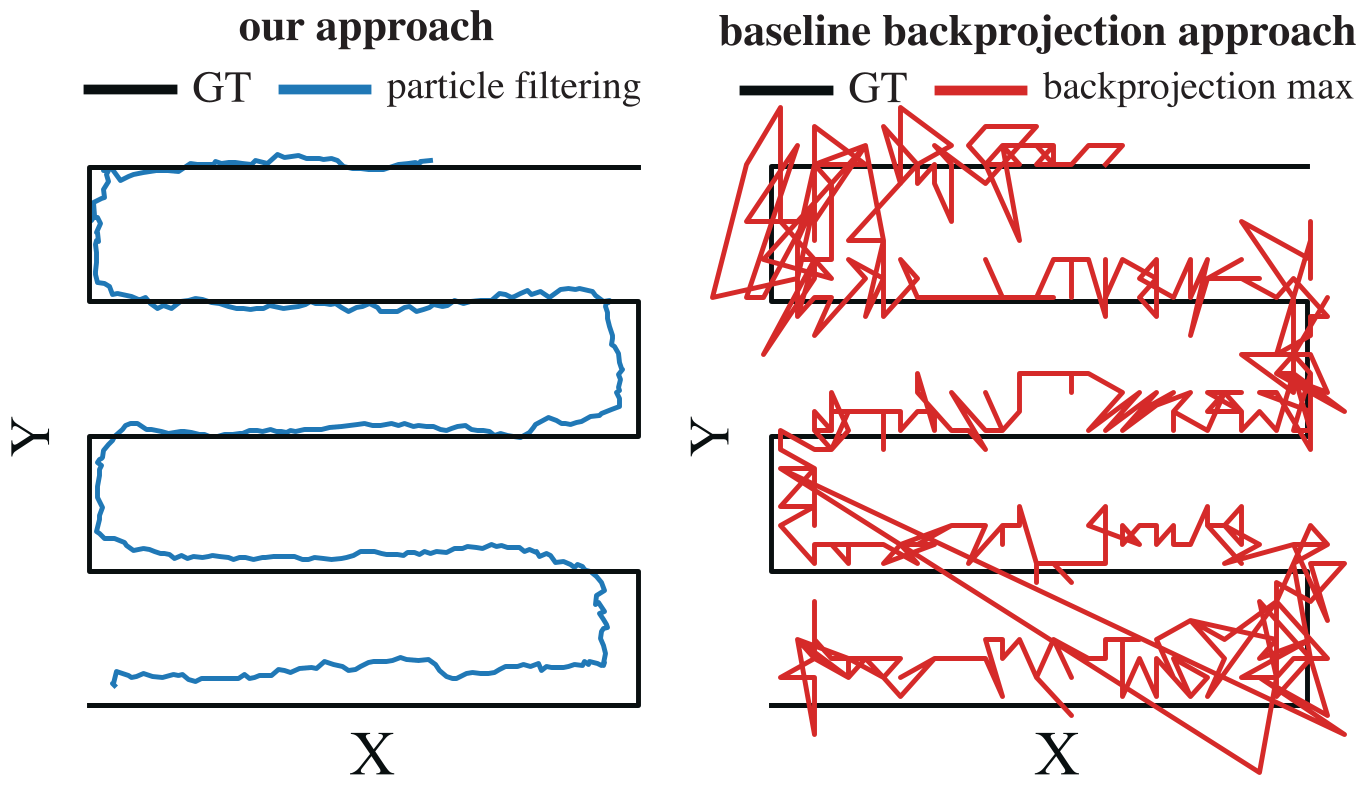 Supplementary Figure: Particle filtering (left) significantly outperforms traditional backprojection (right) in noisy consumer regimes.
Critical Insight & Future Outlook
The genius of this work lies in its Inductive Bias. By assuming the object has a known rigid shape (like a person or a box), the researchers turned an unsolvable "inverse problem" into a tractable "search problem."
Limitations: The current model assumes retroreflective objects (like safety vests or license plates) provide the best signal, though they proved it works—with lower SNR—on diffuse surfaces. Future iterations could leverage Deep Learning to "learn" a better score function that accounts for the complex physics of non-ideal surfaces.
Verdict: This is a seminal step toward "democratized NLOS." It moves the field from "look what we can do in a dark lab" to "look what you can do with your phone."