
Imaging Hidden Objects with Consumer LiDAR: From Lab Curiosities to Plug-and-Play Reality
Imaging Hidden Objects with Consumer LiDAR via Motion Induced Sampling
This paper introduces a real-time Non-Line-of-Sight (NLOS) imaging framework for consumer-grade LiDAR, achieving 3D reconstruction, multi-object tracking, and camera localization using off-the-shelf smartphones (<100). The core method, Motion-Induced Aperture Sampling (MAS), leverages multi-frame fusion and particle filtering to overcome the signal-to-noise ratio (SNR) and resolution limits of low-power sensors.
TL;DR
Researchers from MIT and Dartmouth have broken the "hardware wall" of Non-Line-of-Sight (NLOS) imaging. By using a new mathematical framework called Motion-Induced Aperture Sampling (MAS) and particle filtering, they've turned $100 smartphone-grade LiDARs into sensors that can see around corners, track moving hands, and localize cameras—all in real-time and without specialized lab setups.
Academic Positioning: This work represents a transition from Single-Shot Reconstruction (lab-grade) to Multi-Frame Fusion (consumer-grade), effectively democratization NLOS sensing for mobile and robotic platforms.
The Problem: The "Noise Wall" of Consumer LiDAR
The physics of NLOS is brutal. You are trying to record light that hits a wall, bounces to a hidden object, bounces back to the wall, and finally returns to your sensor—an power drop. While research-grade systems use high-power lasers and superconducting detectors, consumer LiDARs (found in iPhones or Roombas) face three fatal constraints:
- Low SNR: Eye-safety limits mean the laser is weak.
- Poor Resolution: A typical mobile LiDAR has only ~100 pixels.
- Motion Blur: Standard algorithms assume the sensor and object are perfectly still.
Methodology: The MAS Model and Particle Filtering
The breakthrough lies in changing the problem from "What is out there?" to "Given what I know, where is it?"
1. Motion-Induced Aperture Sampling (MAS)
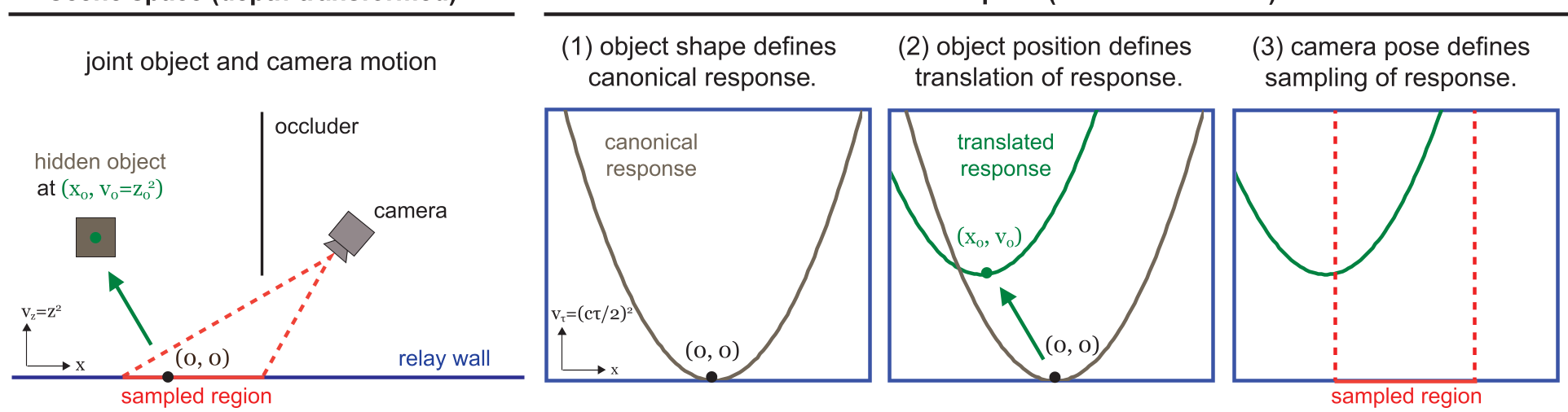
The authors utilize the Light-Cone Transform (LCT), which maps temporal measurements into a 3D space where the relationship between light and geometry becomes a convolution. The MAS model realizes that a shift in object position simply translates this canonical "STIR" (Space-Time Impulse Response).
By moving the camera (Viewpoint Diversity), they create a Synthetic Aperture. This effectively "paints" a larger virtual mirror on the wall, synthesizing high-resolution data from low-resolution hardware.
2. Particle Filtering: Inference in the Dark
Instead of expensive iterative solvers (which fail in real-time), the authors use a Particle Filter.
- Propagation: Moves "particles" (hypothesized object positions) based on a motion prior.
- Evaluation: Renders what the sensor should see for each particle using the MAS model and compares it to actual noisy data.
- Resampling: Kills off hypotheses that don't match the data.
This allows the system to handle multi-object tracking (multi-modal distributions) and quantify uncertainty—essential for robotics.
Results: Seeing the Invisible
The authors demonstrated three transformative applications:
- 3D Reconstruction: Rebuilding the 3D shape of hidden mannequins using natural handheld motion.
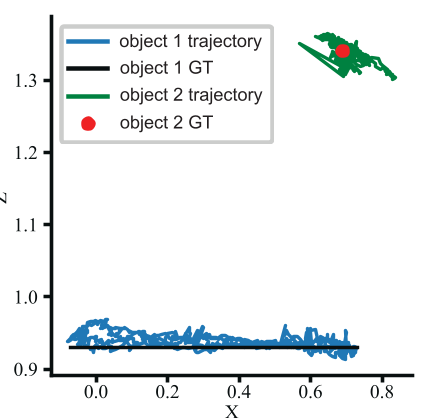
- Multi-Object Tracking: Tracking two hands moving independently around a corner with sub-decimeter accuracy.
- NLOS-based Localization: Using a hidden object as a "landmark" to localize a camera in a room with featureless, white walls where standard SLAM would fail.
SOTA Comparison
Compared to standard Backprojection (BP), the MAS-Particle Filter approach is significantly more robust to noise and computationally lighter, as it samples from a continuous state space rather than computing a dense 3D voxel grid.
| Method | Resolution Support | Real-Time? | Hardware Cost |
|---|---|---|---|
| Traditional BP | High-Grade Only | No | >$10,000 |
| Proposed MAS | Consumer-Grade | Yes (30Hz) | ~$100 |
Critical Analysis & Future Outlook
Strengths: This is a masterclass in Software-Defined Imaging. It circumvents hardware limitations not by building better sensors, but by smarter temporal modeling. The code release for the ST VL53L8CX sensor is a significant "democratization" move.
Limitations:
- Reflectance Assumptions: While it works for diffuse objects, it still prefers retroreflective targets for high reliability.
- Symmetry: Camera localization struggles if the hidden object is perfectly rotationally symmetric (e.g., a sphere).
- Scale: Modeling complex materials (BRDFs) remains a future challenge.
Takeaway: NLOS is no longer a dark-room physics experiment. We are entering the era of Spatial Intelligence where every mobile LiDAR is potentially a "periscope" for looking around the world's corners.