
Deciphering the Digital Pulse: Is Immediate Response Syndrome a Personality Trait?
An analysis of the relationship between immediate response syndrome and the Big Five Personality Scale using structural equation models: A Japanese case study
This study investigates the correlation between "Immediate Response Syndrome" (IRS)—the obsession with checking and replying to digital messages instantly—and the Big Five personality traits. Using Structural Equation Modeling (SEM) on a dataset of 283 Japanese university students, the researchers identified that IRS tendency is primarily driven by spontaneous behavior and social collaboration rather than stress intolerance.
Executive Summary
In an era of "always-on" connectivity, the compulsion to reply to messages instantly—termed Immediate Response Syndrome (IRS)—has become a pervasive psychological phenomenon. This study, conducted by Kazumasa Mori and Hitoshi Umemura, shifts the narrative from viewing IRS as a byproduct of stress to understanding it as a manifestation of specific personality traits. By analyzing 283 Japanese university students through the lens of the Big Five Personality Scale, the researchers conclude that the drive for an immediate response is a spontaneous, socially collaborative act rather than a planned or anxiety-driven one.
The "Why" Behind the Burden: Problem & Motivation
Most users assume that the urge to reply to a Slack message or LINE notification within seconds stems from digital anxiety or a low tolerance for interpersonal stress. However, prior work by Kanoh (2016) only categorized the syndrome without explaining why certain individuals are more susceptible. The authors felt that by mapping IRS to the Big Five—Openness, Conscientiousness, Extraversion, Agreeableness, and Neuroticism—they could uncover the "psychological DNA" of this behavior.
Methodology: Mapping Personality to Action
The study utilized two primary instruments:
- Kanoh’s IRS Scale: A 12-item questionnaire measuring anxiety when away from smartphones and the urgency to reply during meals or at midnight.
- TIPI-J (Ten Item Personality Inventory): A condensed version of the Big Five scale optimized for multi-scale studies.
The researchers went beyond simple correlations, testing five different Structural Equation Models (SEM).
The Winning Architecture: Model E
The researchers found that a two-factor interaction model (grouping traits into OEN and AC clusters) provided the most statistically significant explanation of the data.
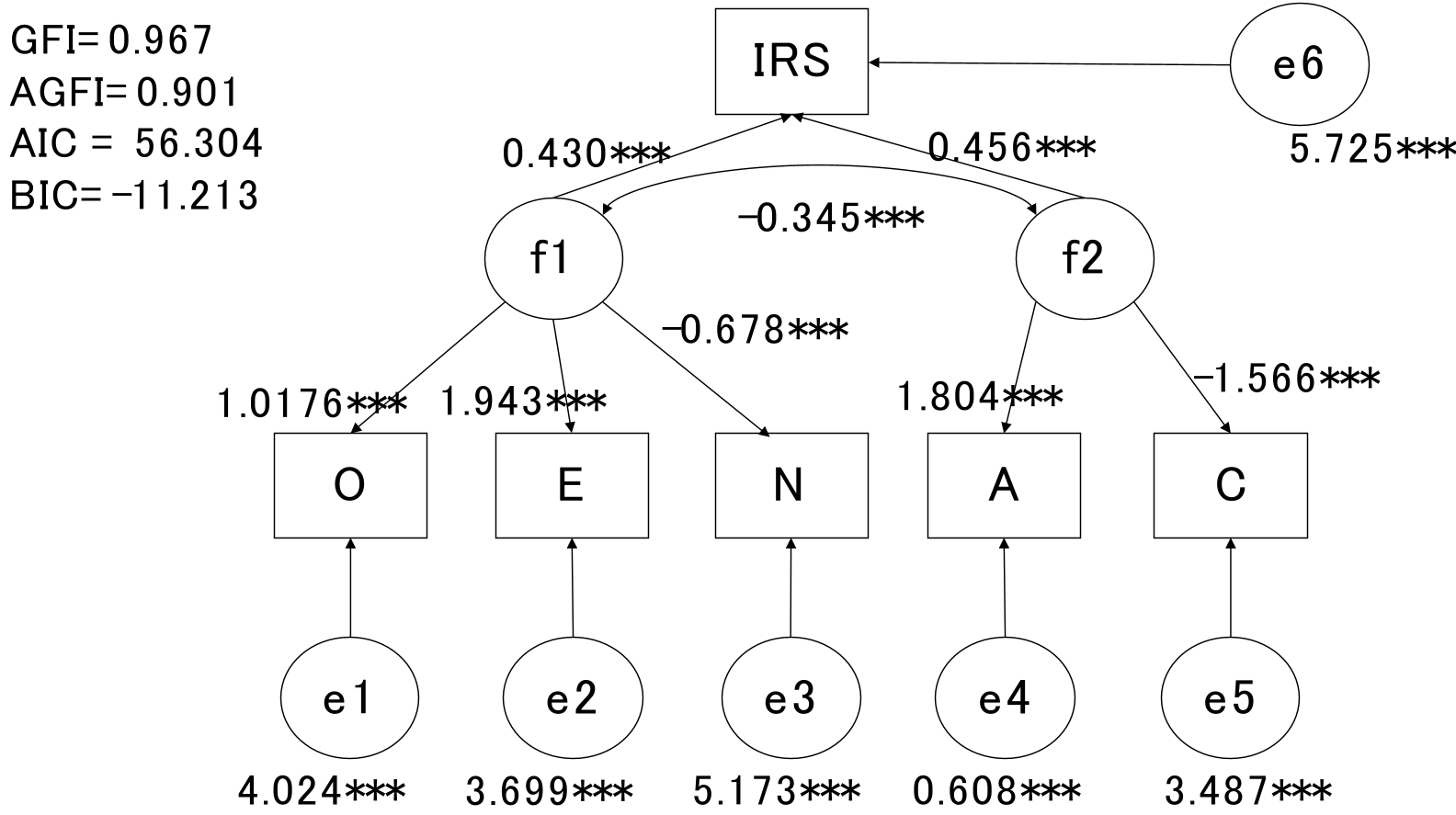 Fig 1: The finalized Model E showing the paths between personality clusters and IRS.
Key Insights and Results
The findings challenge several stereotypes about digital addiction:
- Not a Stress Reaction: Contrary to expectations, there was a negative path between Neuroticism (N) and IRS when mediated through the OEN factor. This suggests that people prone to anxiety are actually less likely to exhibit high IRS, possibly because IRS requires a level of social energy they may lack.
- Spontaneity vs. Planning: High Conscientiousness (C) showed a negative relationship with IRS. This indicates that replying immediately is not a "planned" task-management strategy, but rather a spontaneous impulse.
- Prosocial Collaboration: Extraversion and Openness directed positive paths toward IRS, suggesting that for many, the "syndrome" is actually an expression of their desire for social collaboration and environmental openness.
 Table 1: Descriptive statistics of the TIPI-J and IRS scores among the participants.
Critical Analysis & Future Outlook
The most profound takeaway is that IRS should be treated as "Excessive Communication" rather than a disorder related to stress.
Takeaways for the Future
- For Product Designers: Features like "Do Not Disturb" or "Scheduled Send" shouldn't just be marketed as stress-relievers, but as tools for "spontaneity management" for highly social users.
- Academic Insight: This work breaks the "Neuroticism-Addiction" link often found in internet studies, providing a more nuanced view of how social collaboration drives digital habits.
Limitations
The study did not differentiate between the "unconscious type" (checking habits) and the "needed type" (social pressure) of IRS. Future research should investigate if these two types correlate with different Big Five traits—for example, if "needed" IRS does eventually link back to Agreeableness or anxiety about social rejection.
Conclusion: If you find yourself replying to messages in the middle of the night, it might not be because you're stressed—it might just be your spontaneous, collaborative personality working overtime.