
Immersive Recommendation: Leveraging Personal Digital Traces to Solve the Cold-Start Problem
Immersive Recommendation: News and Event Recommendations Using Personal Digital Traces
The paper introduces "Immersive Recommendation," a user-centric framework that leverages diverse personal digital traces (email, Twitter, Facebook) to drive news and event recommendations. It features a novel Context-Aware LDA (CA-LDA) for multi-platform interest profiling and a hybrid collaborative filtering model that outperforms state-of-the-art baselines like CTM and PMF.
Executive Summary
TL;DR: This paper introduces Immersive Recommendation, a paradigm shift from provider-centric to user-centric systems. By aggregating a user's "digital traces" from email, Twitter, and Facebook, the researchers developed a system that understands a user's interests before they even interact with a new platform. The core innovation—Context-Aware LDA (CA-LDA)—successfully filters out the "noise" of daily communication to find the "signal" of genuine interest, leading to a massive 57.9% improvement in recommendation accuracy over existing SOTA methods.
Background Positioning: This work bridges the gap between Personal Informatics (Small Data) and Recommender Systems. It moves beyond simple social-graph-based recommendations into a holistic, cross-platform interest profiling model that is particularly potent for news and localized events.
Motivation: The Contextual Noise Problem
Prior recommenders often struggle with "Cold-Start"—the scenario where a system knows nothing about a new user. While some systems try to use social media data, they often fail to distinguish between functional language and interest language.
For example, an email about "scheduling a meeting to discuss the CES exhibition" is fundamentally about technology (CES), but a standard model might wrongly flag the user as being interested in "calendars" or "office management" due to the high frequency of those words in the email context. The authors realized that to make cross-platform data useful, they needed to strip away the "background noise" of each channel.
Methodology: CA-LDA and Hybrid Collaborative Filtering
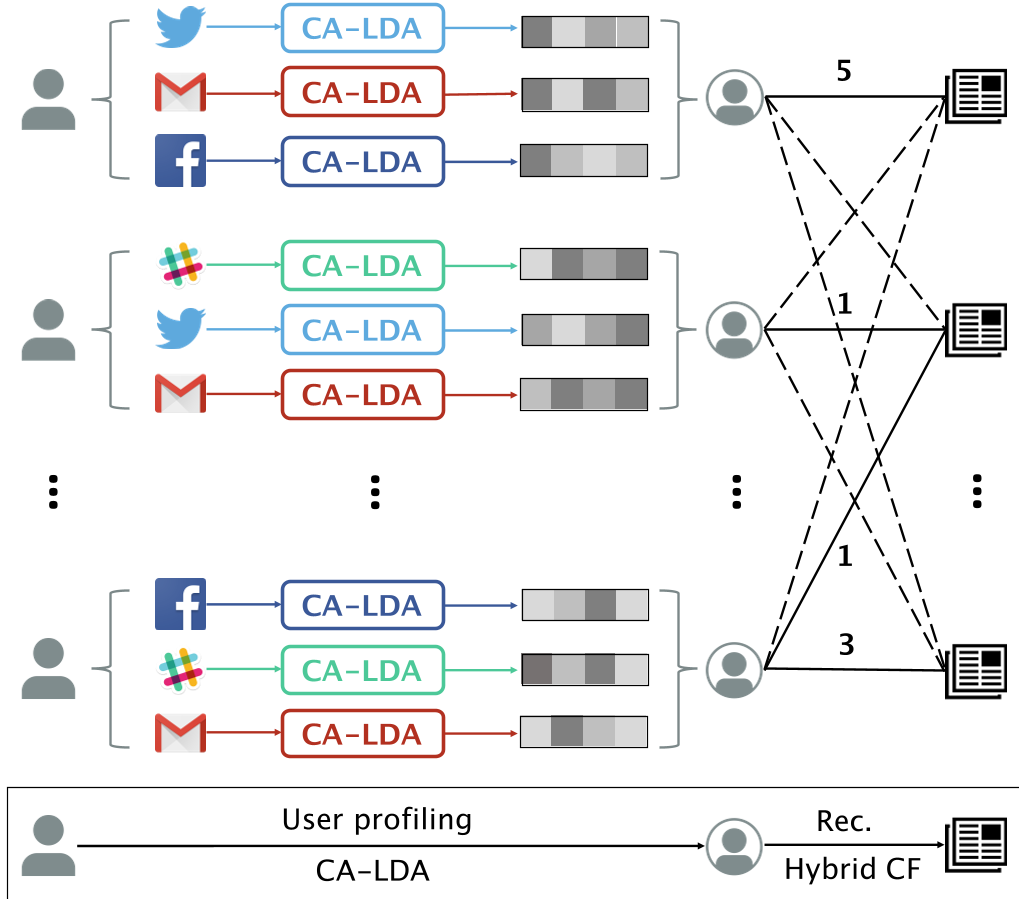
The researchers proposed a two-phase approach: User Profiling and Recommendation.
1. Context-Aware LDA (CA-LDA)
CA-LDA is the engine of the profiling phase. Unlike standard LDA, it assumes that every document is a mixture of salient topics (actual interests) and a background topic (noise specific to the platform). By co-training multiple corpora (e.g., news articles + Enron emails + Twitter feeds), the model learns that "sharing" is a background term for Twitter, while "CES" is a salient interest shared across platforms.
2. The Hybrid Recommendation Model
To ensure the system remains flexible, they introduced a regression-based latent factor model. It combines:
- User/Item Profiles: The objective features derived from CA-LDA.
- Latent Offsets (): These represent the "subjective" preferences. If a user starts liking articles their digital traces didn't predict, the offset adjusts to "fine-tune" the profile to the current platform.
Experiments & Results
The authors conducted an extensive offline evaluation using 63,053 Medium.com users and 50,000 Meetup.com users, leveraging their public Twitter traces.
Performance Gains
- Profiling Accuracy: CA-LDA outperformed standard LDA by 77.4% in mAP for event recommendations.
- End-to-End Recommendation: The "ImmRec" model outperformed Probabilistic Matrix Factorization (PMF) and Collaborative Topic Modeling (CTM).
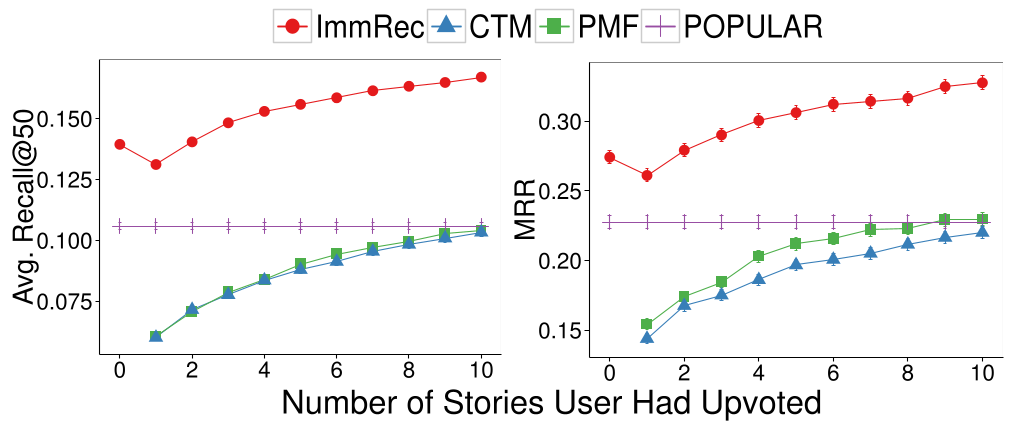
One of the most striking findings: Immersive Recommendation's zero-shot performance (cold-start) was higher than other models' performance after they had received 10 user ratings. This effectively "deletes" the cold-start period for new users.
Critical Analysis & Conclusion
The "Takeaway"
The value of this paper is in its User-Centricity. It proves that our "Small Data" (emails, Slack messages, social posts) contains a dense topical signature that can provide instant value when entering new digital environments.
Limitations & Future Work
- Topical Entropy: The authors noted that if a user has highly focused traces (low entropy), the model can become too narrow. They suggest mixing in popular items to maintain serendipity.
- Privacy: While the authors mention client-side inference, the centralized aggregation of email and social media remains a high-stakes privacy challenge that future "Immersive" systems must solve through federated learning or Differential Privacy.
Ultimately, this work paves the way for a "Digital Twin" of our interests that travels with us across the web, ensuring that the "News that Matters" finds us, rather than us having to train every new app from scratch.