
IIMOF: Elevating Social Opinion through Iterative Influence Maximization
IIMOF: An Iterative Framework to Settle Influence Maximization for Opinion Formation in Social Networks
This paper introduces IIMOF, an iterative framework designed to solve the Influence Maximization for Opinion Formation (IMOF) problem in social networks. By combining a weighted coordination model with a novel SRI2 (Score and Rank of each node by Iterative 2-hop) algorithm, the framework identifies optimal seed nodes to propagate ideal opinions across a network.
TL;DR
The IIMOF (Iterative Framework for Influence Maximization for Opinion Formation) framework tackles the challenge of shifting a social network's collective opinion toward an "ideal" value. By treating opinion formation as a constrained optimization problem and employing a sophisticated 2-hop iterative ranking algorithm (SRI2), it identifies key "seed nodes" more effectively than traditional greedy or heuristic methods.
Problem & Motivation: Beyond Binary Influence
In traditional Influence Maximization (IM), nodes are often treated as binary (active/inactive). However, real-world social dynamics involve Opinion Formation (OF), where opinions are continuous values (e.g., -1 to 1).
Existing research faces two major hurdles:
- Model Simplicity: Standard models like the Bounded Confidence model assume neighbors influence a node equally, ignoring individual node "weight" or authority.
- Algorithmic Inefficiency: Greedy algorithms provide accuracy but are computationally expensive due to Monte Carlo simulations, while heuristics like Degree Centrality are fast but often inaccurate.
The authors' insight was to create a framework that bridges this gap—offering the efficiency of heuristics with the stability of iterative optimization.
Methodology: The Core of IIMOF
1. The Weighted Coordination Model
Unlike previous models, IIMOF introduces a model where the influence of a neighbor on node is weighted by their respective influences , derived from their out-degrees. This ensures that highly influential nodes have a more significant impact on their neighbors' opinion shifts.
2. The SRI2 Algorithm
The "engine" of IIMOF is the Score and Rank of each node by Iterative 2-hop (SRI2) algorithm. It operates on the principle that information spread and influence effectively dissipate beyond 2 hops.
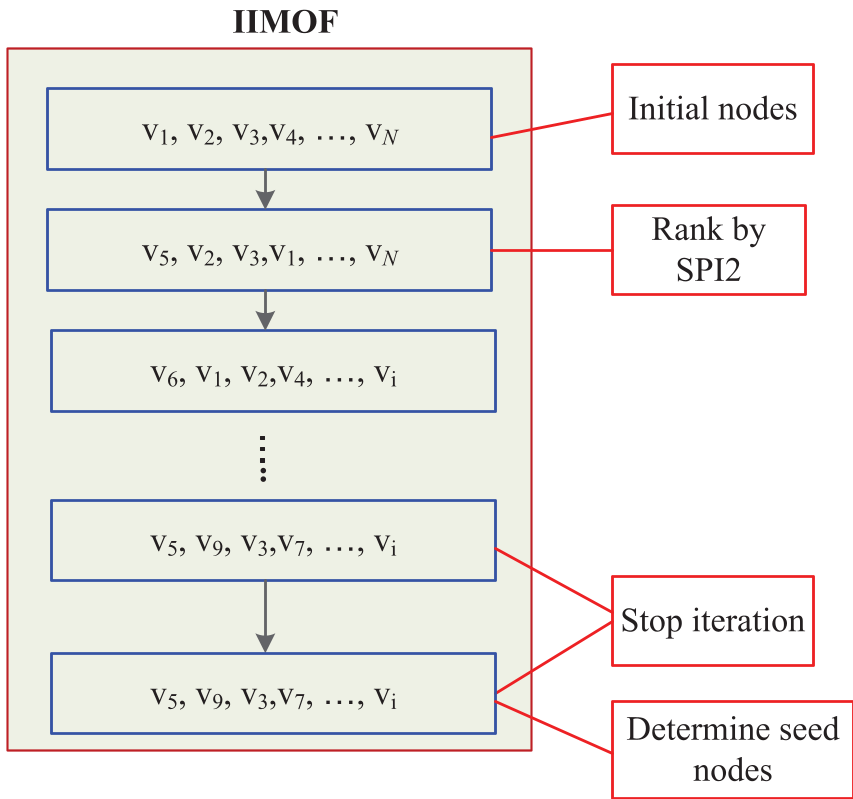
The algorithm iterates through node scores, updating them based on a proportional parameter that balances 1-hop and 2-hop influence, eventually converging to a stable ranking of potential seed nodes.
Experiments & Results
The authors tested IIMOF against state-of-the-art methods including PageRank, Degree Discount, and CoFIM across diverse datasets like Barabasi-Albert (BA) and Email networks.
Performance Gains
In artificial networks, IIMOF achieved an average opinion of 0.893, significantly outperforming the next-best baseline (EPN at 0.846).
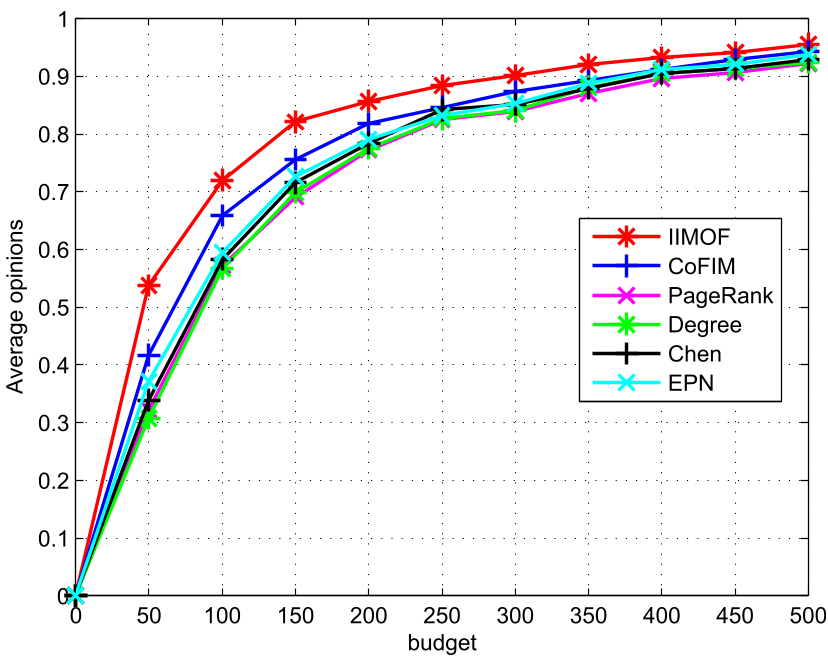
As shown in the charts, as the budget for seed nodes increases, IIMOF's ability to maximize the average opinion remains superior across the board. This advantage is persistent in large-scale real-world networks like Advogato (6,541 nodes, 51,127 edges).
Convergence Stability
A critical contribution of this work is the mathematical proof that IIMOF converges to a stable order within finite iterations, providing a reliable theoretical ceiling for its performance.
Critical Analysis & Conclusion
Takeaway
IIMOF proves that iterative refinement of node influence, specifically looking at the 2-hop neighborhood, provides a "sweet spot" for optimizing opinion dynamics. It moves the field from "how many nodes can we reach" to "how effectively can we change the network's mind."
Limitations
While the 2-hop measure is efficient, it might still miss long-range "cascading" effects in extremely dense or highly clustered networks. Additionally, the model assumes a relatively static network topology during the opinion formation process.
Future Outlook
The next step for this research is adapting the framework for Influence Minimization, which could be vital for counter-acting the spread of misinformation or harmful ideologies in social media ecosystems.