Beyond Words: Decoding the Emotional Pulse of Figurative Language
Impact analysis of emotion in figurative language
This paper introduces an emotion-centric framework for multi-figurative language detection (Humor, Irony, Sarcasm, and Satire) in Twitter data. Using an Ensemble Bagging classifier and a novel "Bag-of Sorted Emotion" (BOSE) feature set, the model achieves a perfect F1-score of 1.00 on both balanced and highly class-imbalanced streaming datasets.
TL;DR
Recognizing humor, irony, and satire in the wild is a nightmare for NLP because these expressions are rare and linguistically "stealthy." This paper presents an emotion-driven approach using Bag-of Sorted Emotion (BOSE) features and Ensemble Bagging to achieve near-perfect detection accuracy, even when figurative tweets are buried in a sea of literal data.
The "Accuracy Paradox" in Figurative Language
Most NLP models are lab-grown on balanced datasets where humor and literal text exist in a 1:1 ratio. Real life—specifically Twitter—looks nothing like this.
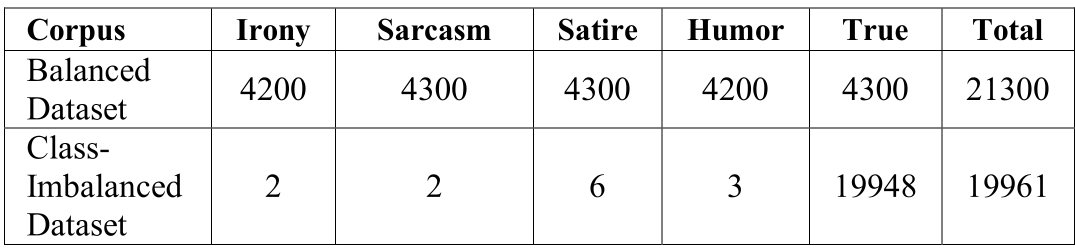
The authors observed that in a stream of "Hillary Clinton" tweets, the ratio of literal ("True") tweets to sarcasm or irony can be as extreme as 8376:2. In such cases, a model that simply predicts everything as "True" would achieve 99.9% accuracy but fail entirely at the task. This is the Accuracy Paradox, and it’s why traditional word-based models fail in production.
Methodology: The Anatomy of an Emotion
The core innovation lies in moving away from what is said (lexical signatures) to how it feels (emotional signatures).
1. Feature Engineering: BOSE & BOSE-TFIDF
Instead of just counting "happy" or "sad" words, the researchers developed Bag-of Sorted Emotion (BOSE). They extract eight basic emotions (Anger, Anticipation, Disgust, Fear, Joy, Sadness, Surprise, Trust) and rank them.
- The Intuition: A sarcastic tweet might have a unique "emotional fingerprint"—perhaps a high ranking of "Joy" mixed with a high ranking of "Disgust"—that differentiates it from pure satire or humor.
- BOSE-TFIDF: By applying TF-IDF weighting to these emotional n-grams (e.g., an "Anticipation-Fear" bigram), the model learns which emotional transitions are most indicative of figurative intent.
2. The Model Architecture
The paper utilizes an Ensemble Bagging Classifier. By training multiple base learners on different subsets of the data, the model becomes significantly more resilient to the noise and sparsity inherent in Twitter's figurative language.
Experimental Showdown
The researchers tested their approach against a standard Bag-of-Words (BoW) baseline and a Linear SVM.
Key Findings:
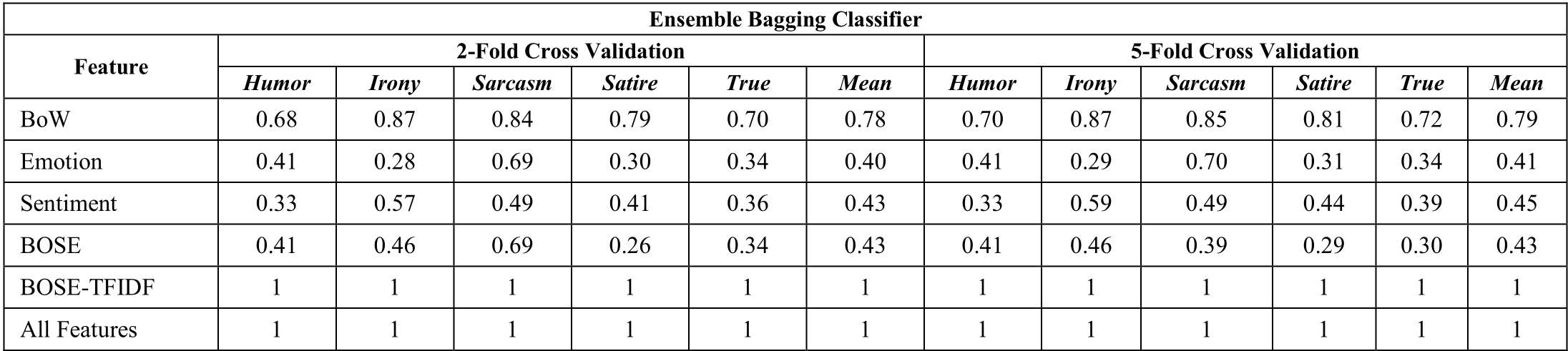
- Balanced Data: While BoW struggled to differentiate between nuance (Mean F1 ~0.78), the BOSE-TFIDF ensemble reached 1.00.
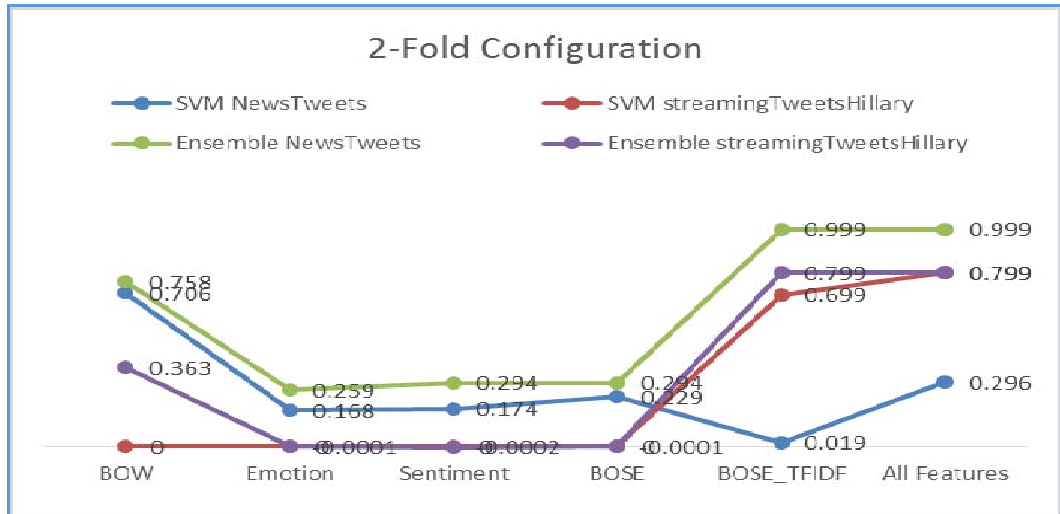
- Imbalanced Data: In the "Hillary" stream dataset, the baseline models collapsed under the weight of the majority class. However, the BOSE-TFIDF features allowed the system to maintain a high Cohen’s Kappa score, proving it wasn't just guessing based on frequency.
Critical Insight: Why Emotion Works
Figurative language is essentially a mismatch between literal meaning and intended emotion. By explicitly modeling the emotional "valence" and the hierarchy of feelings (via BOSE), the researchers effectively captured the pragmatics of the text rather than just the semantics.
Conclusion & Future Outlook
This work demonstrates that when text is implicit—as is the case with irony and sarcasm—we must look at emotional metadata to find the truth. The authors suggest that this framework is a stepping stone toward automated fake news detection, where satirical cues are often used to mislead or entertain.
Limitations: The reliance on pre-defined emotional lexicons (EmoLex) may limit the model's ability to evolve with internet slang, suggesting a future need for deep-learning-based emotional embeddings.