
The Physics of Virality: Decoding Content Popularity and Information Coverage in OSNs
7691_Impact of Content Popularity on Information Coverage in Online Social Networks.
This paper explores the quantitative relationship between content popularity and information coverage in Online Social Networks (OSNs). Using a geography-aware rank-based model and a "first-copy forwarding" behavior analysis, the authors identify critical thresholds for global content dissemination. The study establishes that achieving complete network coverage requires a forwarding probability , where is the number of friends per user.
TL;DR
Why do some news stories spread globally while others die in obscurity? This paper mathematically formalizes the link between content popularity (modeled as forwarding probability ) and information coverage. The core finding: to reach a constant portion of a social network, a user’s forwarding probability must be at least inversely proportional to their number of friends (). Effectively, the "magic number" of friends who share the content must stay constant for the fire to keep burning.
Problem & Motivation: The "First-Copy" Hurdle
In Online Social Networks (OSNs), we are constantly bombarded with information. However, our behavior follows a specific pattern: the first-copy forwarding behavior. You only decide to "Share" a joke the first time you see it. If five other friends share it later, you don't share it again.
This creates a massive analytical headache for researchers. Conventional epidemic models often assume independent events, but in OSNs, the probability of you spreading information depends heavily on who sent it to you first and how your friends are geographically grouped. The existence of the Small-World Phenomenon means your friends likely know each other, leading to "wasted" redundant shares that don't reach new audiences.
Methodology: Geography-Aware Partitioning
The authors use a Rank-Based Model to simulate social ties. In this model, the likelihood of two people being friends depends on how many other people live closer to them (their "rank").
To calculate the coverage without getting lost in the dependencies of the first-copy behavior, the authors introduced a brilliant Network Partition strategy (Torus Partition):
- Concentric Rings: The network is divided into a central circle and multiple surrounding rings.
- Directional Constraints: For the sake of the proof, they analyze a scenario where nodes forward content primarily to the next outer ring.
- Inductive Spreading: They prove that if a constant portion of Ring receives information, it will inevitably spread to a constant portion of Ring , provided the forwarding probability is high enough.
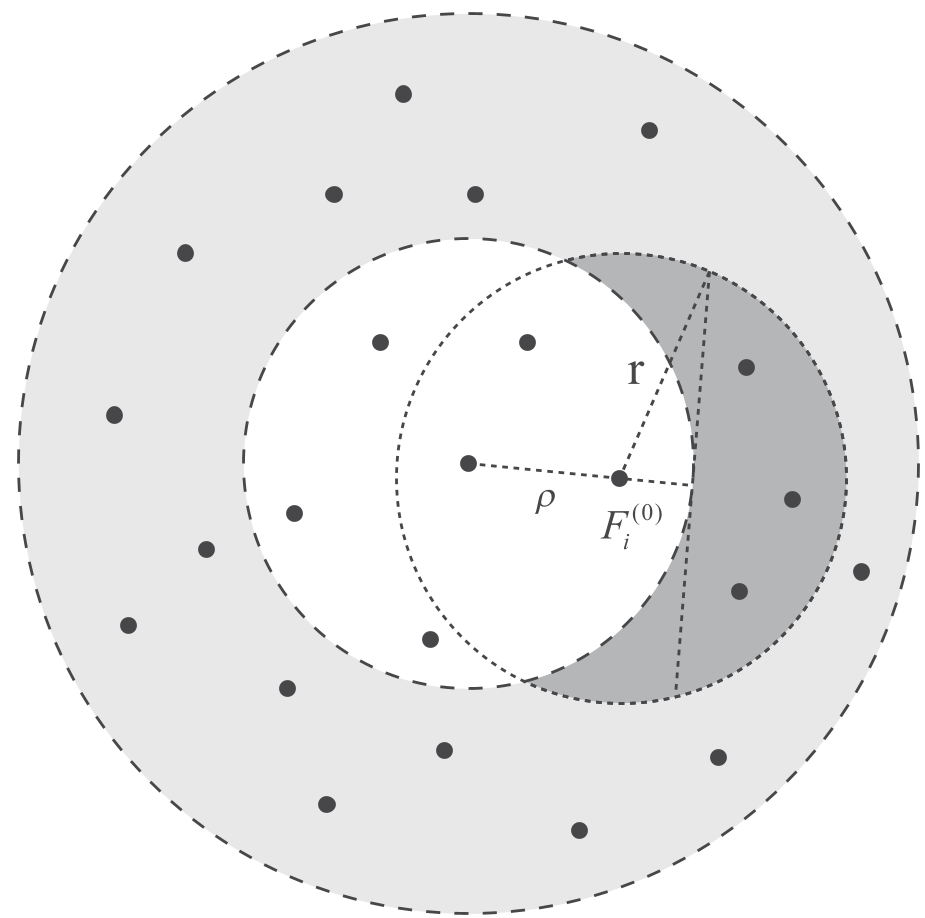 Fig 1: The Torus Partition method used to simplify the dependency analysis of information flow.
The Mathematical Intuition
The paper derives a critical threshold for . The expected number of friends who decide to forward the content is . The research proves that must exceed a constant (where is the locality parameter of the network) to achieve "Complete Coverage."
If , the information dies out exponentially as it moves away from the source. If it exceeds this bound, the coverage achieves a stable "Phase Transition," reaching a constant percentage of the entire population regardless of how large the network grows.
Experimental Validation: Small Scale vs. Real World
The authors tested their math against both synthetic data and a real-world crawl of Weibo (87,321 nodes).
- Homogeneous vs. Heterogeneous: In synthetic networks where everyone has the same number of friends, the spread is predictable.
- The Influence of "Hubs": In the real Weibo data, they noticed that if influential nodes (those with many friends) act as the source, high coverage can be achieved even with very low popularity ().
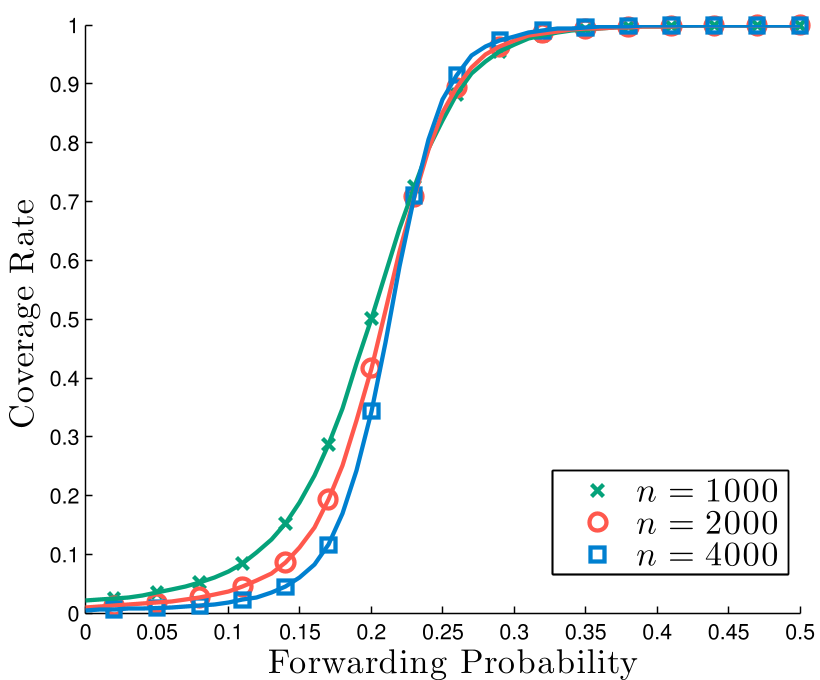 Fig 2: Coverage rate as a function of forwarding probability across different network sizes and friend counts.
Critical Analysis & Conclusion
This work provides a solid theoretical foundation for Viral Marketing. It moves away from "what" spreads to "how much" it spreads based on network topology.
Limitations:
- The model assumes a uniform distribution of nodes, whereas real humans cluster in cities.
- It assumes a fixed for the analytical derivation, while real-world social degrees follow a Power-Law distribution (many have few friends, few have thousands).
Future Outlook: The next frontier is applying this to Multi-modal networks (e.g., how a story spreads from Twitter to YouTube) and incorporating Clustering Distributions to see how urban density affects the speed of digital rumors.