
Digital Agriculture: How Data Analytics is Architecting the Future of Food Security
The Impact of Data Analytics in Digital Agriculture: A Review
This paper provides a comprehensive systematic review of data analytics and big data mining techniques in Digital Agriculture (DA), focusing specifically on crop yield monitoring. It introduces a novel classification of data mining techniques applied to agriculture and discusses the integration of SOTA methods like CNNs and SVMs for productivity enhancement.
Executive Summary
TL;DR: This review explores the technological shift from traditional farming to Digital Agriculture (DA), where Data Science and Big Data Analytics serve as the cognitive engine. By analyzing SOTA methods in crop yield monitoring—from Bayesian classifiers to Deep Learning—the paper establishes a roadmap for how data-driven insights can optimize resource allocation and mitigate environmental impact.
Context: This work functions as a structured taxonomy and critical review, positioning itself as a bridge between classical statistical agronomy and the modern era of Deep Learning and Big Data 4Vs.
Problem & Motivation: Beyond the "Green Revolution"
The 20th-century Green Revolution relied on intensive chemical use, which is now hitting a ceiling of sustainability and environmental degradation. The modern "Digital" revolution faces a different set of obstacles:
- Data Heterogeneity: Information comes from disjointed sources like satellite RGB, spectral sensors, and historical weather records.
- Latency in Decision Making: Farmers often lack the "on-season" insights needed to pivot strategies before the harvest.
- The Complexity of Nature: Unlike factory automation, agriculture involves high variance due to climate aberrations and biological mutations (pests/diseases).
Methodology: The Architecture of Smart Farming
The authors decompose the complexity of Digital Agriculture into a systematic lifecycle. The core insight is that Crop Yield Monitoring is not a single task but a multi-faceted pipeline.
The Crop Management Framework
As shown in the architecture below, the process integrates soil, weather, weed, and irrigation monitoring into a unified yield estimation model.
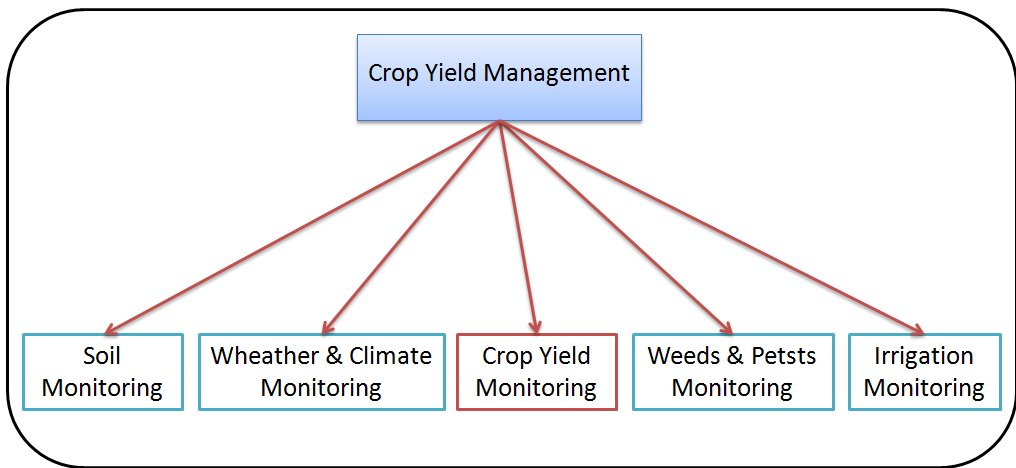
The paper categorizes the analytical methods into four pillars:
- Classification: Identifying plant species and distinguishing weeds (using SVMs and CNNs).
- Prediction: Forecasting output using time-series (RNNs) and soil-climatological regression.
- Detection & Protection: Early-stage disease diagnosis via computer vision.
- Clustering: Delineating "Management Zones" to handle field-level variability.
From Pixels to Decisions: The Big Data View
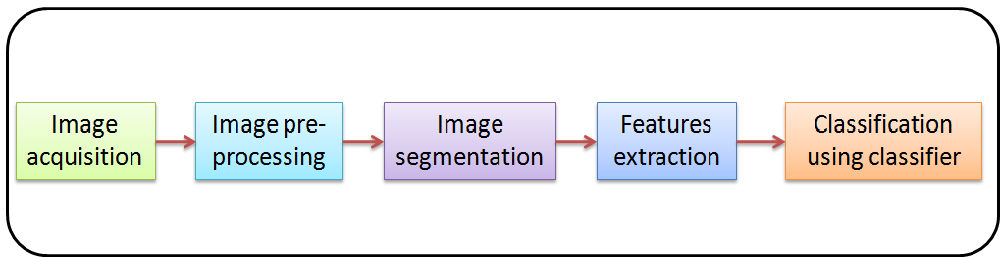
The methodology for image-based data follows a rigorous pipeline: Acquisition → Pre-processing → Segmentation → Feature Extraction → Classification.
SOTA Performance Highlights:
- CNNs for Disease Detection: Recent models (like those using the PlantVillage dataset) have achieved accuracies exceeding 96%, effectively automating the role of a plant pathologist.
- SVMs for Weed Discrimination: SVM architectures have proven robust in high-noise outdoor environments, maintaining near 97% accuracy.
Experimental Analysis: The Big Data 4Vs Test
A unique contribution of this paper is the evaluation of existing research against the 4Vs of Big Data (Volume, Velocity, Variety, Veracity).
The authors conclude that while Variety (multi-source data) and Veracity (data quality) are heavily addressed in current research, Volume is often missing. Most studies use "small" datasets (hundreds to thousands of points) because:
- Agricultural data is often proprietary (owned by big corporations).
- Fragmented smallholder farms do not have the infrastructure for massive data collection.
- Data silos prevent the creation of "ImageNet-scale" agricultural datasets.
Critical Insight & Conclusion
The Shift to Deep Learning
We are seeing a clear transition from shallow learners (K-means, Naive Bayes) to Deep Architectures (LSTM, CNN). LSTMs, in particular, are gaining traction for "Transfer Learning"—applying knowledge from one region’s harvest (e.g., Argentina) to predict yields in another (e.g., Brazil).
Limitations & Future Directions
The "Spirit of algorithms" is data, but the "Soul of the farm" is the farmer. The paper identifies a significant Digital Divide:
- Cost Barriers: Satellite imagery and high-end sensors remain prohibitively expensive for small-scale farmers.
- Interpretability: Complex Deep Learning models act as "Black Boxes." To gain farmer trust, Explainable AI (XAI) is needed to explain why a model recommends more fertilizer in a specific zone.
Takeaway: Digital Agriculture is on the verge of its "Big Data" moment. The integration of edge computing/IoT with cloud-based deep learning will soon move yield mapping from a post-harvest "look-back" to a real-time "look-ahead" decision tool.