
The Myth of Reciprocity: How Influential Leaders Shape Social Networks
The impact of influential leaders in the formation and development of social networks
This study investigates the communication dynamics and network topology of influential opinion leaders on Twitter during the 2011 Seoul mayoral election. By applying the HITS algorithm and triad analysis to approximately 20,000 tweets, it reveals that Twitter influence is highly centralized and characterized by one-way propagation rather than reciprocal exchange.
TL;DR
This research dissects the 2011 Seoul mayoral election on Twitter to uncover a harsh reality: social media is less of a digital "town square" and more of a "broadcast tower." By analyzing the communication patterns of candidate Wonsoon Park and his mentors, the study finds that network structures are predominantly fragmented and one-way, driven by a few "hyper-influentials" who act as digital gateways.
Contextualizing Virtual Influence
In the landscape of Social Network Services (SNS), we often assume that "connectivity" equals "conversation." However, this paper positions itself as a critical examination of the Influential Hypothesis. While scholars like Duncan Watts have suggested that large cascades are driven by easily influenced masses rather than influencers, this study explores whether specific "opinion leaders" reclaim their power during high-stakes events like political elections.
Methodology: Authorities, Hubs, and Triads
To measure influence, the researchers didn't just look at follower counts—which can be misleading—but used the HITS Algorithm. This method distinguishes between two types of nodes:
- Authorities: Highly trusted nodes that many people point to (e.g., subject matter experts).
- Hubs: "Organizers" that point to many good authorities (e.g., news aggregators).
Furthermore, the team used Social Network Triads (structures of three nodes) to see if information "circulates" (transitive) or "converges" (fragmented).
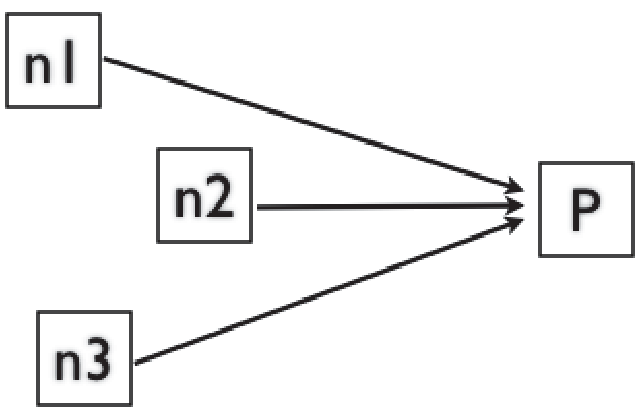 Figure: The recursive logic of Authority and Hub scores used to quantify influencer impact.
Key Findings: The Rise of MeMedia
The results provide a fascinating look at the "Digital/Physical" divide:
- Asymmetric Dominance: Candidate Wonsoon Park’s network was significantly larger and more active than his opponent’s, largely because he utilized "mentors" who acted as structural gateways to different user clusters.
- The "MeMedia" Phenomenon: Some of the most influential "Authorities" on Twitter (like the user coreacom) had zero mentions in traditional offline media. This suggests that Twitter allows for the birth of independent power centers that bypass traditional gatekeepers.
- Lack of Transitivity: Out of the 16 possible triad types, the most frequent ones were those with zero or only one-way connections. Communication didn't flow in circles; it was a one-to-many broadcast.
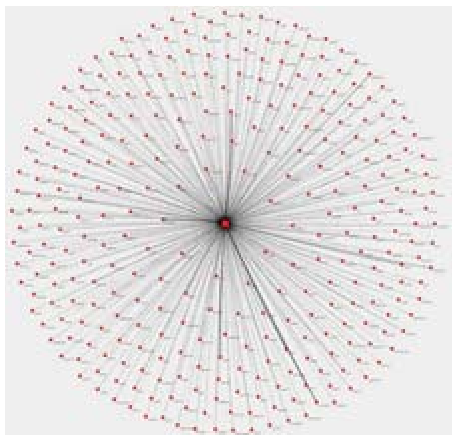 Figure: Visible disparity in the communication range between Candidate Na (left) and Candidate Park (right), highlighting the extensive reach of the latter's 'mentor' network.
Critical Analysis: Why This Matters
The most striking takeaway is the fragmentation of the network. The study concludes that communication on Twitter during the election was an act of "aggregation and propagation."
While Twitter is marketed as a platform for dialogue, this data suggests it functions as a mechanism for scaling influence. The mentors and candidates didn't necessarily engage in "sharing" in the egalitarian sense; they performed "filtering," where the public either accepted or repeated the signal.
Limitations and Future Outlook
While the study is robust in its use of the HITS algorithm, it focuses on a specific cultural and political moment in South Korea. However, the core insight—that virtual communities are often built around "gatekeepers" rather than "peers"—remains a fundamental truth of the modern internet. As we move toward AI-driven social feeds, the role of these "human hubs" may shift, but the structural tendency toward fragmentation likely remains an inherent trait of digital social topology.
Conclusion
This paper serves as a reminder that in the digital age, influence is structural. It is not just about what you say, but where you sit in the triad. For researchers and marketers alike, the message is clear: to move a network, you don't need to talk to everyone—you just need to be the gateway.