
Knowledge Creation: Why Structure Matters for Complex Innovation
The Impact of Knowledge Property and Social Capital on Creation Performance: Moderation of Goal-Driven Strategy
This research investigates how Knowledge Property (tacitness and complexity) and Social Capital (structural, relational, and cognitive) influence Knowledge Creation Performance. Using empirical data from 142 firms, it identifies "Goal-Driven Strategy" as a critical moderator that enhances the impact of complex knowledge and cognitive social capital on innovation outcomes.
TL;DR
In the hyper-competitive landscape of manufacturing and services, innovation is the only currency that doesn't depreciate. This study analyzes 142 companies to prove that while tacit knowledge and social networks are the fuel for innovation, a Goal-Driven Strategy acts as the engine that converts that fuel into performance—especially when dealing with highly complex information.
The Core Conflict: Chaos vs. Control
In management theory, there is a long-standing debate: Does creativity require absolute freedom (Goal-Free), or does it thrive under pressure (Goal-Driven)?
The authors argue that the "Resource-Based View" (RBV) is insufficient on its own. Possessing knowledge (the resource) isn't enough; organizations must understand how the nature of that knowledge (Knowledge Property) and the bonds between employees (Social Capital) interact with corporate strategy.
Methodology: The Analytical Framework
The researchers focused on two primary drivers:
- Knowledge Property: Defined by Tacitness (intuition and experience) and Complexity (the number of interrelated conceptual elements).
- Social Capital: Divided into Structural (who knows whom), Relational (trust and cohesion), and Cognitive (shared vision and language).
They hypothesized that a Goal-Driven mode—where targets are fixed and recognized—would moderate these relationships.
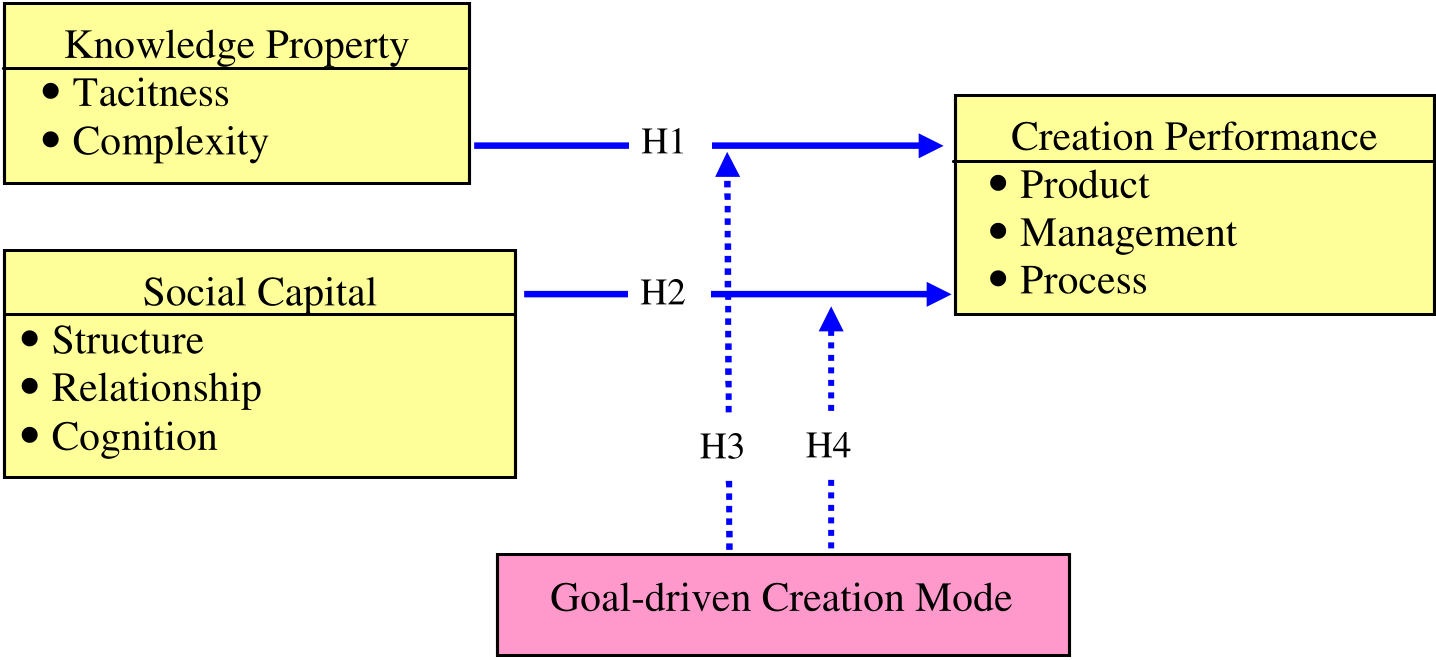 Figure 1: The conceptual framework illustrating the moderating role of Goal-Driven Creation Mode.
Key Insights from the Data
The study’s regression analysis yielded several "Eureka" moments for technical managers:
1. Complexity Demands Direction
One might think that complex, original ideas need freedom. However, the data shows that Goal-Driven modes significantly enhance the performance of complex knowledge. When ideas are complicated, a clear goal provides the "thinking space" and boundaries required to prevent the team from getting lost in the weeds.
2. The Power of "Shared Language"
Social capital isn't just about being friendly. The study found that Cognitive Social Capital (shared vision) is a massive performance multiplier when combined with goal-setting. When everyone speaks the same technical "shorthand" and works toward a defined KPI, the efficiency of knowledge transfer skyrockets.
3. The Limits of Tacit Knowledge
Interestingly, while tacit knowledge (gut feeling/experience) improves performance, the strategy (goal-driven vs. free) didn't significantly change its impact. This suggests that "expertise" is a robust asset regardless of the management style.
 Table 3: Correlation matrix showing the strong relationships between Social Capital (SC), Creation Mode (CM), and Performance (KCPe).
Critical Analysis & Managerial Implication
The "Complexity Task" Strategy
If your team is working on a high-complexity project (e.g., deep-tech R&D or intricate manufacturing processes), do not leave the goals vague. The research suggests that the "top-down" allocation of resources in goal-driven modes helps decode complexity.
Limitations
- Industry Bias: The data is heavily weighted toward Information Manufacturing (58.5%). Results might differ in purely "creative" arts or fundamental scientific research.
- Goal-Free Comparison: The study focuses on the moderation of the goal-driven mode but does not provide a direct comparative baseline for purely goal-free environments in this specific sample.
Conclusion: Structure is a Catalyst
The ultimate takeaway is clear: Innovation is not a random act of genius. It is a structured process where the "Property" of what you know and the "Capital" of who you know are maximized by the "Strategy" of where you are going. For modern enterprises, clear goals are the lens that focuses the diffuse light of knowledge into a laser beam of creation performance.