
Beyond the Wall: Why Your Friends' Privacy Habits Matter More Than Your Own
Impact of Neighbors on the Privacy of Individuals in Online Social Networks
This paper presents a privacy-aware extension of the Susceptible-Infectious-Recovered (SIR) epidemic model to study information diffusion in Online Social Networks (OSNs). By introducing parametric privacy classes, the authors evaluate how individual awareness, neighborhood attitudes, and global network behavior influence the propagation of private data within a Facebook-like synthetic graph.
TL;DR
Even if you are the most privacy-conscious user on the internet, your personal data is only as safe as your weakest link. This paper utilizes an epidemic-style SIR model to prove that in densely connected social networks, a "high-privacy" social circle is often insufficient to halt the spread of private information once it escapes the immediate neighborhood.
Context & Motivation: The Human Firefall
In the "Big Data Era," we often blame centralized platforms for privacy leaks. However, this paper argues that the most potent "weapons" for or against data protection are the users themselves.
The authors identify a critical gap in current research: most models assume individual privacy settings are a binary shield. In reality, privacy is a social contagion problem. The authors introduce the concept of "Privacy Attitude"—a user's inherent willingness to disclose data—and ask: Can a small group of "aware" users stop a leak if the rest of the network is careless?
Methodology: Modeling Privacy as an Epidemic
The researchers adapt the classic SIR (Susceptible-Infectious-Recovered) model. In this analogy:
- Susceptible (S): Users who haven't heard the "rumor" or private info yet.
- Infectious (I): Users who know the info and are actively sharing it.
- Recovered (R): Users who know the info but have lost interest in spreading it.
The "Privacy-Aware" twist comes from three parameters assigned to different classes (Unaware, Average, Aware):
- (Interest): Likelihood of being "infected" by a piece of news.
- (Infectivity): Likelihood of successfully passing info to a neighbor.
- (Recovery): The speed at which a user stops sharing.
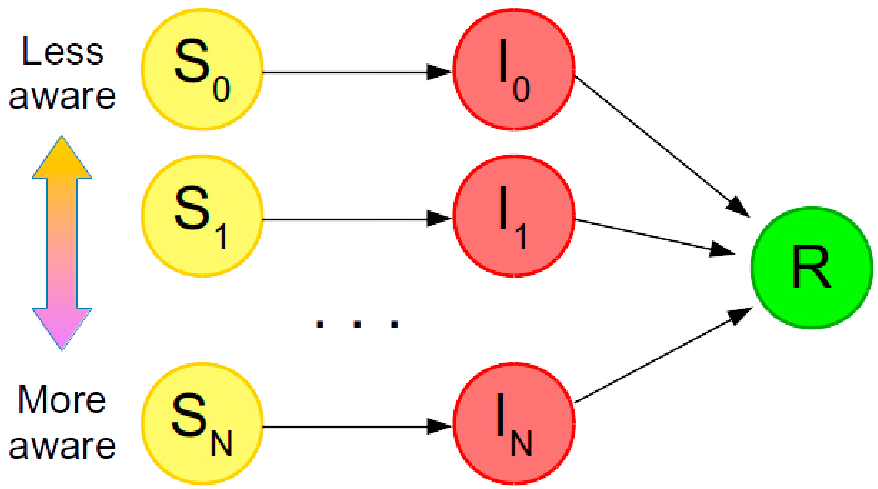 Figure 1: The modified SIR transition model incorporating Privacy Classes.
Experiments: The Facebook-like Proving Ground
The team ran 10,000+ stochastic simulations on a synthetic graph of 75,000 nodes and 2.7 million edges, designed to mimic the high degree distribution (avg. 71 friends) found on Facebook.
They tested three distribution scenarios:
- Safer: Majority of users are "Aware."
- Medium: Balanced awareness.
- Unsafer: Majority of users are "Unaware."
Key Result: The Illusion of Local Safety
The most striking find is the Neighborhood Effect. While having "aware" neighbors slows down the speed of the leak, it rarely stops the total coverage. Because social networks have high connectivity, if a single "unaware" friend exists in your circle, they act as a bridge to the rest of the "unaware" world.
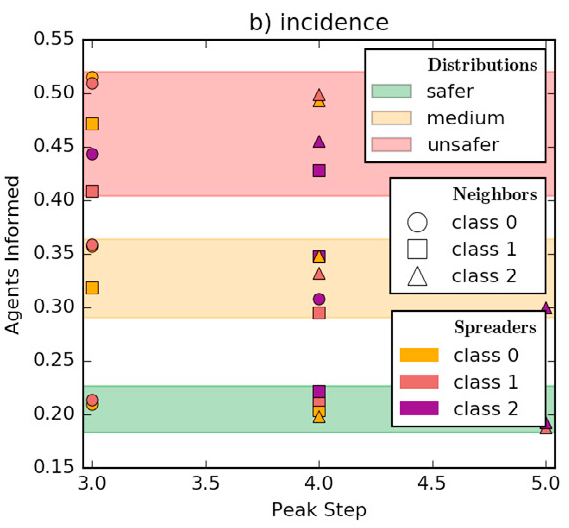 Figure 2: Comparing prevalence (total informed) vs. incidence (rate of new infections) across different population attitudes.
Critical Insights & Takeaways
- Global > Local: The overall "hygiene" of the entire network dictates how far a leak goes. Your local "circle of trust" is easily bypassed in a "small-world" network.
- Time is the Only Buffer: Safe environments don't necessarily stop information; they just spread it slower. This provides a "window of opportunity" for platforms to deploy counter-measures (like hoax detection) before the info reaches critical mass.
- The "Bridge" Risk: A safe spreader with unsafe friends (or vice versa) is a recipe for disaster. Awareness must be consistent across hops to be effective.
Conclusion
This work shifts the privacy debate from a technical access-control problem to a behavioral modeling problem. It suggests that the "Privacy by Design" philosophy must account for the recursive nature of social links—my privacy is a function of your attitude.
Future Outlook: The authors suggest moving toward "Privacy risk prediction" based on local topological features (centrality and clustering). For developers, this implies that social apps should perhaps warn users not just about their own settings, but about the "Privacy Score" of the friends they are about to share with.