
The Physics of Platooning: How AV Headway Reshapes Traffic Equilibrium
The Impact of Autonomous Vehicles' Headway on the Social Delay of Traffic Networks
This paper investigates the impact of Autonomous Vehicle (AV) platooning on transportation network efficiency. By introducing a "capacity asymmetry degree" (μ) to model reduced inter-vehicle headways, the authors analyze Wardrop routing equilibria in mixed-traffic scenarios (AVs and human-driven vehicles).
TL;DR
Autonomous Vehicles (AVs) aren't just about removing drivers; they are about re-engineering the geometry of traffic flow. This paper explores how the longitudinal headway of AV platoons—the gap between cars—acts as a "throttle" for road capacity. The researchers prove that in many network configurations, tighter platoons (shorter headways) lead to guaranteed reductions in total network delay, and they provide the mathematical bounds to prove it.
Background: The Latent Capacity of Autonomy
Modern traffic networks are limited by human reaction times. Human-driven vehicles (HVs) require significant safety gaps to account for latency and error. AVs, through platooning and V2V communication, can safely maintain much shorter headways. This effectively increases the "effective width" of a road without adding physical lanes.
The Core Insight: Capacity Asymmetry
The authors define a critical variable, μ (capacity asymmetry degree), which represents the ratio of HV capacity to AV capacity.
- If , AVs behave like HVs.
- If , AVs increase the road's capacity.
The technical challenge lies in the Wardrop Equilibrium: if we make certain roads "better" (higher capacity), selfish routing behavior might cause so many vehicles to flock to that road that the overall network delay actually increases (a phenomenon related to the Braess Paradox).
Methodology: Mapping Headway to Social Delay
The study focuses on networks with a homogeneous capacity asymmetry degree, meaning the central authority sets a uniform headway standard for all AVs across the network.
1. The Delay Model
The authors use a modified BPR (Bureau of Public Roads) function to calculate link delay : This formula accounts for both the flow of human drivers () and autonomous agents (), where the AVs consume less "capacity real estate."
2. Network Architecture
The researchers analyzed a parallel link topology (as shown below) to determine how traffic redistributes itself when AV efficiency increases.
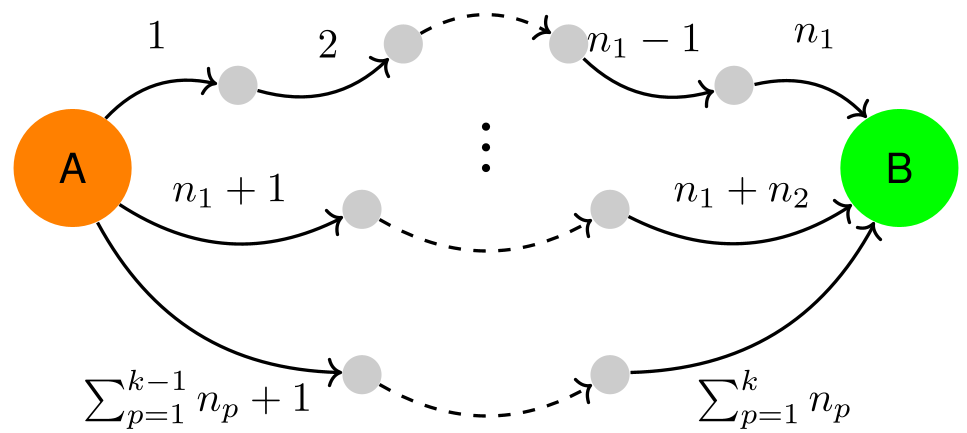 Fig 1: A network of parallel links used to model selfish routing distribution.
Key Results: Guaranteed Improvement
The paper delivers a major theoretical win for traffic engineers:
- Single O/D Pair Networks: For any network with one starting point and one destination, reducing AV headway always decreases the total social delay. It is a monotonic improvement.
- The τ Bound: For parallel networks with affine (linear) delay functions, the improvement is captured by . They established that the delay when AVs have short headways is at most a fraction of the delay when they act like humans: where . This means as the autonomy ratio () increases, the potential for delay reduction scales linearly.
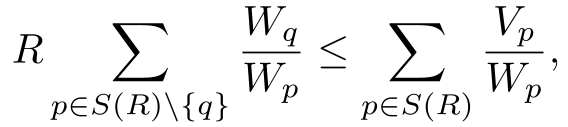 The sufficiency condition derived to ensure social delay reduction.
Critical Analysis & Future Outlook
While the results for single O/D pairs are robust, the authors concede that Multiple O/D pairs introduce complexity. In multi-O/D networks, a "selfish" AV might take advantage of an increased-capacity link, potentially displacing other traffic and causing a cascade of delays elsewhere.
Takeaways for the Future
- Policy Integration: Regional transit authorities can use these bounds to set "target headways" for AV manufacturers to ensure infrastructure ROI.
- Dynamic Headway: Future research could investigate dynamic μ values, where headways are adjusted in real-time based on current congestion levels.
Conclusion: This work provides the mathematical justification for "High-Occupancy-Autonomous" lanes. By controlling the inter-vehicle gap, we can effectively tune the throughput of our existing cities without pouring a single new drop of concrete.