
Beyond the Universal User: How Culture Redefines Visual Attention in UX
The Impact of Culture on Visual Design Perception
This paper investigates cultural variations in interface perception by comparing remote eye-tracking data from Danish, Chinese, and Kenyan users against AI-driven predictive heatmaps. Using iMotions for behavioral tracking and EyeQuant for AI prediction, the study challenges the "universal user" myth in Human-Computer Interaction (HCI).
TL;DR
Is there such a thing as a "universal user"? This study suggests the answer is a resounding no. By comparing AI-predicted heatmaps with empirical eye-tracking data from Denmark, China, and Kenya, the research reveals that cultural background significantly dictates where we look first. While AI tools like EyeQuant focus on text and high-contrast labels, actual users often prioritize icons and central clusters, depending on their cultural origin.
The "Universal User" Myth
In the race for global market dominance, many companies have turned to AI-driven predictive analysis as a "shortcut" for user testing. These tools promise to visualize what a user focuses on without needing a single human participant. However, these algorithms are often built on the assumption of a Universal User—a standardized human eye that responds to visual stimuli identically regardless of geography, language, or social context.
This paper argues that this assumption is not only flawed but potentially damaging to product efficacy. As companies go global, the "one-size-fits-all" design approach risks alienating entire regional markets whose visual processing habits don't align with Western-centric AI models.
Methodology: Human vs. Machine
The study utilized a two-pronged approach to test visual perception:
- AI Prediction: Using EyeQuant, an AI software that predicts attention based on previously collected datasets and algorithms.
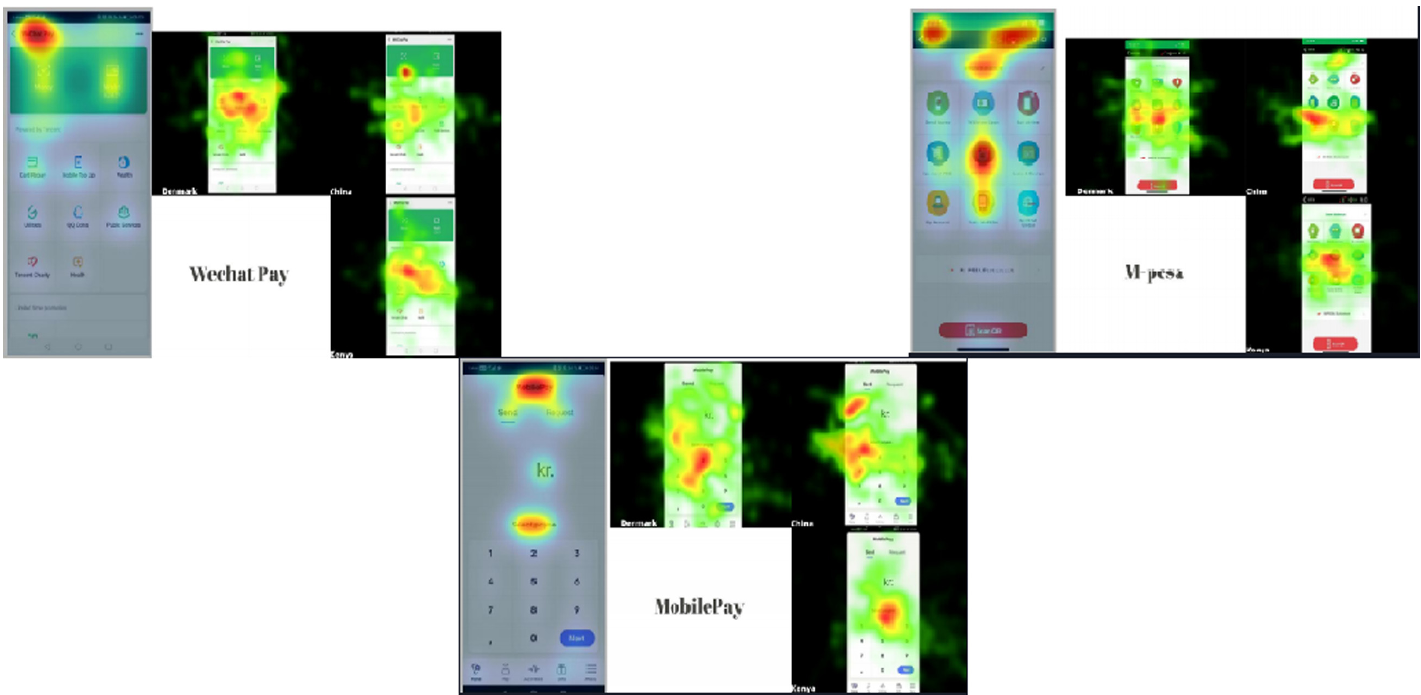
- Empirical Eye-Tracking: Using iMotions for remote webcam-based eye-tracking of 38 participants across three countries: China (WeChat Pay users), Denmark (MobilePay users), and Kenya (M-Pesa users).
Participants viewed local and foreign mobile payment interfaces for 6 seconds each. The resulting heatmaps were then overlaid to see if the "Algorithm" matched the "Human."

Key Findings: The Perception Gap
The results exposed a striking mismatch between what AI thinks we see and what we actually see.
1. The Text vs. Icon Debate
The AI (EyeQuant) consistently predicted that users would focus on text labels and "call to action" buttons. However, the human data told a different story. Chinese and Kenyan users showed a marked preference for icons and central visual clusters, often ignoring the text-heavy sections that the AI flagged as high-priority.
2. Cultural Divergence
- Danish Users: Tended to follow a more balanced distribution but were still influenced by the specific "Call to Action" designs of their local application.
- Chinese & Kenyan Users: Focused heavily on the middle third of the screen, showing little interest in the text-over-icon hierarchy predicted by the software.
Critical Insight: Architecture of Attention
The discrepancy stems from the hidden bias in AI training sets. Algorithms often prioritize "salience" (color, contrast, size) without accounting for "semantic value" (what an icon means to a specific culture). A Chinese user navigating the complex ecosystem of WeChat Pay views information hierarchy through a vastly different lens than a Danish user interacting with the minimalist MobilePay interface.
Conclusion and Future Outlook
The study concludes that visual perception consists of a cultural spectrum rather than a monolith.
- For UX Professionals: Stop relying solely on AI predictive heatmaps for global launches. Remote eye-tracking with local participants is non-negotiable.
- For Product Strategy: Cultural adaptation isn't just about translating text; it’s about rearranging the visual hierarchy to match local cognitive patterns.
- Limitations: The study acknowledged small sample sizes and the relative novelty of remote webcam tracking, which can be less precise than infrared hardware.
As we move toward 2026, the goal for HCI should be the "Cultural Persona"—designing interfaces that don't just work globally, but feel local.