
From the Bar to the Feed: How Offline Check-ins Shape Online Emotions
The Impact of Foursquare Checkins on Users’ Emotions on Twitter
This paper presents a cross-platform observational study investigating the impact of offline activities (Foursquare check-ins) on online emotional expression (Twitter). Using a causal inference framework, it demonstrates that specific offline behaviors, such as frequenting bars or gyms, significantly influence a user's "Emotion Conformity" relative to the general online community.
TL;DR
We often think our online personas are independent of our daily errands, but research suggests otherwise. This study tracks users across Foursquare and Twitter to prove that starting a new offline habit—like going to the gym or the bar—statistically alters how we express emotions online. Interestingly, frequenting bars significantly reduces your "emotion conformity," making your tweets diverge from the community's emotional baseline.
Background & Motivation: The Inverse Impact
For years, researchers have asked: Does social media make us do things in the real world? (e.g., visiting a restaurant because of an Instagram post). This paper flips the script: Does what we do in the physical world change how we feel and talk in the digital world?
The authors argue that social media acts as a "large-scale sensor" for human behavior. By linking Foursquare (offline activity traces) with Twitter (online emotional expression), they aim to measure the causal effect of real-world "interruptions" on digital sentiment.
Methodology: Bridging the Digital-Physical Gap
The core challenge of this study was ensuring that changes in emotion were actually caused by the offline activity, not by other factors (like age or popularity).
1. Emotion Conformity ()
The researchers introduced a metric called Emotion Conformity. It quantifies how much a user's emotional reaction to a topic (like "The new iPhone release") aligns with the general public.
- High : You feel the same way the internet feels.
- Low : Your emotional response is an outlier compared to the crowd.
2. The Experimental Design
Using Propensity Score Matching (PSM), they compared three groups of users:
- Treated (Bar): Users who began visiting bars weekly.
- Treated (Gym): Users who began exercising weekly.
- Control: Users with no change in activity.

Insights from the Results
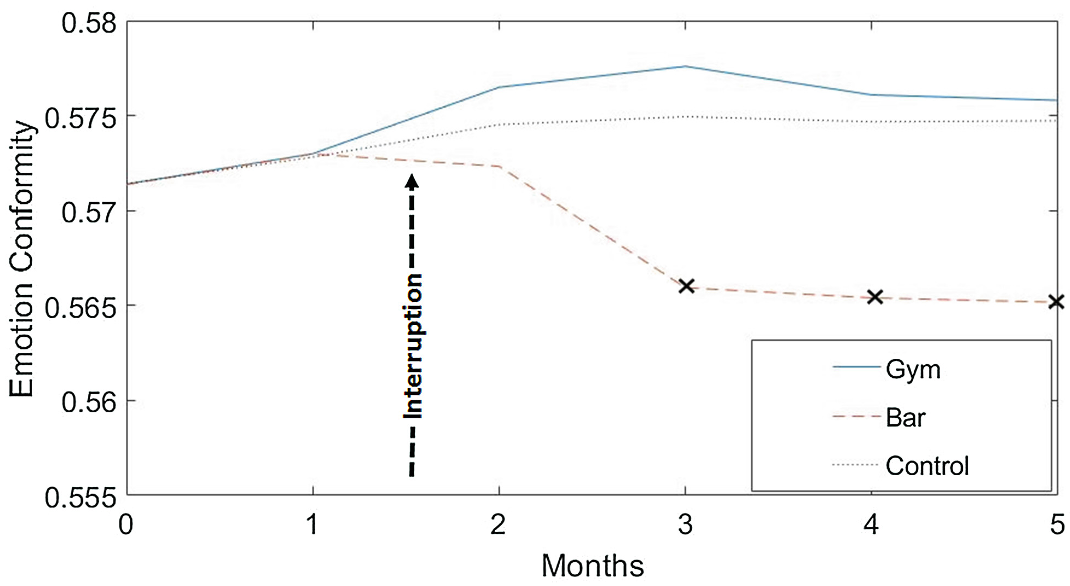
The findings, visualized in the study’s longitudinal analysis, show a clear divergence after the second month (the "interruption" point).
- The Bar Effect: Users who started going to the bar showed a significant decrease in emotion conformity. They became "emotional rebels," expressing sentiments that drifted away from the community consensus. This effect was sustained over the 8-month observation period.
- The Gym Effect: Visiting the gym led to a slight increase in conformity (feeling more "in sync" with the community), but this was neither statistically significant nor permanent.
Critical Analysis & Conclusion
This work provides a fascinating glimpse into the porosity of our lives. It suggests that social environments (like bars) may foster more individualized or idiosyncratic emotional states than health environments (like gyms).
Limitations & Future Work
While the study is robust in its use of PSM, it primarily looks at whether a change happened, rather than why. Is the bar-goer's emotional shift due to the alcohol, the social environment, or a specific personality trait that is triggered by bar-going? Future research exploring a wider variety of venues—such as libraries, parks, or workplaces—could help map the "Emotional Geography" of the internet.
Takeaway: Your physical location is a latent variable in your digital sentiment. If you find yourself disagreeing with the "vibe" of Twitter, you might want to check your Foursquare history.