
Balancing Lives and Livelihoods: A Machine Learning Framework for Pandemic Simulation
Impact of Interventional Policies Including Vaccine on COVID-19 Propagation and Socio-economic Factors: Predictive Model Enabling Simulations Using Machine Learning and Big Data
The paper presents a predictive analytics framework using an ensemble machine learning pipeline to model the propagation of COVID-19 and its socio-economic impacts. By leveraging the C3 AI COVID-19 Data Lake and a self-evolving Voting Regressor model, the authors simulate how interventional policies and vaccine rollout influence daily case counts and small business revenue.
Executive Summary
TL;DR
The paper introduces a sophisticated predictive framework designed to help policymakers navigate the "dilemma" of the COVID-19 pandemic. By combining big data from the C3 AI COVID-19 Data Lake with an ensemble of machine learning regressors, the authors provide a tool that simulates the outcomes of interventional policies and vaccine rollouts on both daily infection counts and economic indicators like small business revenue.
Academic Positioning
This work sits at the intersection of Epidemiology, Economics, and Explainable AI (XAI). Rather than being a purely theoretical SEIR model, it is a data-driven, engineering-heavy approach that prioritizes interpretability and real-world deployment for decision support.
The Core Challenge: The Policy Dilemma
Policymakers face a brutal trade-off: strict lockdown measures (Interventional Policies) successfully curb the virus's "Effective Reproduction Number" (), but they trigger immediate contractions in local economies. The difficulty lies in the complexity of variables—some controllable (policy, mobility, vaccines) and some stochastic (weather, human behavior). Prior models often focused on one side of the coin, either public health or macroeconomics, but rarely provided a unified, interpretable simulation environment.
Methodology: The Self-Evolving Ensemble
To tackle the noise inherent in pandemic data, the authors didn't rely on a single algorithm. Instead, they built a Voting Regressor pipeline.
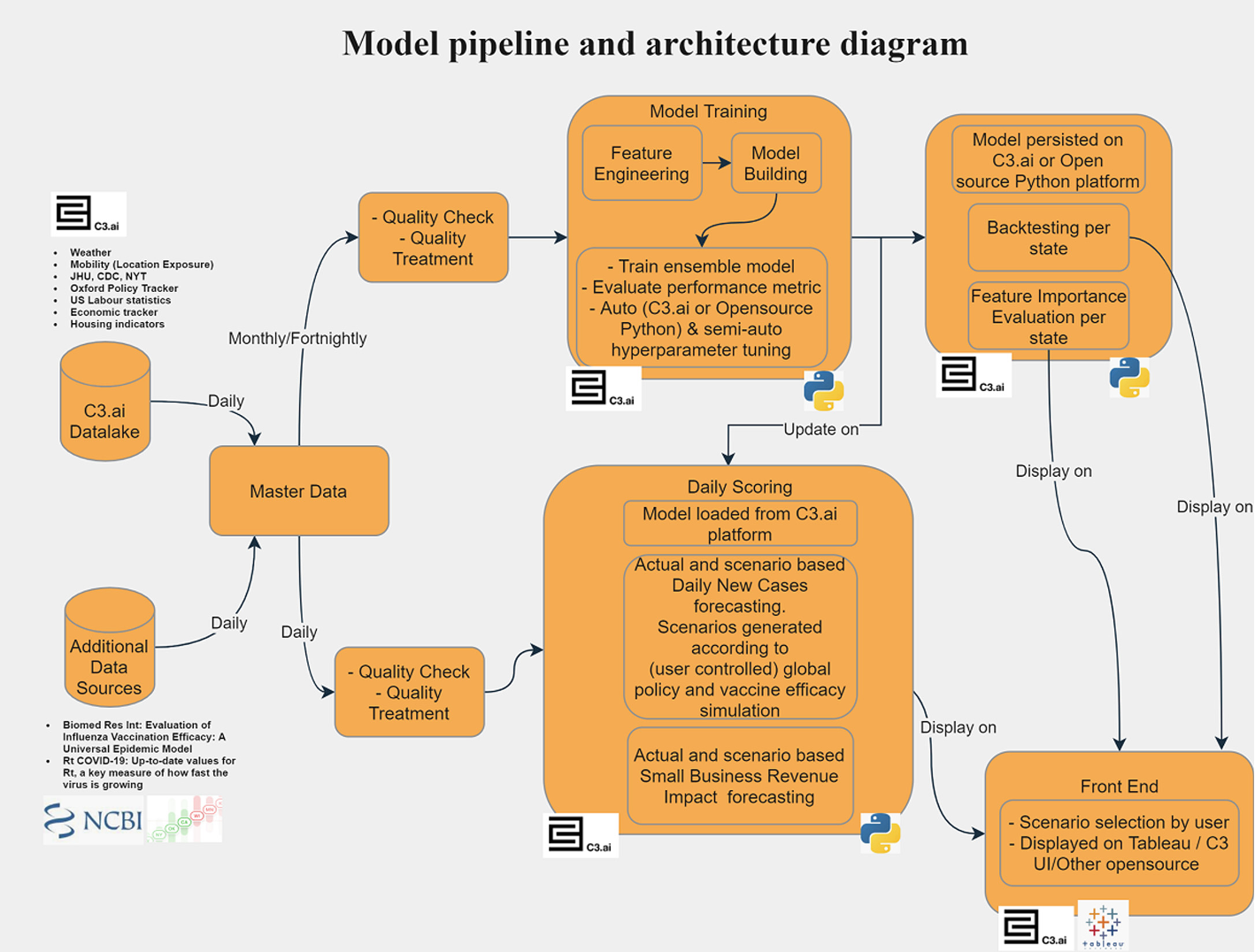
1. The Architecture
The pipeline integrates:
- Linear Regression: For baseline trend capture.
- Random Forest & Gradient Boosting: To handle non-linear interactions between features like humidity, testing coverage, and stay-at-home orders.
- Self-Evolving Mechanism: The model is scheduled to retrain monthly, ensuring it "learns" shifting human behaviors and variant characteristics over time.
2. Explainability (The "Why")
One of the paper's strongest contributions is the use of weighted LIME. Standard LIME explains individual predictions, but the authors customized it to be time-sensitive. In an evolving pandemic, recent data points are more representative of the current state than data from six months prior. Their framework allows users to see exactly which policy (e.g., "Stay-at-home" vs "School closing") is driving the predicted case count for a specific state.
Experimental Insights: The California Case Study
The researchers applied their model to California to visualize the trade-offs.
Key Findings:
- Lockdown vs. Revenue: Increasing the "Stay-at-home" restriction to level 3 effectively turned the virus spread downward but caused a sharp decline in small business revenue indices.
- The Vaccine as a "Game Changer": The simulation showed that only with the introduction of a vaccine can the curve of infections be crushed without a corresponding destruction of economic activity.
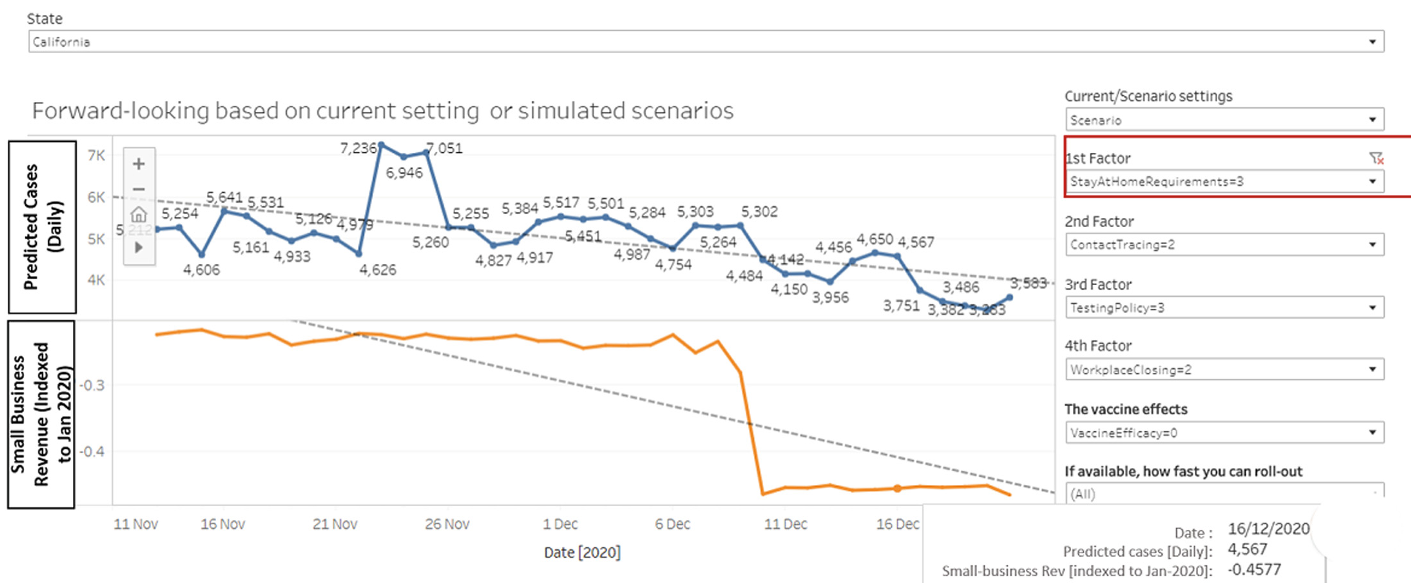 Fig 4: Simulation showing how high-level restrictions decouple the infection curve from economic growth.
Critical Analysis & Conclusion
Takeaway
The framework moves beyond "static" prediction and provides a "what-if" laboratory for leaders. By quantifying the weight of each policy through XAI, it reduces the reliance on intuition and replaces it with evidence-based scenario planning.
Limitations
- Data Latency: Even with a Big Data platform, there is an inherent lag between policy implementation and observable changes in case rates (usually 10-14 days).
- Human Factor: As the authors admit, human behavior is notoriously difficult to capture in discrete data points, especially when "policy fatigue" sets in.
Future Outlook
This architecture is highly scalable. Its modular nature allows it to be adapted for other U.S. states or countries by swapping the data source, provided the granularity (state/provincial level) is maintained. In a post-pandemic world, this type of multivariate socio-economic modeling will likely become a standard tool for government resilience planning.