
The Power of Pixels: How Multimedia Context Extends Life Span and Popularity on Sina Weibo
Impact of Multimedia in Sina Weibo: Popularity and Life Span
This paper presents a large-scale statistical analysis of multimedia content's impact on Sina Weibo, focusing on images and URLs. Analyzing 230 million tweets, it reveals that multimedia content dominates popularity metrics and significantly extends the life span of social media posts compared to pure text.
TL;DR
In the world of microblogging, "a picture is worth a thousand words" is more than a cliché—it is a measurable statistical reality. This study analyzes 230 million tweets from Sina Weibo to prove that multimedia content (images and URLs) doesn't just attract more retweets; it literally lives longer. While text-only tweets fade rapidly, image-based content resists the decay of time, dominating trending lists and defining user popularity.
Context: Beyond the 140-Character Limit
Early microblogging research treated platforms like Twitter primarily as text-driven news feeds. However, Sina Weibo emerged as an early adopter of native multimedia integration. The researchers behind this paper recognized a shift: users were moving away from pure text toward a more "eye-catching and entertaining" experience. The core question was no longer what people were saying, but how the medium (text vs. image vs. URL) changed the mechanics of social propagation.
The "Popularity" Anatomy
The researchers categorized the data into "General Tweets" and "Popular Tweets" (those with >1,000 retweets). The findings revealed a stark contrast in content composition.
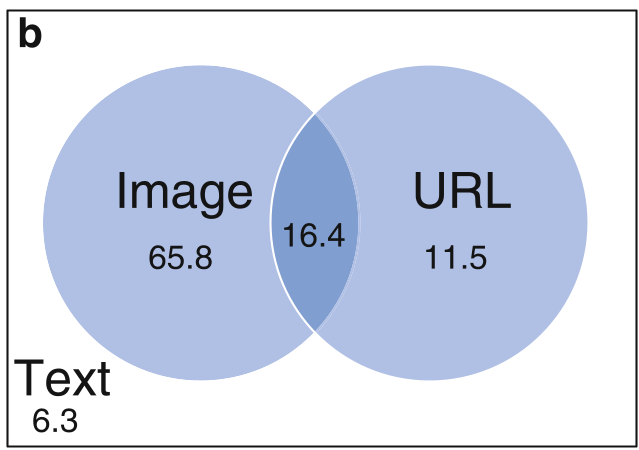
As shown in the Venn diagrams above:
- In General: Image tweets account for about 40% of the platform.
- In Popularity: Text-only tweets nearly vanish, shrinking to a mere 6.3%.
- Insight: If you want to trend, multimedia isn't an option; it's a requirement.
The Survival of the Most Visual
One of the paper's most sophisticated contributions is the Life Span Analysis. While most social media interactions happen within the first hour of posting, some tweets remain "viral" for months.
The authors applied an exponential decay model: Where represents the decay rate. A lower means the content stays relevant longer.
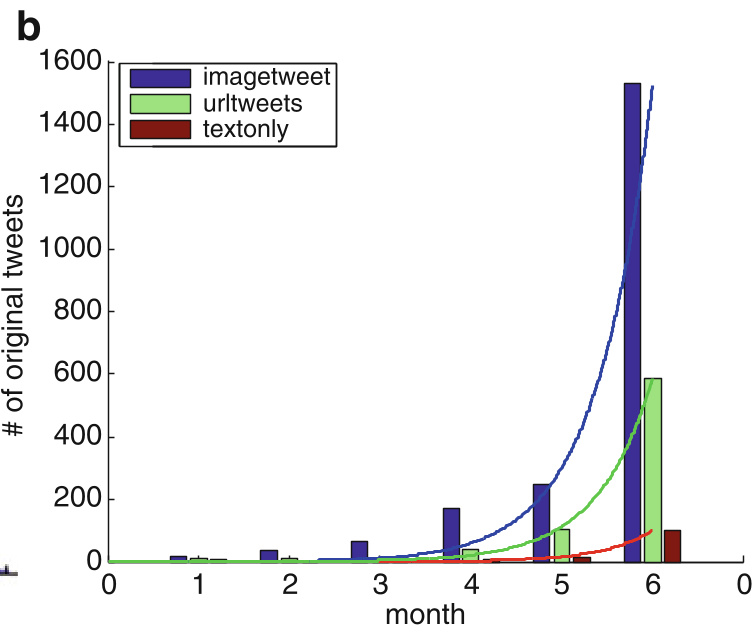
The results (summarized from Table 1 in the paper) show that:
- Image Tweets () have the longest life span.
- URL Tweets () follow closely.
- Text Tweets () disappear the fastest.
Why the difference? The authors suggest that images provide direct visualization. Unlike a URL that requires a click or text that requires reading, an image delivers its value instantly under the user's thumb, creating a lower friction for engagement and a higher likelihood of being rediscovered months later.
The Active User Paradox
Do "multimedia lovers" post less text? Using Spearman’s rank correlation, the study found the opposite. There is a strong positive correlation (up to 0.814 for top users) between text production and multimedia production. The most "active" users are not specialists; they are "prolific polymaths" who dominate across all formats.
Critical Insight: The Long Tail of Marketing
The distribution of retweets follows a power-law pattern, but with a "heavy tail" in the multimedia segment. This means that extremely popular multimedia tweets occur more frequently than standard statistical models would predict.
For marketers and influencers, this provides a clear directive:
- Multimedia is the hedge against irrelevance. Because image-based tweets decay 12% slower than text, they provide a higher "Return on Effort" for brand visibility.
- Engagement is Integrative. The overlap between images and URLs in popular tweets suggests that the most successful content uses a "multi-pronged" approach to hold user attention.
Conclusion
This study serves as a foundational quantitative proof of the "Visual Turn" in social media. By showing that multimedia impacts not just the peak of popularity but the persistence of content, it redefined our understanding of digital life spans. While the data comes from the Sina Weibo of 2011, the underlying physics of human attention—favoring the visual over the textual—remains the blueprint for the social platforms of today.