
Decoding Election Dynamics: How Party Branding and Sentiment Shaped #AnambraDecides2017
The impact of political party/candidate on the election results from a sentiment analysis perspective using #AnambraDecides2017 tweets
This study employs Natural Language Processing (NLP) and Sentiment Analysis to examine the 2017 Anambra State gubernatorial election using 7,430 tweets. By utilizing TextBlob and SentiWordNet, the authors analyze polarity and subjectivity to determine how the interplay between political parties and individual candidates influences election outcomes, finding that the winner, Willie Obiano (APGA), significantly benefited from his party's established cultural and ideological resonance.
TL;DR
This research provides a deep dive into the 2017 Anambra State gubernatorial election through the lens of NLP. By analyzing over 7,400 tweets, the study reveals that while individual candidate charisma matters, the ideological alignment of a political party acts as a powerful anchor for voter sentiment. The winner, Willie Obiano, leveraged the All Progressive Grand Alliance (APGA) brand—deeply rooted in Igbo identity—to secure a victory characterized by high-volume, low-subjectivity (factual) social media support.
Contextual Positioning
Within the landscape of computational social science, this paper moves beyond simple "positive vs. negative" counts. It positions itself as a dual-layer analysis of Polarity (feeling) and Subjectivity (fact vs. opinion), arguing that the nature of the sentiment is just as critical as its direction for predicting political stability and electoral success.
Problem & Motivation: The "Noise" of Political Social Media
Measuring political support in developing nations is notoriously difficult due to "noise" in social media data. Previous studies often failed to account for:
- Time Sensitivity: How does the public mood shift during the actual hours of voting?
- Credibility vs. Emotion: Are people tweeting facts about the election or purely subjective emotional outbursts?
- The Party-Candidate Dualism: Does a strong candidate save a weak party, or does a strong party carry an average candidate?
The authors' insight was to use Subjectivity Analysis to see if some candidates' support was built on "emotional hype" (high subjectivity) versus "perceived performance" (low subjectivity).
Methodology: A Multi-Dimensional NLP Pipeline
The researchers utilized a robust pipeline to transform raw JSON tweet streams into actionable insights:
- Preprocessing: Standardizing tweets via tokenization, stemming, and specific "stopword" removal (e.g., removing candidate names from word clouds to see underlying topics).
- Sentiment Dual-Classification: Using TextBlob’s Naive Bayes and SentiWordNet for cross-validation of scores.
- Topic Discovery (LDA): Unsupervised learning to group tweets into 5 primary topics per actor, revealing what specifically was driving the sentiment.

Figure 1: The research workflow from data streaming to detailed sentiment and topic analysis.
Experiments & Results: The Power of the "Nke A Bu Nke Anyi" Ideology
The data revealed a striking pattern. Willie Obiano (APGA) didn't just win on the ground; he dominated the digital discourse.
The Polarity Landscape
While most candidates maintained positive polarity, their volume differed vastly. Obiano and APGA recorded the highest frequency of mentions. Interestingly, when the name "Willie Obiano" was paired with "APGA", the positive sentiment strengthened, showing a synergistic effect.
Subjectivity as a Success Metric
In a fascinating finding, the study showed that APGA supporters were the least subjective. Their tweets were more objective and factual compared to the highly emotional and subjective tweets surrounding candidates like Tony Nwoye (APC) and Oseloka Obaze (PDP). This suggests that long-standing ruling parties might benefit from a discourse based on "track records" whereas challengers must rely on "emotional appeals."
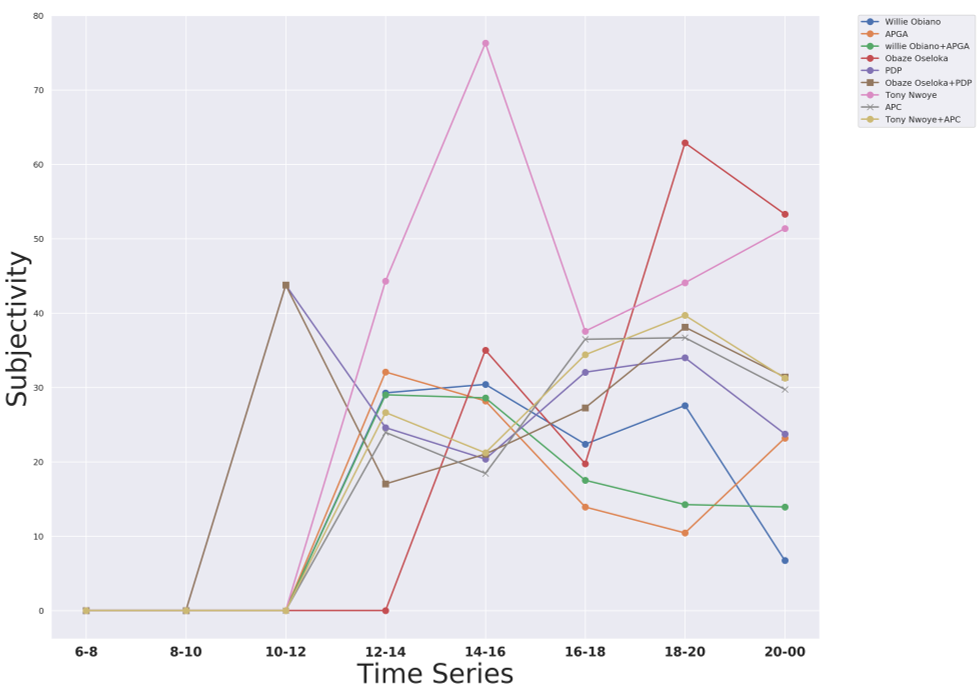
Figure 2: Time-series Subjectivity Scores. Note the spikes in subjectivity for opposition candidates during crucial hours.
Topic Modeling Insights (LDA)
LDA revealed that "Political Marketing" and "Indigenous Acceptance" were the primary themes for APGA. Keywords like Ojukwu and Bianca (symbols of Igbo heritage) were frequent, illustrating that APGA successfully framed the election as a defense of cultural value rather than just a political choice.

Figure 3: Comparison of TextBlob vs SentiWordNet results, highlighting the prevalence of neutral and positive sentiments.
Critical Analysis & Conclusion
Takeaway
The core contribution of this work is the verification that political party influence is an underlining factor in electoral victory. In Anambra, the party (APGA) served as a "cultural umbrella" that protected the candidate from the high subjectivity and negative shifts seen by other candidates.
Limitations & Future Work
- Platform Bias: The study is limited to Twitter users, who may not fully represent the broader electorate in rural Nigeria.
- Semantic Complexity: Nigerian Pidgin and local dialects like Igbo were used in tweets; while TextBlob is powerful, specific local-language NLP models might provide even deeper nuance in future studies.
Ultimately, #AnambraDecides2017 proves that in the digital age, a winning campaign is a blend of ideological heritage and factual credibility.